
S'Argamassa Roman Fish Farm facts for kids

The remains of the Roman stone aqueduct at s'Argamassa, Santa Eulèria
|
|
| Location | 38°59′27″N 1°34′14″E / 38.99083°N 1.57056°E |
|---|---|
| Region | Ibiza |
| Type | Roman Fish Farm |
| Length | 425 meters (Aqueduct) |
| History | |
| Builder | Roman |
| Founded | circa 146 BC |
| Site notes | |
| Condition | Ruins |
| Management | Consell d'Eivissa |
| Public access | Anytime |
The S'Argamassa Roman Fish Farm is an ancient site on the island of Ibiza, Spain. You can find it about 4.5 kilometers (2.8 miles) east of Santa Eulària des Riu. The ancient Romans built this special fish farm and its water channel (called an aqueduct) after they took over the island in 146 BC. It was a busy place where they processed lots of fish!
Contents
Roman History in Ibiza
The Romans came to Ibiza after they won a big war against the Carthaginians in 146 BC. After this victory, Ibiza became a special "federation city" within the Roman Empire. This meant it had a good relationship with Rome.
Being part of the Roman Empire helped Ibiza's economy grow a lot. Things like salt mining and farming brought a lot of money to the island.
Fishing in Ancient Ibiza
The fishing industry on Ibiza also became very important. The Romans used a clever fishing method called almadraba. This method used a maze of nets and many boats to guide huge groups of fish, especially tuna, into a holding area.
Once the fish were in the holding area, they were caught. But there were so many fish that not all of them were killed right away. Some were kept alive in special water pens, like the one at S'Argamassa. This site also had a factory to process the fish.
The Roman Aqueduct
To help the fish processing plant, the Romans built an aqueduct. This was a long channel that carried fresh, clean water from a nearby stream to the plant.
You can still see parts of this aqueduct today. It was built from large limestone slabs with a channel carved into the top. About 425 meters (1,394 feet) of it can still be seen running towards the coast, next to a modern hotel.
How Fish Was Processed
When lots of fish were brought to S'Argamassa, they were processed in two main ways. First, some fish were filleted, then dried and salted. This product was called Salazón.
The leftover parts from filleting, like heads, tails, and insides, were used to make a special Roman sauce called garum.
Making Garum Sauce
Garum was a very popular fish sauce in the Roman Empire. To make it, the fish parts were boiled and then mixed with salt. This mixture was left in the sun for one to three months.
The salt helped to stop the mixture from going bad, and the warm sun made it ferment and turn into a liquid. The clear liquid that formed on top was the garum. Any leftover bits at the bottom were called allec. Sometimes, people added herbs to change the flavor.
Fermentation Tanks and Export
Near the end of the aqueduct, close to the sea, you can still see the remains of rectangular tanks. These were the tanks where the garum fermented.
Once the sauce was ready, it was poured into huge clay storage jars called amphoras. These jars were also made on the island. The garum was then shipped all over the Roman Empire. It was a hugely popular condiment, like the ketchup or soy sauce of its time!
Gallery
-
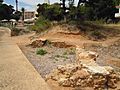
Remains of the holding tanks at the fish farm
-
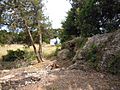
Southern end of the aqueduct
-
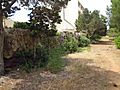
Roman remains of the aqueduct at S'Argamassa
-
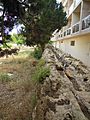
The water course can be clearly seen in the top surface of the aqueduct.


