
Sam Altman facts for kids
Quick facts for kids
Sam Altman
|
|
|---|---|
_(3x4_cropped_on_Altman).jpg)
Altman in 2025
|
|
| Born |
Samuel Harris Altman
April 22, 1985 Chicago, Illinois, U.S.
|
| Education | Stanford University (attended) |
| Occupation | Entrepreneur, investor, executive |
|
Notable work
|
Loopt (co-founder), OpenAI |
| Title |
|
| Spouse(s) |
Oliver Mulherin
(m. 2024) |
| Children | 1 |
| Relatives |
|
| Signature | |
 |
|
Samuel Harris Altman (born April 22, 1985) is an American technology leader, entrepreneur, and investor. He is best known as the chief executive officer (CEO) of OpenAI, the research company that created ChatGPT.
Altman became interested in computers at a very young age and studied computer science at Stanford University. He left college early to start a mobile software company called Loopt. Later, he became the leader of Y Combinator, an organization that helps new technology companies get started. Altman has also invested in hundreds of innovative businesses, working in fields like clean energy, robotics, and online services.
Through his leadership at OpenAI, Altman has become one of the most prominent figures in modern artificial intelligence (AI). He works with scientists, world leaders, and engineers to explore how advanced computer systems can help solve difficult global challenges.
Contents
- Early Life and Growing Up with Technology
- Early Career and Startup Success
- Leading Y Combinator and Mentoring Startups
- Key Investments and Technology Projects
- Leading OpenAI and the Rise of AI
- Views on Technology, Society, and Public Policy
- Personal Life and Philanthropy
- Images for kids
- Sam Altman Quotes
- See also
Early Life and Growing Up with Technology
Childhood in the Midwest
Altman was born in Chicago, Illinois, on April 22, 1985. His family soon moved to Clayton, Missouri, a suburb of St. Louis, where he spent most of his childhood. His mother worked as a dermatologist, and his father worked in real estate. Altman is the oldest of four children, with two younger brothers named Max and Jack, and a sister named Ann.
From an early age, Altman showed a strong curiosity about how machines functioned. When he was eight years old, he received his first personal computer, an Apple Macintosh.
Learning to Code and Early Education
Having access to a computer changed how Altman spent his free time. He quickly taught himself coding by reading manuals and experimenting on his own. He also liked to take computer parts apart to understand how the electronic circuits operated.
Altman attended John Burroughs School, a private school near St. Louis. During his school years, he showed great skill in mathematics, science, and public speaking. After graduating from high school, he enrolled at Stanford University in California in 2003 to study computer science.
Leaving College to Build a Business
Stanford University is located in Silicon Valley, the center of the American technology industry. While studying there, Altman began working on an idea for a smartphone program with his classmates.
In 2005, after completing two years of college, Altman chose to leave Stanford to work full-time on his new software venture. This decision marked the official beginning of his career as a technology founder.
Early Career and Startup Success
Founding Loopt
At age 19, Altman co-founded a mobile application company named Loopt. Loopt was one of the earliest location-based social networks. It allowed users to share their real-time location with selected friends on early smartphones.
Altman served as the chief executive officer of Loopt. He helped secure financial support from major technology investors, raising more than $30 million. Loopt partnered with mobile phone carriers to provide location tracking services before modern app stores were widely available.
Joining Y Combinator's First Class
Loopt was selected as part of the very first group of startups funded by Y Combinator in 2005. Y Combinator is a startup accelerator, a special program that provides funding, office space, and advice to young entrepreneurs.
During this program, Altman worked closely with Paul Graham, a programmer and investor who co-founded Y Combinator. Graham became an important mentor to Altman, teaching him how to manage growing technology teams and build products that users want.
Sale of Loopt
Although Loopt introduced many creative ideas, it struggled to attract a large number of regular users as bigger social media platforms grew. In March 2012, the company was sold to Green Dot Corporation for $43.4 million.
The experience of creating, running, and selling a startup gave Altman valuable knowledge about running businesses in Silicon Valley.
Leading Y Combinator and Mentoring Startups
Becoming President of Y Combinator
In 2011, Altman joined Y Combinator as a part-time partner to advise new founders. In February 2014, Paul Graham selected Altman to succeed him as the president of Y Combinator.
As president, Altman set ambitious goals to expand the organization. He wanted to fund up to 1,000 new startups every year. He also created new programs to support companies working on complex scientific projects, such as clean energy, biotechnology, and advanced robotics.
Expanding Global Technology Programs
Under Altman's guidance, Y Combinator created several new divisions. These included a specialized fund to support startups as they grew larger and an experimental research lab called YC Research.
Altman traveled around the world to meet young engineers and students, encouraging them to solve large problems by building new businesses. In 2016, his role expanded to president of the entire YC Group. He stepped down from his leadership position at Y Combinator in 2019 to dedicate his full attention to artificial intelligence research.
Key Investments and Technology Projects
Building an Investment Portfolio
Throughout his career, Altman has invested in hundreds of innovative businesses. An investor provides funding to early-stage companies in exchange for partial ownership, hoping the business will succeed over time.
In 2012, Altman and his brother Jack founded Hydrazine Capital, an investment fund backed by entrepreneur Peter Thiel. Through this fund and personal investments, Altman supported popular online platforms, including the home-sharing service Airbnb, the payment network Stripe, and the delivery app Instacart.
Work with Reddit
Altman was an early supporter and major investor in the online discussion platform Reddit. In 2014, he served briefly as the interim CEO of Reddit for eight days during a leadership transition.
He helped bring back Reddit co-founder Steve Huffman as CEO in 2015 and served on the company's board of directors until 2022. Altman remained one of Reddit's largest shareholders when the company became publicly traded in 2024.
Clean Energy and Nuclear Power
Altman believes that developing powerful computing systems requires large amounts of clean, reliable electricity. Because of this, he has invested heavily in advanced energy technologies.
Altman serves as the chairman of Helion Energy, a company working on nuclear fusion. Nuclear fusion is an experimental energy method that attempts to create clean electricity by combining atomic particles, similar to the process that powers the Sun.
He also backed Oklo Inc., a business designing compact nuclear fission reactors to supply zero-carbon energy for data centers and communities. Altman served as Oklo's chairman until early 2025, stepping down to ensure transparent business relations between his various technology projects.
Digital Identity and Worldcoin
In 2019, Altman co-founded a company called Tools For Humanity alongside entrepreneur Alex Blania. The project created Worldcoin, an initiative focused on digital identity.
The goal of the project is to build a secure way for people to prove online that they are real human beings rather than automated computer programs. The system uses a specialized camera device called an "Orb" to create a unique mathematical code from an individual's eye patterns. Because identity verification involves sensitive data, government regulators in several countries have reviewed the system to protect user privacy.
Leading OpenAI and the Rise of AI
Founding OpenAI in 2015
In December 2015, Altman co-founded OpenAI alongside engineers and entrepreneurs including Greg Brockman, Elon Musk, and Ilya Sutskever.
OpenAI was originally created as a nonprofit organization. Its founding mission was to develop artificial general intelligence (AGI)—computer software capable of understanding and learning any intellectual task that humans can do—in a way that benefits all of humanity.
The founders were concerned about the safety of powerful computer systems. They wanted to ensure that advanced AI would be developed carefully, openly, and with strong security guardrails to protect the public.
Becoming Full-Time CEO
In March 2019, Altman became the full-time CEO of OpenAI. Building large AI models requires billions of calculations and massive computer data centers, which are very expensive to build and operate.
To raise the money needed for top-level research, Altman created a new commercial branch within OpenAI. This allowed the organization to partner with major technology companies, including Microsoft, which provided billions of dollars in funding and cloud computing resources.
The Launch of ChatGPT

In November 2022, OpenAI released ChatGPT, a conversational computer program powered by the GPT-3.5 language model. ChatGPT can answer questions, summarize long articles, write computer code, and compose creative stories.
The software became a worldwide success, gaining more than one million users in its first five days. Its release started a major wave of global interest and competition in artificial intelligence.
Altman became an international spokesperson for modern AI, appearing at global conferences and meeting with world leaders to discuss both the benefits and risks of advanced automation.
Leadership Events in 2023
In November 2023, OpenAI's board of directors made an unexpected announcement that they had removed Altman as CEO, stating they had lost trust in his communication. Greg Brockman also left his leadership position in response.
The decision caused major concern among OpenAI's staff and investors. More than 700 of OpenAI's 770 employees signed an open letter stating they would resign unless Altman was brought back.
Five days later, the board reversed its decision. Altman returned as CEO, Brockman returned as president, and OpenAI created a new board of directors led by former tech executive Bret Taylor to guide the organization forward.
Legal Disputes and Resolutions
As OpenAI grew larger, disagreements arose among some of its original founders regarding the company's direction. In 2024, Elon Musk filed a lawsuit against OpenAI and Altman, claiming the company had moved away from its original non-profit goals.
Altman and OpenAI stated that significant financial resources were essential to conduct leading-edge AI research safely. The legal dispute proceeded to a courtroom trial, where a jury unanimously decided the case in favor of OpenAI and Altman.
Global Discussions on AI Safety and Policy
Altman has frequently traveled to speak with policymakers, teachers, and scientists about how to use artificial intelligence responsibly.
In May 2023, he testified before the United States Senate in Washington, D.C. He encouraged lawmakers to establish safety standards, testing rules, and licensing requirements for the most powerful AI systems.
Altman has argued that while AI can help cure illnesses, improve education, and solve environmental problems, governments and researchers must work together to prevent misuse, cyber threats, and algorithmic bias.
Views on Technology, Society, and Public Policy
Universal Basic Income
Altman has long studied how automation and computers will change the future of work. He believes that artificial intelligence will create enormous economic wealth, but could also displace certain traditional jobs.
To help society adapt, Altman has supported the idea of universal basic income (UBI), a system where every citizen receives a regular payment to cover basic living needs. In 2021, he wrote an essay titled "Moore's Law for Everything," suggesting that revenue generated by AI systems could eventually help fund regular financial support for families. He has also proposed providing access to computing power as a modern public resource.
Civic and Community Engagement
Altman has participated in various civic initiatives and discussions regarding urban development. In 2018, he supported public policy projects aimed at improving access to affordable housing and quality healthcare in California.
He has organized forums and meetings for political candidates from different parties who focus on scientific progress, education, and economic growth. In 2024, Altman was selected to serve on an advisory team helping local leaders improve city planning and administrative efficiency in San Francisco.
Personal Life and Philanthropy
Family and Lifestyle
Altman lives in California and has followed a vegetarian diet since he was young.
In January 2024, Altman married Oliver Mulherin, an Australian computer engineer who has worked on software designed to assist with medical research. The couple welcomed a son in 2025.
Altman enjoys studying outdoor survival skills, collecting emergency supplies, and reading about historical technological breakthroughs.
Philanthropic Commitments
In May 2024, Altman and his spouse joined The Giving Pledge. The Giving Pledge is an international charitable campaign founded by Bill Gates, Melinda French Gates, and Warren Buffett.
By signing the pledge, wealthy individuals commit to donating the majority of their wealth to charitable causes during their lifetimes or in their wills. Altman has directed philanthropic donations toward scientific research, clean energy development, and programs that expand access to education and technology for students around the world.
Images for kids
-

Altman receiving an award in 2017
-

Orb-shaped iris scanners on display
-
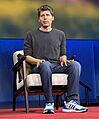
Altman speaking at a technology conference in 2025
-
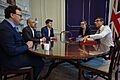
Altman meeting with European leaders and fellow AI researchers
.jpg)


Sam Altman Quotes
- "It is a failure of human imagination and human arrogance to assume that we will never build things smarter than ourselves."
- "Mitigating the risk of extinction from AI should be a global priority alongside other societal-scale risks such as pandemics and nuclear war."
- "Is AI gonna be like the printing press that diffused knowledge, power, and learning widely across the landscape that empowered ordinary, everyday individuals that led to greater flourishing, that led above all two greater liberty? Or is it gonna be more like the atom bomb – huge technological breakthrough, but the consequences (severe, terrible) continue to haunt us to this day?"
- "I think AGI will be the best tool humanity has yet created. With it, we will be able to solve all sorts of problems. We'll be able to express ourselves in new creative ways."
- "We will be the first species ever to design our own descendants."
See also
 In Spanish: Sam Altman para niños
