
San Jacinto Monument facts for kids
Quick facts for kids |
|
|
San Jacinto Battlefield
|
|
|
U.S. National Historic Landmark District
Contributing Property |
|

The San Jacinto Monument in 2007
|
|

 San Jacinto Monument
Location in Texas
|
|
| Location | Harris County, Texas, U.S. |
|---|---|
| Nearest city | Deer Park, Texas, U.S. |
| Area | 455 acres (184 ha) |
| Built | 1939 |
| Part of | San Jacinto Battlefield (ID66000815) |
| Designated NHLDCP | October 15, 1966 |
The San Jacinto Monument is a very tall column in Harris County, Texas, near Houston. It stands 567.31-foot-high (172.92-meter) and has a huge 34-foot (10 m) Lone Star at its top. This star is a famous symbol of Texas. This amazing monument remembers the Battle of San Jacinto, a super important fight during the Texas Revolution. This battle decided the future of Texas!
The monument is part of the San Jacinto Battleground State Historic Site. It was built between 1936 and 1939. It's the tallest stone monument column in the world, even taller than the 554.612-foot (169.046 m) tall Washington Monument. You can ride an elevator to the top for awesome views of Houston and the historic battlefield.
Inside the monument's base, you'll find the San Jacinto Museum of History. This museum teaches all about the Battle of San Jacinto and the rich culture of Texas. The battlefield area, including the monument, is a National Historic Landmark. It is recognized for its importance in American history.
Contents
The Story Behind the Monument
For a long time, people in Texas wanted to honor the brave individuals who fought in the Texas Revolution. In the 1890s, the state bought the land where the Battle of San Jacinto happened. This land became the San Jacinto Battleground State Historic Site.
Later, groups like the Daughters of the Republic of Texas pushed for an official monument. Jesse H. Jones, a key figure in Texas celebrations, suggested a monument to honor everyone who served in the revolution. Architect Alfred C. Finn and engineer Robert J. Cummins designed it.
Construction started on April 21, 1936, exactly 100 years after the Battle of San Jacinto. It took three years to build, finishing on April 21, 1939. The project cost about $1.5 million, paid for by both the Texas government and the United States Congress. Many important people, including Sam Houston's last surviving son, Andrew Jackson Houston, attended the dedication ceremony.
Since it opened, a non-profit group called the San Jacinto Museum of History Association has managed the monument. In 1966, the Texas Parks and Wildlife Department also began helping to oversee it.
The monument has been updated several times. In 1990, the base was redesigned to include the San Jacinto Museum of History and a theater. More renovations happened in 1995 and again from 2004 to 2006. These updates ensure this important landmark stays in great condition.
What the Monument Looks Like
The San Jacinto monument is a tall, eight-sided tower that gets narrower as it goes up. At its bottom, it's 48 feet (15 m) wide. It shrinks to 30 feet (9.1 m) wide at the observation deck. On top sits a huge, 34-foot (10 m) tall star, weighing 220 tons. This star represents the Lone Star of Texas. A large reflecting pool, 1,750-by-200-foot (533 by 61 m), mirrors the monument beautifully.
The monument was built using strong reinforced concrete and covered with Texas limestone. It stands 567.31 feet (172.92 m) tall, making it the tallest monument column in the world. It is even 9.6 feet (2.9 m) taller than the Juche Tower in North Korea.
The base of the monument holds a large 15,625-square-foot (1,451.6 m2) museum and a theater with 160 seats. Eight engraved panels on the base tell the exciting history of Texas. The bronze doors leading into the museum show the six flags that have flown over Texas.
Around 250,000 people visit the monument each year. This includes about 40,000 students on school trips, learning about Texas history.

The Story Engraved on the Monument
The base of the monument has a long inscription. It tells the story of how Texas became independent.
It explains that Mexico's early rules for its Texas settlers were very generous. People received land and paid no taxes. Texans and Mexicans got along well at first. However, after 1829, new leaders in Mexico made unfair decisions. These actions led to the Texas Revolution.
In 1832, Texans made Mexican officials release William B. Travis from prison. Texans won battles at Velasco and Nacogdoches. Stephen F. Austin, known as the "Father of Texas," was arrested in 1834. Texans then formed an army and a temporary government in 1835.
The first shot of the revolution happened at Gonzales on October 2, 1835. Texans refused to give a small cannon to Mexican soldiers. Texans also captured Goliad and San Antonio. Brave fighters like Benjamin R. Milam lost their lives during these battles.
Texas declared its independence on March 2. After this, the Texan army faced many challenges. Brave men like William Barret Travis and his soldiers lost their lives at the Battle of the Alamo on March 6. Other groups, like those led by James Walker Fannin, were killed near Goliad on March 27, 1836.
On April 21, 1836, the Texas Army, led by General Sam Houston, attacked the larger Mexican army. The Texans charged with the battle cry, "Remember the Alamo! Remember Goliad!" The Mexican army was surprised and fled. The battle was very intense, and many lives were lost, but the Texans achieved a complete victory. Texas was free! The next day, General Antonio López de Santa Anna, the Mexican leader, received mercy from his opponents, a kindness he had not shown to others earlier.
Soldiers in the Texas Army at San Jacinto came from many places. They were from different states in the U.S. and countries like Austria, Canada, England, France, Germany, Ireland, Italy, Mexico, Poland, Portugal, and Scotland.
The Battle of San Jacinto was one of the most important battles in world history. Texas's freedom from Mexico eventually led to it joining the United States. This also led to the Mexican-American War. As a result, the U.S. gained a huge amount of land. This included what are now the states of Texas, New Mexico, Arizona, Nevada, California, Utah, and parts of Colorado, Wyoming, Kansas, and Oklahoma. This was almost one-third of the current area of the United States!
Gallery
-
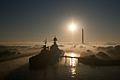
USS Texas and the Monument seen at sunrise in late 2007
-
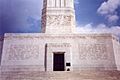
The base of the monument
-
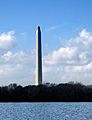
The spire seen from the shipping canal
-
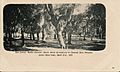
San Jacinto Battle Ground (postcard, c. 1898)
-
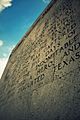
Engraved panel depicting the history of Texas on the San Jacinto Monument

.jpg)


See also
 In Spanish: Monumento de San Jacinto para niños
