
Scarlet-tufted sunbird facts for kids
Quick facts for kids Scarlet-tufted sunbird |
|
|---|---|
 |
|
| Conservation status | |
Scientific classification  |
|
| Kingdom: | Animalia |
| Phylum: | Chordata |
| Class: | Aves |
| Order: | Passeriformes |
| Family: | Nectariniidae |
| Genus: | Nectarinia |
| Species: |
N. johnstoni
|
| Binomial name | |
| Nectarinia johnstoni Shelley, 1885
|
|
| Script error: The function "autoWithCaption" does not exist. | |

Script error: No such module "Check for conflicting parameters".
The scarlet-tufted sunbird (scientific name: Nectarinia johnstoni) is a beautiful type of bird. It belongs to the Nectariniidae family, which includes all sunbirds. You can find this bird in several countries in Africa, including the Democratic Republic of the Congo, Kenya, Malawi, Rwanda, Tanzania, Uganda, and Zambia. People sometimes call it the red-tufted sunbird or the scarlet-tufted malachite sunbird.
Contents
What Does the Scarlet-Tufted Sunbird Look Like?
The scarlet-tufted sunbird is a fairly large sunbird. It has some very special features!
Male Sunbirds
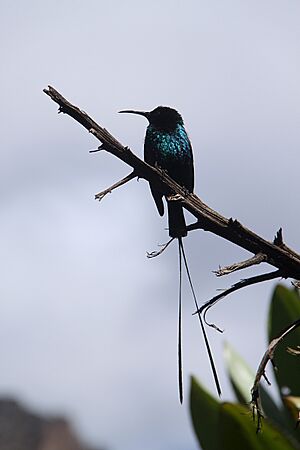
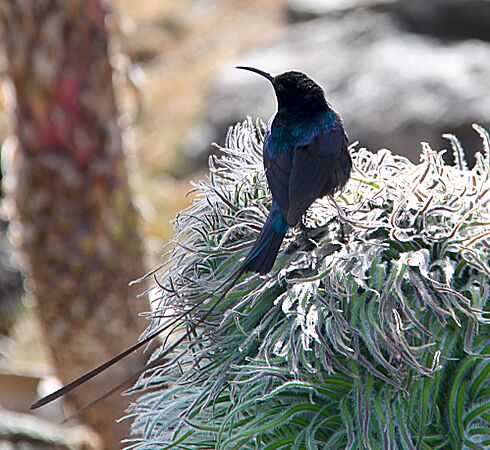
Adult male scarlet-tufted sunbirds have long tails, which can be up to about 20 centimeters (about 8 inches) long. They also have bright scarlet (red) pectoral tufts on their chests. These tufts are like little bunches of feathers, about 10 millimeters (less than half an inch) wide. You can usually see these bright tufts when the bird is flying or moving its wings. However, they are often hidden when the bird is just sitting still.
The male's head is black, and its upper body is a shiny metallic green. From far away, this green can look almost black. Its lower back (rump) is bluish, and its wings and tail are black. The feathers in the middle of its tail are extra long. The feathers on its belly are also a shimmering green, which fades to a bluish-purple on its upper belly and black on its lower belly.
Female Sunbirds
Female scarlet-tufted sunbirds look a bit different from the males. Their upper parts are brownish-grey, and their wings and tail are dark brown. Their underparts are whitish with dark spots. The females also have pectoral tufts, but they are smaller than the males' and might be more orangey-red.
Young Sunbirds
Young scarlet-tufted sunbirds look similar to adult females. However, they do not have the special pectoral tufts yet.
Where Does the Scarlet-Tufted Sunbird Live?
The scarlet-tufted sunbird lives in very high places in Africa. It prefers the cool, high-altitude areas known as Afroalpine Rwenzori-Virunga montane moorlands and East African montane moorlands.
High-Altitude Homes
These birds usually live in mountain forests and moorlands. They are found at altitudes between 3,000 and 4,500 meters (about 9,800 to 14,800 feet) above sea level. This covers different types of plant zones.
Favorite Plants
The scarlet-tufted sunbird especially loves to be around giant lobelia plants. It feeds on the sweet nectar from these plants and also eats insects found on them. The tall flowerheads of the lobelia plants are also perfect spots for the sunbirds to sing their songs. In lower areas, they might feed on Protea plants and other types of flowers.
Is the Scarlet-Tufted Sunbird Safe?
The scarlet-tufted sunbird is a common bird, even though it lives in a specific area. Experts believe its population is stable, meaning the number of these birds is not going down.
Conservation Status
The International Union for Conservation of Nature (IUCN) is an organization that checks on how safe different animal species are. They have looked at the scarlet-tufted sunbird and found no major threats to it. Because of this, its conservation status is listed as "least concern". This means scientists are not worried about it becoming endangered anytime soon.
Gallery
-
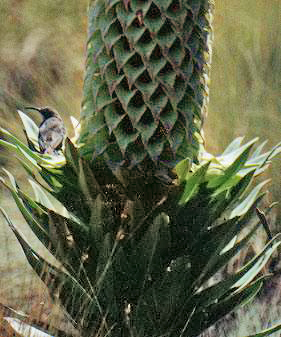
A scarlet-tufted sunbird on a Lobelia deckenii plant.
-
-
-

A nest of the scarlet-tufted sunbird.


