
Scottish Cemetery at Calcutta facts for kids

Main entrance of the Scottish Cemetery
|
|
| Details | |
|---|---|
| Established | 1820 |
| Location |
Karaya Road, Mullick Bazar, Kolkata, West Bengal 700017
|
| Country | India |
| Type | Private (closed) |
| Owned by | St. Andrew's Church, Kolkata |
| Size | 3 acres (1.2 ha) |
| No. of graves | 1,809 |
| No. of interments | 4,000 |
The Scottish Cemetery at Calcutta was opened in 1820. It was made for the many Scottish people living in Kolkata, India. These Scots included soldiers, missionaries, and business people. They worked for important groups like the East India Company and the British government in India. Kolkata was the capital of British India at that time.
The cemetery was used until the 1940s. It was then left alone in the 1950s after India became independent. Most people buried here have Scottish names, like Anderson or Campbell. About 10% of those buried are Bengali.

Contents
What is the Scottish Cemetery Like?
This cemetery is about 3 acres (12,000 m2) big. It is located in a busy part of Kolkata on Karaya Bazar Road. The cemetery is mostly laid out in a grid pattern. But the oldest part, near the road, has tombs placed more randomly.
There are over 1,809 burial plots here. At least 2,000 people are buried in them. The main entrance has "Scottish Cemetery" written above an archway. A gatehouse stands next to it. A tall wall surrounds the entire cemetery.
Building Materials and History
The gravestones are usually made of Scottish sandstone or granite. Many stones show the names of their makers from Scotland. This tells us that almost all the stones were made in Scotland. They were then brought all the way to India.
The cemetery feels very Scottish, even with Indian plants growing there. In the second half of the 1900s, most of the original lead and iron was taken from the cemetery.

Bringing the Cemetery Back to Life
The Scottish Cemetery has 1,809 gravestones and about 4,000 burials. It was used even after India became independent in 1947. But by the 1970s, it started to fall apart.
In 2008, a group called the Kolkata Scottish Heritage Trust (KSHT) was started in Scotland. Their goal is to fix up the cemetery. This project is run by a group of trustees. They work with St. Andrew’s Church, which owns the cemetery. KSHT gets money from people and charities to help with the work.

Why Restoration Matters
Restoring the Scottish Cemetery helps the environment and the area around it. It also improves the lives of people connected to it. The project uses local and lasting resources. It tries to keep nature balanced and protect history. The work considers today's needs without harming the future. This project focuses on history, nature, and people.

The Scottish Cemetery holds many old records of burials. This information helps people research Scottish history around the world. The cemetery is also like a park in the city. It gives the busy city a much-needed "green lung." It also brings tourists, especially those interested in their family history.
The cemetery is in an area with families who need help. So, the project also runs programs for the local community.


Nature in the Cemetery
Kolkata is near the Hooghly River. It has a varied natural environment. The city gets a lot of rain and has a humid, tropical climate. It has different plants and animals, including parts of monsoon forests.
The city has areas where rainwater collects in clay soils. Old trees, bamboo, palm trees, and wetlands create the natural landscape. Many of these natural areas are disappearing as the city grows. But some important places, like the Scottish Cemetery, are protected.
When the cemetery was no longer used in the 1970s, nature took over. The city grew around it, but the 3-acre site stayed untouched. It became a home for many local and rare plants and animals. It has a rich variety of life, including microbes, plants, and animals. It also has parts of semi-aquatic grasslands and forests.
Along with fixing old monuments, protecting nature is a top goal for the cemetery. It is becoming an urban park and a place to protect biodiversity. This helps clean the air and reduce noise. It also helps refill groundwater and protects soil, plants, and animals. All of this helps fight climate change.
Famous Graves
Some notable people buried in the Scottish Cemetery include:
- Dr. James Meik, a senior doctor in the British Army in Calcutta. He was born in 1758 and died in 1837.
- Thomas Jones (1810-1849), a missionary from Wales.
- The director of the Calcutta Zoological Gardens.
- Many officers from the East India Company.
- James Wheatley, a police officer who was "murdered while doing his job" in 1844.
- Rev. John Adam, a missionary.
- John Reddie FRSE (1805-1851), a judge.
The gravestones also mention towns in Scotland where people came from. These include Paisley, Broughty Ferry, Sutherlandshire, Fife, Campbeltown, and many from Dundee. Many people from Dundee were linked to the jute industry.
Cemetery Records and Archives
There is an old photo album in Dundee that has pictures of 25 graves. These photos were taken in the mid-1900s. The same 25 graves were photographed again in 2008. This showed how much they had decayed over time.
Recently, Presidency University created a digital archive of the graves. It includes records from when the cemetery started until 1858. You can see this archive online at scotscemeteryarchivekolkata.com.
Images for kids
-
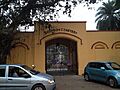
Main entrance of the Scottish Cemetery
-
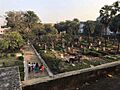
A view of the Scottish Cemetery from above.
-
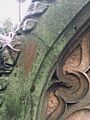
Lichen growing on a sandstone gravestone.
-
The logo of the Kolkata Scottish Heritage Trust.
-
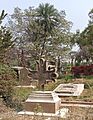
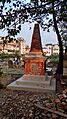
A tomb that has been restored.
-
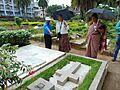
Marion Geddes visiting the cemetery.
-
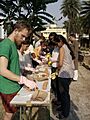
A workshop on using lime for restoration.
