
Scramble (slave auction) facts for kids
A scramble auction was a special way of selling enslaved people during the Atlantic slave trade. It happened in European colonies in the West Indies and the United States. It was called a "scramble" because buyers would all rush at once into an open area. They would try to grab as many people as they could. Another name for this type of auction was "Grab and Go."
Ship captains worked hard to prepare the captives and set prices. They wanted to make the most money possible. This kind of auction usually didn't involve talking about prices or bidding beforehand.
Contents
What Was a Scramble Auction?

Scramble auctions first began in the West Indies in the late 1700s. They usually took place on a ship, in a special pen, or in another closed-off area. Captains used enclosed spaces to stop revolts or to sell the enslaved people quickly.
Once the ships arrived, the captives were led into these areas. Many eager buyers would surround the area, often pushing to get to the front. The auction started with a signal, like a gunshot or a drum beat. When the signal sounded, buyers rushed in to claim as many people as they could. Sometimes, fights even broke out among the buyers.
Olaudah Equiano, a man who was once enslaved but later became free, described a scramble auction. He said it started with a drum beat. Then, buyers rushed into the yard where he and others were kept. They grabbed the people they liked best.

Anna Maria Falconbridge and Alexander Falconbridge were a married couple from London in the 1700s. Anna Maria wrote about her experiences in West Africa. Her writings were used to help end the Atlantic slave trade.
Historian Christopher Fyfe shared Anna Maria Falconbridge's descriptions of scramble auctions. She saw them in Jamaica, in Kingston and Port Maria. In Kingston, the enslaved people were gathered on the ship's deck, which was made dark. This was to prevent buyers from seeing them clearly. When the signal was given, buyers rushed in. Some enslaved people were so scared that about thirty of them jumped off the ship.
The auction in Port Maria was similar. Anna Maria described the women as terrified. They clung to each other for protection and were in great pain. The buyers were described as "savages" because of how brutally they rushed to grab and buy the enslaved people.
How Were Enslaved People Prepared for Sale?
Preparing Captives for Auction

Enslaved people were "prepared" for auctions by "experts," surgeons, or crew members. First, they were gathered in a small open space. Surgeons would check their health and age. Crew members would wash them, often with sea water. They would also shave adults to hide grey hair, hoping to make them look younger.
A main goal was to make the enslaved people look healthy. Crewmen sometimes gave them rum to make their eyes seem bright. They also rubbed oil or animal fat on them to make their muscles stand out. There are even reports of "experts" fixing wounds with gunpowder or iron rust. Palm oil was also used to cover bruises, sores, and cuts.
Sometimes, enslaved people were branded with a mark showing which European nation or owner they belonged to. All these methods were used to help captains make the most money.
On the morning of a scramble auction, buyers could come early to inspect the captives. They would open mouths to check teeth and touch arms and legs to feel muscles. They made people walk to check for limping. They also made them bend in different ways to find any hidden wounds. There were no private sales or negotiations at these auctions.
What Was Seasoning?
Another part of preparation was called "seasoning." This was a period of adjustment. Merchants and traders tried to make enslaved people get used to their new life on plantations. Seasoning was meant to break their spirit and identity. This was done so they would be less likely to revolt and would work harder.
To "season" them, traders would "Creolize" them. This meant changing African-born captives into people who acted like they were born in America. They would shave off all their hair, wash them, oil them, and feed them very little. Some enslaved people were sent to the West Indies before being sold in the American South. This was so they would learn what plantation work was like. Other seasoning methods included branding them with their new owner's mark and renaming them. This was to take away their African identity.
Experiences of Enslaved Women
It is hard to find historical records from the point of view of enslaved people. It is even harder to find stories from women about scramble sales. We mostly rely on what buyers saw and reported. We also rely on accounts from others, like John Josselyn, a traveler.
When Josselyn went to New England, he stayed at Samuel Maverick's home. Maverick was one of the first slave owners in Massachusetts. By 1638, he owned at least three enslaved people. Two of them were women who did not speak English. It is thought that these two women were bought in a scramble auction. They were sold for less money than the young men.
One young girl, about sixteen or seventeen years old, was forced to show her arms, legs, and teeth to buyers. While she smiled, one interested buyer even moved her lips to look closely at her teeth.

Enslaved women were often used as wet nurses for white slave owners' children. They were also forced to have more children. This created more enslaved people for cheap labor and meant that future generations would also be enslaved. In her book, They Were Her Property, Stephanie Jones-Rogers shares many experiences of enslaved women. One example is Mary Kincheon Edwards. Her only job was to nurse white children. This suggests that she and many other women who did this job were often pregnant.
First-Hand Accounts of Scramble Auctions
,_frontispiece_-_BL.jpg)
In his book, The Interesting Narrative of the Life of Olaudah Equiano, Olaudah Equiano wrote about being prepared for a scramble auction. While still on the ship, he said they were separated into groups of men and women. They were "examined" by having to jump. Once on land, they were herded like sheep into a merchant's yard. They stayed there for a few days until the auction began with a drum beat. Equiano described how cruelly buyers acted during this process. He said buyers seemed very eager to get their hands on as many people as possible.
John Tailyour, a ship captain who often sailed to Guinea, Africa, wrote about how he prepared for scramble auctions. Tailyour held these auctions between 1782 and 1793. Each time, he used the same methods to make sure he earned the most money. Before going ashore for the sale, Tailyour divided his captives into two groups: "prime" and "refuse." "Prime" people were young men and women, from their late teens to thirty years old. They were healthy and had no injuries or sickness. "Refuse" people were either very old or very young, sick, or had many wounds.
On the day of the scramble, or the day before, Tailyour created ten different categories for the enslaved. These included "privilege men," "cargo men," "privilege men-boys," and "men-boys," with similar categories for women. Prices were set at two Jamaican pounds. "Better quality" captives cost two pounds more than the next group. Each female category was priced two pounds lower than its male equivalent. Tailyour made these separations because "privilege slaves" were saved for his close friends and family. The rest were put into the scramble. His "refuse slaves" were also part of scrambles, but they were specifically for plantation owners who could not afford the other categories.
Thomas Hibbert, an English merchant and plantation owner in Jamaica, talked about the dangers of a scramble he saw. He told Nathaniel Phillips, another plantation owner, that he expected half of the buyers waiting at the gates to be trampled to death by the other half.
Alexandre Lindo, a captain of two slave ships, recorded selling an entire ship of captives in four hours. This was the largest number of people sold until 1805. That year, thirty plantation owners bought an entire ship's worth of human cargo in one hour. The enslaved people from both ships were sold using the scramble method.
Alexander Falconbridge, husband of Anna Maria Falconbridge, also wrote about scramble slave auctions in his book, An Account of the Slave Trade on the Coast of Africa. He said buyers paid a set price that was agreed upon by the ship's captains and the buyers. Falconbridge explained that at the agreed start time, the doors of the yard where the captives were held were opened. Buyers immediately ran in to gather people. Some buyers came prepared with handkerchiefs or ropes. They used these to tie enslaved people together so they wouldn't lose them while grabbing others.
Falconbridge called the buyers "brutes" who had no sympathy for the captives. Because of this, he remembered some enslaved people being so scared that they jumped over the walls to escape. On the ship Golden Age, Falconbridge recorded the sale of 503 captives in two days in December 1784, in Port Maria, Jamaica.
Images for kids
-
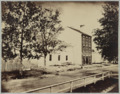
A "slave pen" which was used to hold slaves before the auction.
