
Sharpie (boat) facts for kids

Sharpies are a special kind of sailboat with a flat bottom and straight, outward-sloping sides. They have a very shallow draft, meaning they don't sit deep in the water. This design allows them to sail easily in shallow areas. Sharpies typically use centreboards and balanced rudders. These boats are believed to have started in the New Haven, Connecticut region of the United States. They were traditional fishing boats, especially for catching oysters.
Contents
The History of Sharpie Boats
Sharpies Begin in New Haven

Sharpies first became popular in New Haven, Connecticut, in the late 1800s. They replaced older dugout canoes and likely came from flatiron skiffs. A man named James Goodsell claimed to have built the first sharpie in 1848. This claim was never challenged.
Building sharpies became a growing business. These boats were sold to oyster fishermen along the East Coast. Builders like Rowe, Graves, and Thatcher became famous for their sharpies by the 1880s.
Sharpies were perfect for oyster fishing. They were easy to row, cheap to build, and fast when sailing. People even used them for races. Some sharpies could sail eleven nautical miles in just 34 minutes. By the 1880s, about 200 sharpies were found in Fair Haven alone.
Smaller sharpies, about 24–28 feet long, usually had one sail. Larger boats, around 35 feet, had two sails. They used special sails called leg-o-mutton sails. These sails had sprit booms on masts that stood on their own. The bigger boats had three places to put masts. This allowed them to change the mast setup for different weather. Their hulls were narrow with low sides. They had a straight front (bow) and a round back (stern). The centreboard and rudder were long and shallow.
Sharpies Travel to New Places
Sharpies soon traveled to other parts of the country. They were popular in places with shallow water, like Chesapeake Bay, the Carolinas, the Great Lakes (Ohio), and Florida. Deep-draft boats could not operate easily in these areas.
Most sharpies had simple leg-o-mutton sails on free-standing masts. However, larger sharpies, especially in the Carolinas and Florida, sometimes used more complex gaff schooner rigs. These rigs included an extra sail called a jib.
Famous Sharpie Designs and Builders

Sharpies arrived in Florida in 1881. Commodore Ralph Munroe brought his own 33-foot sharpie, named Kingfish, to Miami. One of the most famous sharpies was Munroe's Egret design. He designed Egret in 1886.
The Egret was special because it had higher, wider sides than other sharpies. It was also "double-ended," meaning both ends looked similar. This made it more stable when carrying cargo. It also helped prevent waves from crashing over the back of the boat. Commodore Munroe even called the Egret a "sharpie-lifeboat."
Many designers helped sharpies change and improve over time. They created sharpie yachts for fun, inspired by the working boats. Designers like Thomas Clapham and Larry Huntington tried different bottom shapes. Modern designers such as Bruce Kirby and Reuel Parker still use these ideas. Small sharpie skiffs were very common because they were easy and cheap to build.
Howard I. Chapelle, a naval architect, wrote many books about traditional boats. He designed many sharpie sailboats and yachts for people to enjoy.
Sharpie Boats Today

Today, sharpies are becoming popular again. Many designers and sailors like them because they can sail in shallow water and are easy to build. Most modern sharpies are built by individuals or as unique projects.
However, some designers offer plans for new sharpie models. These include Bruce Kirby's Norwalk Islands series and designs by Parker Marine. Phil Bolger also created many interesting sharpie designs.
How Sharpie Boats Are Designed
Sharpies, like dories, can feel a bit wobbly at first. This is because they have a shallow bottom without a deep keel. To make them more stable, heavy weights called ballast are added to the floor. A 30-foot sharpie might need 600 to 900 pounds of ballast.
Sharpies get their stability from their high, flared sides. These sides help keep the boat upright when it leans in the wind. Having two masts that stand on their own makes setting up the sails very easy. These flexible masts also help the boat stay stable by letting strong winds spill out of the sails.
The flat bottom and narrow shape make sharpies fast when sailing with the wind. The flat bottom can even help them glide or "plane" on the water in strong winds. However, these features mean they are not as good at sailing directly against the wind. But they are excellent for shallow waters or places with many turns, like rivers or rocky areas.
Sharpie boats with cabins can feel a bit cramped inside. This is because the large box for the centreboard takes up space. Even a 30-foot sharpie is best for only two people on a week-long trip. Sharpies are best for calm, sheltered waters. They do not have the strong self-righting ability of boats with deep keels. An experienced sailor who understands their unique design is best for a sharpie.
Some modern sharpie designs have improved features. For example, some now have a different kind of rudder that pivots. This helps with steering in rough seas. Other designs have special sails to improve sailing against the wind. Designers have also found ways to reduce noise from waves slapping the flat bottom when the boat is anchored.
Images for kids
-
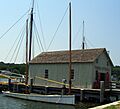
New Haven Oyster sharpie, Mystic Seaport, Connecticut
-
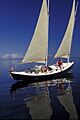
Egret-type sharpie sailing in Biscayne Bay, Florida
-
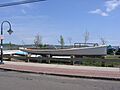
Hauled sharpie, New Haven, Connecticut
-
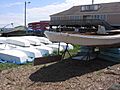
New Haven sharpie showing typical round stern and balanced rudder


