
Somali bushbaby facts for kids
Quick facts for kids Somali bushbaby |
|
|---|---|
 |
|
| Conservation status | |
Scientific classification  |
|
| Kingdom: | Animalia |
| Phylum: | Chordata |
| Class: | Mammalia |
| Order: | Primates |
| Suborder: | Strepsirrhini |
| Family: | Galagidae |
| Genus: | Galago |
| Species: |
G. gallarum
|
| Binomial name | |
| Galago gallarum Thomas, 1901
|
|
 |
|
| Somali bushbaby range | |
| Script error: The function "autoWithCaption" does not exist. | |

Script error: No such module "Check for conflicting parameters".
The Somali bushbaby (Galago gallarum), also called the Somali lesser galago, is a small, furry animal. It belongs to the primate family, just like monkeys and humans. This animal is nocturnal, meaning it is active at night. It is also arboreal, which means it lives mostly in trees.
You can find the Somali bushbaby in countries like Ethiopia, Kenya, and Somalia. Sadly, its home is shrinking because of habitat loss. This means there are fewer places for these bushbabies to live.
Contents
Where Do Somali Bushbabies Live?
The Somali bushbaby lives in parts of Kenya, Somalia, and Ethiopia. Unlike some other bushbabies, it prefers specific types of forests. It lives in thorny woodlands and scrublands. These are dry areas with lots of thorny bushes and trees.
You can find them in large areas of southwestern Ethiopia. They also live in most of Kenya, except for the coast and very dry desert areas. In Somalia, they live from a place called Odweina down to the border with Kenya.
What Does a Somali Bushbaby Look Like?
The Somali lesser galago is a medium-sized bushbaby. Adult males are usually about 41.5 to 46.4 centimeters (16 to 18 inches) long. Females are a bit smaller, measuring about 38 to 44.2 centimeters (15 to 17 inches). Their tails are quite long, around 25.9 centimeters (10 inches) for males and 24.6 centimeters (9.7 inches) for females.
Their faces and throats are whitish. Their ears, eye-rings, and tails are dark brown or black. This creates a cool contrast! Their bellies are pale. Their fur is mostly gray, but the tips are buff-colored. This makes them look sandy during the day and grayish at night.
How to Tell Them Apart from Other Bushbabies
It can be tricky to tell the Somali bushbaby apart from other similar species. For example, the Senegal bushbaby lives in some of the same areas. However, Somali bushbabies have different measurements for their legs, feet, ears, and tails.
You can also tell them apart by their calls and the type of habitat they prefer. Another species, the Kenyan coast galago, also lives in some southern parts of Kenya and Somalia. But its calls are different, and it likes wetter places. The ears of these other bushbabies also look different.
How Scientists Study Somali Bushbabies
The Somali bushbaby was first described by a scientist named Oldfield Thomas in 1901. For a while, it was thought to be a type of Senegal bushbaby. But in 1979, another scientist, T.R. Olson, studied them closely. He found enough differences to say it was its own separate species again. Other scientists agree with this idea.
The Somali lesser galago is considered a "monotypic" species. This means that scientists have not found any different types or subspecies within the Somali bushbaby group.
Images for kids
-
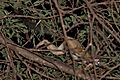
A Somali bushbaby looking curious.
-
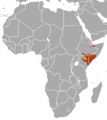
Map showing where Somali bushbabies live.
