
Southwest facts for kids

Southwest is a special direction that sits exactly halfway between south and west. Imagine a compass: if you're facing south and then turn halfway towards west, you'll be looking southwest. It's the exact opposite direction of northeast. Knowing directions like southwest helps us find our way, read maps, and even understand weather patterns.
Contents
Understanding Directions: What is Southwest?
Southwest is one of the eight main directions on a compass rose. These directions help people navigate on land, at sea, or even in the air. The four main directions are north, south, east, and west.
Southwest is one of the four "intercardinal" or "intermediate" directions, which are found between the main ones. The other intermediate directions are northwest, southeast, and northeast.
- Northeast (NE): Halfway between North and East. Its azimuth is 45 degrees.
- Southeast (SE): Halfway between South and East. Its azimuth is 135 degrees.
- Southwest (SW): It's halfway between South and West. Its azimuth is 225 degrees. Southwest is also the exact opposite of Northeast!
- Northwest (NW): Halfway between North and West. Its azimuth is 315 degrees. It's the exact opposite of Southeast!
Southwest in Nature and Weather
In many parts of the world, winds often blow from the southwest. For example, in the United Kingdom, southwest winds are very common and often bring mild, wet weather. In the United States, the "Southwest" region is a famous area known for its unique deserts and landscapes. This shows how directions can also describe large geographical areas.
Tools for Finding Southwest
The most common tool for finding southwest is a compass. A compass has a needle that always points north. Once you know where north is, you can easily figure out where south, west, and then southwest are. Maps also use directions, usually with north at the top, to help you find your way.
The Compass Rose: A Visual Guide
A compass rose is a design found on maps and nautical charts. It shows all the main and intermediate directions. The point for southwest is usually marked clearly, helping anyone quickly see where that direction is. These designs have been used for hundreds of years to help explorers and travelers.
Directions Without a Compass: Nature's Guides
Not all cultures rely solely on compass directions. Some use natural landmarks or features of their environment to guide them.
- Sea and Mountains: In places like Hawaii or Bali, people might use "toward the sea" or "toward the mountains" as their main directions. Imagine living on an island where the ocean is always in one direction and the mountains in another – it makes perfect sense!
- Upstream and Downstream: Along rivers, like the Nile in ancient Egypt or for the Yurok and Karuk people, "upstream" (against the current) and "downstream" (with the current) become very important directional terms.
- Lengo Language: On Guadalcanal in the Solomon Islands, the Lengo language has four unique non-compass directions: "landward," "seaward," "upcoast," and "downcoast."
Some languages even lack words for "left" or "right" and instead use geographical directions. So, instead of saying "turn left," they might say "turn north" or "turn toward the mountains"! This shows how deeply our environment can shape our language and how we think about space.
Why Directions Matter
Understanding directions is super helpful! It helps you read maps, use a compass, or even follow directions on your phone to get where you need to go.
It helps you understand where countries, cities, and natural features are located on Earth.
From astronomy to geology, directions are fundamental for describing observations and locations.
Interesting facts about cardinal directions
- The word "north" comes from an old word that might have meant "submerged" or "below," or even "to the left of the rising sun."
- East comes from an ancient word related to "dawn" or "shine (red)." It makes perfect sense, as the sun rises in the east!
- The word "south" is thought to come from an old word related to "seethe" or "boil," and it's connected to the word "Sun." So, "south" could mean "the region of the Sun," which makes sense because in the Northern Hemisphere, the sun is often highest in the southern sky.
- West comes from an ancient word for "evening" or "shine (red)." Just like east is where the sun rises, west is where it sets, marking the evening.
- In traditional Chinese culture, there aren't just four cardinal directions, but five! The fifth point is the center. Each direction is associated with a color, a season, an element, and a mythical creature.
- The Hopi people in the Southwestern United States don't just use North, South, East, and West. Their four named directions are connected to where the sun rises and sets during the winter and summer solstices (the longest and shortest days of the year). Each direction might also be linked to a specific color, like black, red, white, or yellow, which can have deep symbolic meaning.
- In classical Indian scriptures, there are ten special deities called "Dikpālas" who symbolize the four cardinal directions, the four intercardinal directions, and the directions of "up" and "down." Each direction has its own name in Sanskrit, often named after the god associated with it. For example, the East is associated with Indra, and the South with Yama.
- The Guugu Yimithirr people even use cardinal directions (like "north" or "southwest") instead of relative directions (like "left" or "right") even when talking about objects very close to their bodies! This means they always know exactly where they are in relation to the world around them.
- In Japanese the main cardinal directions (North, East, South, West) are native Japanese words. But for the intercardinal directions (like southeast), the Japanese often use words borrowed from Chinese!
Related Directions
Images for kids
-
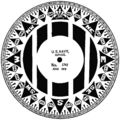
Compass rose from "American Practical Navigator" 1916
-
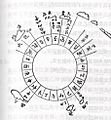
Ming Dynasty 24-pointed compass


