
St Olave's Church, Exeter facts for kids
Quick facts for kids Church of St Olave |
|
|---|---|

St Olave's Church, Exeter
|
|

 Church of St Olave
Location in Devon
|
|
| 50°43′18″N 3°32′02″W / 50.721697°N 3.533884°W | |
| Location | Fore Street, Exeter |
| Country | England |
| Denomination | Church of England |
| History | |
| Founder(s) | Lady Gytha |
| Dedication | Saint Olaf |
| Administration | |
| Diocese | Exeter |
| Province | Canterbury |
St Olave's Church is an old church located in Exeter, England. It started as a private chapel, built by Lady Gytha. She was the wife of Godwin, Earl of Wessex, and the mother of King Harold Godwinson.
St Olave's is mentioned in the Domesday Book from 1086 AD. This book was a big survey of England ordered by William the Conqueror. The church became a public parish church in the 1200s. It was rebuilt between the late 1300s and 1400s. On January 4, 1950, the building was officially named a Grade I listed building. This means it's a very important historical site.
Contents
What the Church Looks Like
St Olave’s Church is on Fore Street in Exeter, Devon, England. It was first built with rough stones. Over many years, it has been changed and updated. In the 1300s, it was rebuilt with a simple rectangular main area (nave) and a special area for the altar (chancel). Two side sections were added on the north side.
One of the oldest parts you can still see is the "long-and-short quoining" at the north-west corner. This is a special way of laying stones that was common in Anglo-Saxon times. The south wall has a tall window from the 1400s. It also has older parts, like an arch from a smaller opening, possibly from the 1300s.
The church tower was built in the 1200s. The top part was added in the early 1700s. It is made of yellow bricks and has an eight-sided turret. Inside, you can see a pulpit from the late 1600s and a communion table from the mid-1700s. There is also a gallery and organ from the early 1800s. A damaged stone carving showing the Scourging of Christ is set into the wall. It was probably part of an altar.
Church History
Early Beginnings (Medieval Era)
Some experts believe the church began as a private chapel. It was founded by Lady Gytha, the mother of King Harold Godwinson. She built it after her husband, Godwin, Earl of Wessex, passed away. The church was named after St Olaf, a Norwegian king (995–1030).
The church is mentioned in the Domesday Book (1086). It was connected to Battle Abbey in Sussex. The land and money given to the church were linked to the powerful Godwin family and King Edward the Confessor. Records from St Nicholas Priory in Exeter show that Lady Gytha gave land to St Olave's church between 1057 and 1065. She did this for her own soul and her husband Godwin's soul. Her sons, Tostig and Gyrth, and a priest named Sæwin, witnessed this gift.
Changes Over Time (Post-Medieval Era)
St Olave's church had big changes in the 1300s and 1400s. Two new sections were added on the north side, with tall windows. A small southern room, perhaps for a priest, was later changed in the 1700s. The south entrance and a small room on the south-east side were added in 1661. A new doorway was built next to the tower, but it is now blocked up. This blocked doorway holds a World War I memorial.
The church was not used for worship for a while in the 1600s. During this time, it was used as a parish school. From 1635 to 1758, it became a place of worship for French Huguenot refugees. These were people who had to leave France because of their religion. Many of them are remembered on memorial stones inside the church. The building was also used as a military chapel for soldiers stationed in Exeter at different times.
Recent Times (Modern Era)
Major updates happened in the early 1800s. The south wall was taken down and rebuilt further south. The main part of the church and the south-west tower were also made bigger. In 1874, new benches were made from the old box pews. An iron screen was added in the sanctuary, the area around the altar.
A beautiful stained glass window showing St Olave as the King of Norway was put in in 1875. A screen between the nave and chancel was added in 1902. In the early 1900s, a special three-panel artwork called a triptych was placed behind the altar.
A World War I memorial is set into a blocked doorway. It was dedicated on January 10, 1917. This small sculpture might have been one of the first memorials for the Great War in England. A wooden memorial cross stands on steps, with the words "Pray for the men of St. Olave’s" carved into it. A list of names, called the Roll of Honour, is displayed in two panels. One panel lists those who died.
The church's wooden roof was destroyed during World War II and later rebuilt. In 1971, St Olave’s became part of the Parish of Central Exeter. It is still used regularly for worship by the local church community and by the Romanian Orthodox Church. The Church of St Olave was officially named a Grade I listed building on January 4, 1950.
Gallery
-
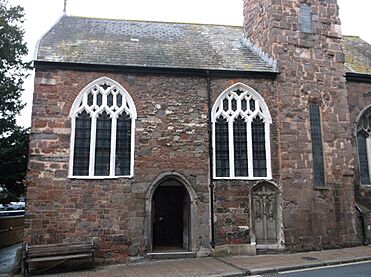
Church exterior
-
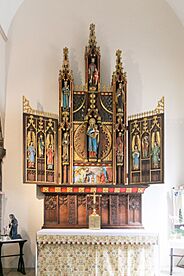
Reredo
-
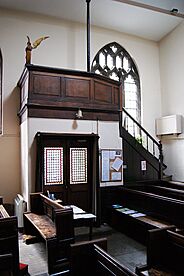
Gallery
-
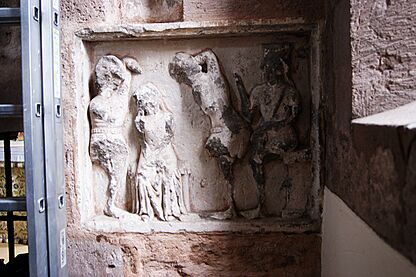
Interior relief sculpture
-
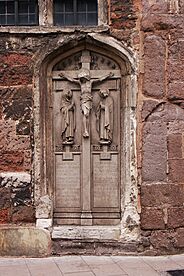
World War I memorial
.JPG)

.jpg)
.jpg)
.jpg)
