
Su Bai facts for kids
Quick facts for kids
Su Bai
|
|
|---|---|
| 宿白 | |

Su Bai in his youth (c. 1943)
|
|
| Born | 3 August 1922 |
| Died | 1 February 2018 (aged 95) |
| Alma mater | Peking University |
| Known for | Study of Buddhist grottoes and art |
| Awards | Lifetime Achievement Award, Chinese Archaeology Society |
| Scientific career | |
| Fields | Archaeology of Buddhism |
| Institutions | Peking University |
Su Bai (Chinese: 宿白; pinyin: Sù Bái; Wade–Giles: Su Pai; born August 3, 1922 – died February 1, 2018) was a famous Chinese archaeologist. An archaeologist is a scientist who studies human history by digging up old things. Su Bai was also a bibliographer, meaning he studied and collected books. He was the first head of the Archaeology Department at Peking University from 1983 to 1988. He was known for his important work in studying ancient Buddhist sites. In 2016, he received a special award for his long and successful career in Chinese archaeology.
Contents
Su Bai's Early Life and School
Su Bai was born on August 3, 1922, in Shenyang, which is in Liaoning Province, China. He started studying history at Peking University (PKU) in 1940. After he finished his first degree in 1944, he continued his studies in archaeology at PKU.
He learned from many famous teachers. He studied the history of China's relationships with other countries. He also learned about Chinese myths and ancient writings called oracle bones. He even studied the history of Buddhism. One of his students, Zhang Zhongpei, said Su Bai knew "everything" about many topics. Su Bai started teaching at the university in 1948.
Su Bai's Career as an Archaeologist
Discovering History Through Research
In 1950, Su Bai began working on archaeological digs. From 1951 to 1952, he led a team that dug up three tombs from the Song Dynasty in a place called Baisha. He wrote a report about what they found, called The Song Tombs at Baisha, which came out in 1957. This report helped people understand more about life and customs during the Song Dynasty. Even today, many years later, his report is still very important for archaeologists.
Su Bai became a leading expert in studying ancient Buddhist sites in China. He started looking into Chinese Buddhist caves in 1947. In 1978, he wrote an article that questioned how some Japanese experts had dated the Yungang Grottoes. After some discussions, the Japanese experts agreed with Su Bai's ideas.
He also made new discoveries about the age of the Kizil Caves. These caves are located in the Silk Road oasis town of Kucha. His work changed what earlier German archaeologists had thought about their age.
Teaching Future Archaeologists
When Peking University started its Department of Archaeology in 1983, Su Bai was chosen to be its first leader. Many of his students became very famous archaeologists themselves. Some of them include Hang Kan, who now leads the School of Archaeology at Peking University, and Fan Jinshi, who became the president of the Dunhuang Research Academy.
Su Bai was known as a very strict teacher and a careful scholar. For example, even after Fan Jinshi became a well-known expert, Su Bai did not approve of her first reports on the Dunhuang Grottoes. It took her five more years to revise the report before it was finally published in 2011. Su Bai retired in 2004, after working for over 50 years.
Su Bai's Amazing Book Collection
Besides his archaeology work, Su Bai loved collecting books. He was a bibliographer, which means he studied and collected books. Three out of the four rooms in his home were filled with books! By 2010, he had more than 10,000 books, including many rare ones. That year, he gave all his books to the Peking University Library. The library even created a special "Su Bai Reading Room" to keep his collection.
Su Bai's Passing
Su Bai passed away in Beijing on February 1, 2018. He was 95 years old.
Images for kids
-
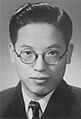
Su Bai in his youth (c. 1943)
