
Tea (meal) facts for kids

A tea is a special meal, often with delicious food and, of course, tea to drink. The English writer Isabella Beeton, who wrote popular books in the 1800s, described many types of tea meals. These included the "old-fashioned tea," "family tea," and "high tea."
Teatime is when this meal is usually enjoyed, typically from mid-afternoon to early evening. This meal is very popular in the United Kingdom and many Commonwealth countries. In some parts of Britain and Australasia, people call their main evening meal 'tea' instead of 'dinner' or 'supper.' A tea break is a short pause during work for a cup of tea or another drink.
Traditional 'afternoon tea' often includes tea, delicious baked goods like scones with jam, cakes, and small sandwiches. These are the main parts of the fancy afternoon teas you might find in expensive hotels. At home, people might offer different kinds of drinks and foods.
Contents
The History of Tea as a Meal
How Tea Became a Meal

People started drinking tea in the afternoon around the late 1600s. But 'tea' as a special meal came later, in the late 1700s or early 1800s. An early mention of "five o'clock tea" was made by Madame de Sévigné in France. In 1763, Alexander Carlyle wrote about ladies in Harrogate serving "afternoon tea or coffee." The Oxford English Dictionary shows other early examples of tea as a social gathering.
The time people ate the "tea" meal changed over the years. This happened because the main meal, dinner, also changed its timing. Until the late 1700s, dinner was eaten around midday. Later, dinner slowly moved to the evening. At first, the "tea" meal was often in the early evening, a few hours after midday dinner. Sometimes, it was even later, after supper and before bed.
In 1804, Alexandre Balthazar Laurent Grimod de La Reynière wrote about afternoon tea in Switzerland. He described it as strong tea with cream, served with buttered bread. He noted that wealthier homes added coffee, pastries, fruits, and even ice cream.
Afternoon Tea Becomes Popular

Many people say that Anna Russell, Duchess of Bedford, started the tradition of afternoon tea. The story goes that in the 1830s or 1840s, she felt hungry between her midday meal and her late evening dinner. So, she asked for tea and snacks to be brought to her room. Later, she invited friends to join her, turning this personal habit into a social event.
There's some debate about how much the Duchess really started this custom. Some believe afternoon tea existed before her. Others think she helped make it a formal event with its own rules and menu. The Duchess was a close friend of Queen Victoria, which helped her set trends.
First, rich families started having afternoon tea. Then, by the 1860s and 1870s, it became popular with the middle class too. While 'afternoon tea' (also called 'low tea') was for wealthier families, working-class people started having 'high tea'. This was a bigger, more filling meal eaten around the same time. By the end of the 1800s, tea as a meal was common among all social groups.
Afternoon tea parties were seen as friendly and enjoyable. They could be planned quickly. People usually kept conversations light and pleasant. Guests were not expected to stay long, perhaps only half an hour. Ladies sometimes wore special, comfy dresses called tea gowns for these gatherings. These dresses were much more relaxed than the tight corsets they usually wore!


Places to Enjoy Tea
Special places called teahouses or tearooms used to be very common in the UK. People went there to enjoy tea as a meal. Their popularity went down after World War II. The first tearoom was opened in Glasgow, Scotland, by Stuart Cranston in the 1880s. His sister, Catherine Cranston, later opened a famous chain of tearooms, including the Willow Tearooms.
In London, chains like the Aerated Bread Company and Lyons were very popular. Unlike older coffeehouses, these new tea places welcomed women, which was a big change! Outdoor tea gardens also became popular in places like Hyde Park. Afternoon tea was also served in hotels, theaters, railway stations, and on ships. Even the British royal family held annual garden parties with tea.
Tea Today
In the mid-1900s, tea as a meal became less popular. But since the early 2000s, it has made a big comeback! More and more restaurants and hotels are adding it to their menus. People in Britain and the Commonwealth are showing a growing interest in enjoying tea, both at home and in public places. Hotels and restaurants now offer many types of tea, from traditional black teas to herbal and green teas.
Some fancy places even have 'tea sommeliers.' These experts help choose the perfect tea from all over the world. In Britain, afternoon tea is seen in two ways. Some think it's an old tradition. Others see it as a key part of their country's food culture. Today, famous hotels like the Ritz Hotel in London still keep this tradition alive. They even compete for annual Afternoon Tea Awards! In Canada, the grand railway hotels are known for their afternoon tea ceremonies. In Australia, hotels like the Hotel Windsor have served high tea since 1883. In the United States, many hotels also offer special afternoon tea experiences.
Types of Tea Meals
Afternoon Tea (Low Tea)
Afternoon tea, sometimes called low tea, is a lighter meal. People usually eat it between 4:00 PM and 5:00 PM. It often includes thin bread and butter, small sandwiches (like cucumber or egg and cress), and tasty cakes. You might also find Battenberg cake or Victoria sponge cake. Warm scones with clotted cream and jam are also a must! The sandwiches are usually cut into small triangles or fingers, with the crusts removed.
A special multi-tiered stand often holds the food in the middle of the table. Sandwiches are on the bottom, scones in the middle, and small sweet cakes on top. Typically, black tea is served, such as Darjeeling, Assam, Earl Grey, or Ceylon tea. It's often served with milk, or lemon if it's a Chinese or Russian-style tea.
-
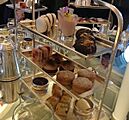
Afternoon tea on a silver serving tower at a hotel in Edinburgh
-
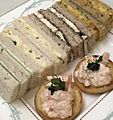
Finger sandwiches: cucumber, egg, cheese, curried chicken, with prawn canapés served at the Savoy in London
-
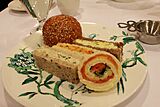
A typical afternoon tea sandwich selection at the King Edward Hotel in Toronto


.jpg)
High Tea
High tea is a heartier meal eaten in the late afternoon or early evening. It was often enjoyed by working-class people, farmers, or after sports. It's usually served between 5 PM and 7 PM. It got its name because it was eaten at a regular 'high' dining table, not a low coffee table. It was also sometimes called "meat-tea."
While afternoon tea was for wealthier families, working people chose high tea. It was a much bigger meal, eaten around the same time. High tea usually has a savory dish, like hot food or cold meats. Then come cakes, bread, butter, and jam, all with tea. Historians describe it as a meal where bread, butter, and tea were joined by fish or meat, often cooked in a frying pan.
In some parts of the United Kingdom (like Northern England, Wales, and Scotland), people traditionally call their midday meal dinner and their evening meal tea (served around 6 PM). In other places, the midday meal is lunch and the evening meal (after 7 PM) is dinner or supper.

Cream Tea
A cream tea is a simpler version of afternoon tea. It usually includes tea, scones, clotted cream, and jam.
Tea Around the World

Afternoon tea is a well-known symbol of English culture. It spread to many countries that were once part of the British Empire. How popular it became shows how much English culture influenced those places. By the late 1800s, British officials in these countries regularly enjoyed afternoon tea. They kept this tradition alive wherever they went. This made afternoon tea a lasting part of many cultures, sometimes changed and sometimes kept the same.
Afternoon tea became widespread in countries of the former British Empire, including Australia, Hong Kong, India, Canada, Kenya, Malta, and South Africa. The custom is also seen in fancy hotels in countries like Austria, Belgium, Hungary, Greece, Italy, and Switzerland. In Russia, the term "five o'clock tea" became a symbol of a refined lifestyle in the late 1800s. Even among ordinary people, afternoon tea with a samovar (a special tea urn) became a habit.
Australia, New Zealand, and South Africa
In South Africa, New Zealand, and Australia, a casual get-together at someone's home for tea and snacks is called 'afternoon tea'. These snacks might be biscuits, scones, cake, or sandwiches. It can also mean any light snack in the mid-afternoon, with or without tea. If this snack is in the mid-morning, it's called 'morning tea' in Australia and New Zealand. These terms are less common now, especially with the rise of coffee culture in Australia.
Today, in these countries, 'high tea' often means a fancy, formal afternoon tea. These formal teas are usually held outside the home, in tearooms, hotels, or special event venues. In Australia and New Zealand, a work or school break in the morning is 'morning tea.' A break in the afternoon is 'afternoon tea,' even if no tea is drunk. A smoko is also a slang term for a break, especially for people doing manual jobs. In Australia and New Zealand, 'tea' can also refer to the evening meal, or "dinner."
See also
 In Spanish: Hora del té para niños
- History of tea
- Merienda, the Hispanic analogue
- Tea culture
- Tea dance
- Tea in the United Kingdom
- Tea lady, an employee in a hospital or place of work
- Tea set, the tea pot, sugar bowl, milk jug, etc.
- Tiffin
- Elevenses
- Palm court, a room in a hotel where tea dances took place
