
Tree-kangaroo facts for kids
Quick facts for kids Tree-kangaroo |
|
|---|---|
 |
|
| Matschie's tree-kangaroo (Dendrolagus matschiei) | |
Scientific classification  |
|
| Kingdom: | Animalia |
| Phylum: | Chordata |
| Class: | Mammalia |
| Infraclass: | Marsupialia |
| Order: | Diprotodontia |
| Family: | Macropodidae |
| Subfamily: | Macropodinae |
| Genus: | Dendrolagus S. Müller, 1840 |
| Type species | |
| Dendrolagus ursinus S. Müller, 1840
|
|
| Species | |
|
About 14; see text |
|
Tree-kangaroos are amazing marsupials that live mostly in trees. They belong to a group of animals called Dendrolagus. These special kangaroos are found in the warm, wet tropical rainforests of New Guinea and parts of northeastern Queensland, Australia. You can also find them on some nearby islands. Unlike their ground-dwelling cousins, tree-kangaroos are the only true macropods that spend almost all their lives in trees. Sadly, many types of tree-kangaroos are considered threatened. This is mainly because of hunting and the loss of their forest homes.
Contents
How Tree-Kangaroos Evolved
The story of how tree-kangaroos came to be is quite interesting! Scientists believe their ancient relatives might have looked a bit like small pademelons. These early ancestors lived on the rainforest floor. Over a very long time, the climate in Australia and New Guinea changed. It became drier, and the rainforests shrank.
This forced the ancestors of tree-kangaroos to adapt to new places. They started living in drier, rockier areas. Eventually, they may have evolved into animals similar to rock-wallabies. These rock-wallabies learned to eat many different kinds of plants. This helped them survive in various environments.
Later, some of these rock-wallabies moved into new rainforests that grew in Australia. They began to spend more time climbing trees. Over many generations, these tree-climbing rock-wallabies slowly changed. They became the extinct tree-kangaroo group called Bohra. As the Earth's climate cooled even more, rainforests became smaller and more spread out. This led to the Bohra evolving into the tree-kangaroos we know today. They became perfectly suited for living high up in the forest canopy.
Types of Tree-Kangaroos

There are about 14 different kinds, or species, of tree-kangaroos. Each one is unique! Here are some of the species in the Dendrolagus group:
| Image | Scientific name | Where they live |
|---|---|---|
 |
Grizzled tree-kangaroo (D. inustus) |  |
 |
Lumholtz's tree-kangaroo (D. lumholtzi) |  |
 |
Bennett's tree-kangaroo (D. bennettianus) |  |
 |
Ursine tree-kangaroo (D. ursinus) |  |
 |
Matschie's tree-kangaroo (D. matschiei) |  |
 |
Doria's tree-kangaroo (D. dorianus) |  |
 |
Ifola (D. notatus) | |
| Seri's tree-kangaroo (D. stellarum) |  |
|
 |
Goodfellow's tree-kangaroo (D. goodfellowi) |  |
| Golden-mantled tree-kangaroo (D. pulcherrimus) |  |
|
| Lowlands tree-kangaroo (D. spadix) |  |
|
| Dingiso (D. mbaiso) |  |
|
 |
Tenkile (D. scottae) |  |
| Wondiwoi tree-kangaroo (D. mayri) (scientists thought it was extinct until 2018) |  |
Sometimes, scientists debate if an animal is a full species or a subspecies (a group within a species). For example, the Seri's tree-kangaroo was once thought to be a subspecies of Doria's tree-kangaroo. Now, many experts consider it a separate species. The same happened with the golden-mantled tree-kangaroo, which was once a subspecies of Goodfellow's tree-kangaroo.
The Wondiwoi tree-kangaroo was once thought to be lost forever. It was even on a list of the "25 most wanted lost" species! Luckily, it was rediscovered in 2018. This shows how important it is to keep looking for rare animals.
Where Tree-Kangaroos Live
Tree-kangaroos make their homes in the lush tropical rainforests. These forests are found in New Guinea, the far northeastern part of Australia, and some nearby islands. These islands include the Schouten Islands and the Raja Ampat Islands. Most species prefer living in mountains, but some, like the lowlands tree-kangaroo, live closer to sea level.
In Australia, you can find two specific types: Bennett's tree-kangaroo and Lumholtz's tree-kangaroo. Bennett's lives north of the Daintree River. Lumholtz's lives in the rainforests of northeastern Australia. Tree-kangaroos are very good at living in high places. Their forest homes are also where their predators live, like the amethystine python. This snake also climbs trees and can be a danger to young tree-kangaroos.
What Tree-Kangaroos Look Like
Tree-kangaroos come in different sizes. The Lumholtz's tree-kangaroo is the smallest. Its body and head are about 48 to 65 centimeters long. Its tail adds another 60 to 74 centimeters. Males usually weigh around 7.2 kilograms, and females about 5.9 kilograms.
Doria's tree-kangaroo is a bit larger, with a body length of 51 to 78 centimeters. Its tail is 44 to 66 centimeters long, and it can weigh between 6.5 and 14.5 kilograms. Matschie's tree-kangaroo has a body and head length of about 81 centimeters. Males weigh 9 to 11 kilograms, and females 7 to 9 kilograms. The grizzled tree-kangaroo is one of the biggest, growing to 75 to 90 centimeters long. Males are much larger than females, weighing 8 to 15 kilograms.
These animals have special features that help them live in trees. Unlike kangaroos that live on the ground, tree-kangaroos have longer, wider hind feet. Their nails are longer and curved, perfect for gripping branches. Their paws and the soles of their feet have a sponge-like texture for extra grip. They also have a very long, thick tail. This tail acts like a balancing pole, helping them move safely through the trees. When they are on the ground, they hop just like other kangaroos. To cool down, they lick their forearms. The moisture then evaporates, helping them stay comfortable in the warm rainforest.
Tree-Kangaroo Behavior
How Tree-Kangaroos Move
On the ground, tree-kangaroos are not very graceful. They move slowly, about as fast as a person walking. They hop a bit awkwardly, leaning forward to balance their heavy tails. But in the trees, they are amazing! They are brave and quick. They climb by wrapping their front paws around a tree trunk. Then, they use their strong back legs to hop upwards, letting their front paws slide.
They are also incredible jumpers. They can leap 9 meters downwards from one tree to another! They can even jump to the ground from 18 meters or more without getting hurt. Imagine jumping from a six-story building and landing safely!
What Tree-Kangaroos Eat
Tree-kangaroos mainly eat leaves and fruit they find in the trees. Sometimes, they will also pick up food from the ground. They enjoy grains, flowers, different kinds of nuts, tree sap, and bark. Some tree-kangaroos in zoos have even been seen eating eggs, birds, and snakes. This means they are omnivores, eating both plants and animals.
Tree-Kangaroo Reproduction and Life Cycle
We don't know much about how tree-kangaroos reproduce in the wild. Most of what we know comes from watching them in zoos. Female tree-kangaroos can have babies when they are about two years old. Males are ready to reproduce around 4.6 years old.
A female tree-kangaroo is fertile for about two months. They usually have only one baby, called a joey, at a time. Tree-kangaroos have one of the longest development times for marsupial babies. The joey stays in its mother's pouch for a long time, usually 246 to 275 days. After leaving the pouch, it continues to drink milk for another 87 to 240 days. They breed carefully in the treetops during the rainy season.
Dangers to Tree-Kangaroos
Tree-kangaroos face two main dangers: losing their homes and hunting. Their rainforest homes are being cut down for wood and to make space for farms. These farms grow crops like coffee, rice, and wheat. When their habitat is destroyed, tree-kangaroos become more exposed to predators. This includes wild dogs.
Local communities also sometimes hunt tree-kangaroos. This has a big impact on how many tree-kangaroos are left. A study on Lumholtz's tree-kangaroo in Australia showed common causes of death. Out of 27 tree-kangaroos, 11 were hit by cars, six were killed by dogs, and four died from parasites. The rest died from other reasons.
Tree-Kangaroos in Zoos
As of 2021, five types of tree-kangaroos live in zoos around the world. These include Goodfellow's and Matschie's tree-kangaroos, with smaller numbers of Lumholtz's, Grizzled, and Doria's tree-kangaroos. You can find them in zoos across North America, Oceania, Europe, and some in Asia. Zoos work together through the World Association of Zoos and Aquariums. They have special breeding programs. These programs help make sure there are healthy tree-kangaroos outside of the wild. This helps protect their genetic diversity.
In November 2014, something amazing happened at the Adelaide Zoo. An orphaned tree-kangaroo joey, whose mother had died, was placed in the pouch of a yellow-footed rock-wallaby. The rock-wallaby became a surrogate mother and successfully raised the joey!
On April 29, 2022, the Bronx Zoo announced the birth of a Matschie's tree-kangaroo joey. This was the first of its kind born at that zoo since 2008. The joey was tiny at birth, about the size of a human thumbnail!
Images for kids
-
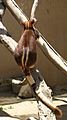
The back and tail of a Buergers' tree-kangaroo (Dendrolagus goodfellowi buergersi)
-
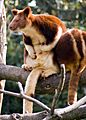
Two Goodfellow's tree-kangaroos, (Dendrolagus goodfellowi)
-
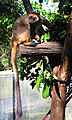
Lumholtz's tree-kangaroo (Dendrolagus lumholtzii)
-
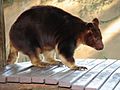
Buergers' tree-kangaroo (Dendrolagus goodfellowi buergersi)
-
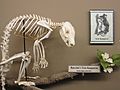
A Matschie's tree-kangaroo (Dendrolagus matschiei) skeleton


See also
 In Spanish: Canguros arborícolas para niños
