
Tylosaurus facts for kids
Quick facts for kids Tylosaurus |
|
|---|---|
 |
|
| Skeleton cast of Tylosaurus rex | |
Scientific classification  |
|
| Unrecognized taxon (fix): | Tylosaurus |
| Type species | |
| †Macrosaurus proriger Cope, 1869
|
|
| Species | |
|
|
Tylosaurus was a giant marine reptile that lived during the Late Cretaceous period. It belonged to an extinct family of ocean lizards called mosasaurs. These creatures swam in ancient seas between 92 and 66 million years ago. Its fossils have been found across North America, Europe, and Africa. As an apex predator, it hunted at the very top of the ancient ocean food chain.
Contents
What Did Tylosaurus Look Like?

Tylosaurus had a streamlined body built for fast swimming. Instead of legs, it had four strong paddles and a long tail with a fin. While early drawings showed mosasaurs swimming like giant sea snakes, scientists now know they swam more like sharks. They moved mainly using the back of their body and their powerful tail.
The largest species was named T. rex in 2026. A famous specimen nicknamed "Bunker" reached about 13.2 metres (43 ft) long. Other species, like T. proriger and T. bernardi, were also huge ocean hunters.
Its name means "knob lizard" because of a hard, toothless snout called a rostrum. Inside the snout were many branches of the ophthalmic nerve. Scientists believe this snout was packed with sensitive nerves to detect vibrations and sense prey in murky water.
Hunting and Diet

Tylosaurus was a fierce carnivore that ate almost anything it could catch. Its jaws held sharp pointed teeth, as well as extra teeth on the roof of its mouth. These extra teeth on the pterygoid bone helped push struggling prey down its throat.
Fossil stomach contents show that Tylosaurus ate:
- Large bony fish like Bananogmius and Cimolichthys
- Plesiosaurs like Dolichorhynchops
- Diving seabirds like Hesperornis
- Hard-shelled sea turtles
- Other mosasaurs, including Clidastes and Platecarpus
Fossil bite marks on ancient squid and coiled shells show that it also hunted large sea creatures like ammonites.
Discovery and History

The first fossils were found in the Great Plains of the United States. Many stories from Native American folklore about water monsters fighting thunderbirds were likely inspired by these huge bones.
During the late 1800s, two famous rival paleontologists named Edward Drinker Cope and Othniel Charles Marsh argued over its name during the Bone Wars. Cope first named it Macrosaurus proriger in 1869. Marsh gave it the official name Tylosaurus in 1872.
Amazing Biology and Growth

Scientists have discovered amazing details about how Tylosaurus lived. Microscopic studies of its skin scales showed signs of eumelanin. This meant it was dark in color, which provided camouflage and helped it absorb warmth from the sun.
Tests on bone chemistry reveal that Tylosaurus was warm-blooded. Its internal body temperature was about 34.3 °C (93.7 °F), similar to modern seabirds. Being warm-blooded gave this huge hunter the energy to swim into colder waters and chase fast prey. Like modern sea snakes and some other marine reptiles, mosasaurs gave birth to live young in the open sea.
Images for kids
-

Skulls of different Tylosaurus species
-
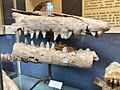
Jaw bones of T. gaudryi
-

Fossil tooth of T. ivoensis
-
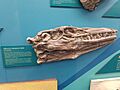
Skull of T. kansasensis
-

Skeleton of T. saskatchewanensis
-
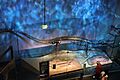
Skull of T. rex
-

Historic 1872 drawing showing an early idea of Tylosaurus
-

Anatomy drawing from 1898
-
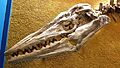
Side view of a T. proriger skull
-
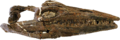
Snout bone showing the rounded tip
-
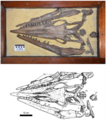
Fossil skull viewed from above
-
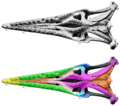
Underside view of the upper skull
-
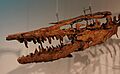
Fossil skull of T. bernardi
-

Ear bones, skull roofs, and teeth of different species
-
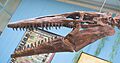
Jaws showing pointed teeth
-
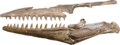
Jaw bones of T. nepaeolicus
-
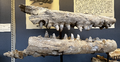
Fossil skull of T. gaudryi
-
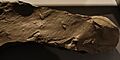
Fossil skin scales of a mosasaur
-
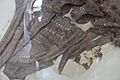
Fossilized airway tubes of the throat
-
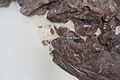
Fossil windpipe section
-
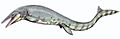
Life restoration of T. pembinensis
-
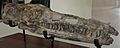
Fossil skull from Mexico
-
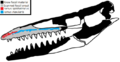
CT scan model of a related mosasaur snout
-
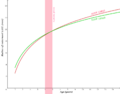
Growth chart showing age and size
-
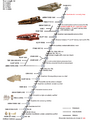
Growth chart for T. proriger
-
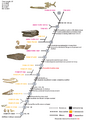
Growth chart for related species
-
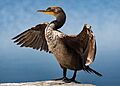
Modern seabirds are warm-blooded like Tylosaurus
-
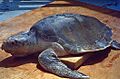
Sea turtles lived alongside mosasaurs
-

Art from 1899 showing Tylosaurus hunting fish
-

Modern art of Tylosaurus catching a plesiosaur
-
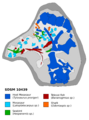
Drawing of fossil belly contents
-
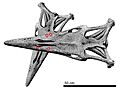
Fossil skull showing healed bite marks
-

Map of the oceans during the Late Cretaceous
-
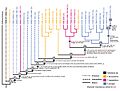
Chart showing how skull traits changed over time


Related pages
- Tylosaurinae
- Taniwhasaurus
- Mosasauridae
See also
 In Spanish: Tylosaurus para niños
