
Wat Arun facts for kids
Quick facts for kids Wat Arun Ratchawararam |
|
|---|---|
|
Temple of Dawn
|
|

The temple, seen from across the river
|
|
| Religion | |
| Affiliation | Theravada Buddhism |
| Location | |
| Country | Thailand |

 Location in Bangkok
|
|
| Architecture | |
| Completed |
|
Wat Arun Ratchawararam, often called the Temple of Dawn, is a famous Buddhist temple in Bangkok, Thailand. It stands proudly on the west bank of the Chao Phraya River. This beautiful temple is one of Thailand's most well-known landmarks. Its name comes from Aruna, a Hindu god linked to the rising sun. The temple's unique main tower, called a prang, was mostly built in the early 1800s. It shows a mix of Hindu and Buddhist art styles.
Contents
What's in a Name?
The name Wat Arun comes from the Hindu god Aruna. Aruna is known as the charioteer of the sun god Surya. This connection gives the temple its nickname, "Temple of Dawn."
A Look Back: Wat Arun's History
A Buddhist temple has stood on this spot since before the 1600s, during the Ayutthaya Kingdom. Back then, it was known as Wat Bang Makok, later shortened to Wat Makok.
When King Taksin made Thonburi his new capital in the late 1700s, he renamed the temple Wat Chaeng. It's said he vowed to fix up the temple after seeing it at dawn. For a time, the famous Emerald Buddha statue was kept here. Later, it was transferred to Wat Phra Kaew on the other side of the river in 1785.
The temple was part of the royal palace grounds during King Taksin's rule. But King Rama I, who followed him, moved the palace. Wat Arun was then left alone for a while.
King Rama II began restoring the temple in the early 1800s. He also planned to make the main tower much taller. This big construction project continued under King Rama III. The main prang was finally finished in 1851, after nine years of work.

In 1858, a French explorer named Henri Mouhot visited Wat Arun. He wrote that its spire, over 200 feet tall, was the first sign of Bangkok for travelers coming up the river.
Later, in 1871, an American explorer, Frank Vincent Jr., also described the temple. He noted its bell shape and tall spire, decorated with colorful broken Chinese cups and plates. These pieces formed pictures of animals and mythical creatures. He also mentioned the beautiful gardens and statues around the temple.
Wat Arun has had several major repairs over the years. A big restoration happened from 2013 to 2017. During this time, many broken tiles were replaced. Some people thought the temple looked too white after this work. However, the Fine Arts Department explained that they were trying to bring back its original look.


.jpg)

Amazing Architecture of Wat Arun
The most striking part of Wat Arun is its central prang, a tall, tower-like spire. This prang is covered with colorful porcelain pieces. These pieces were once used as weights in boats coming from China! The main prang is very tall, reaching between 66 and 86 meters (219 to 282 feet) high.
Four smaller prangs surround the main one. All the towers are decorated with shells and bits of porcelain. Around the base of the main prang, you can see statues of ancient Chinese soldiers and animals. Higher up, there are four statues of the Hindu god Indra riding his three-headed elephant, Erawan.
.jpg)
The central prang has three symbolic levels. The base represents all parts of existence. The middle level stands for a heaven where wishes come true. The very top represents the highest heavens of happiness.
Near the river, there are six Chinese-style pavilions. These pavilions are made of green granite and have small bridges.

Next to the prang is the Ordination Hall. Inside, you'll find a beautiful Buddha image. The entrance to this hall has a roof with a central spire, decorated with colorful ceramics. Two large demon statues, called yaksha, guard the front entrance. The walls inside are covered with murals painted during the time of King Rama V.
Stories and Symbols
The central prang of Wat Arun represents Mount Meru. This is a sacred mountain in Hindu and Buddhist stories, believed to be the center of the universe. The smaller prangs are dedicated to Phra Phai, the wind god.
The giant demon figures, or yaksha, guarding the entrance to the ubosot (main hall) come from the Ramakien. This is Thailand's national epic, based on the Indian story of the Ramayana. The white giant is named Sahassa Deja, and the green one is called Thotsakan. Thotsakan is the demon king Rāvana from the original Ramayana story.
Visiting Wat Arun
You can easily reach Wat Arun by boat on the Chao Phraya River. Ferries cross the river to the Maharaj pier. For visitors from other countries, there is an entrance fee of 200 baht (as of March 2024).
During a special ceremony called Kathina, the king travels to Wat Arun in a grand procession of royal barges. He goes to present new robes to the monks.
In December 2023, Wat Arun was a special location for the Tourism Authority of Thailand’s Vijit Chao Phraya 2023 program. This event featured amazing light and sound shows along the Chao Phraya River.

Gallery
-
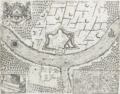
An old French map showing Wat Makok (now Wat Arun) in 1688.
-
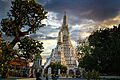
The prang, seen from within the temple grounds (2020)
-
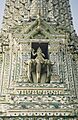
Main prang, Indra seated atop Airavata (2001)
-
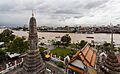
View of the river from the main prang (2013)
-
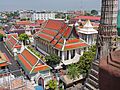
The vihara, seen from the main prang (2014)
-
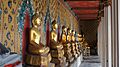
Buddha statues in the cloister (2017)
-
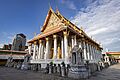
The ordination hall (2025)
-
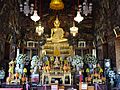
The principal Buddha image, in the ordination hall (2018)
-
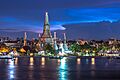
The temple lit up at night (2017)
-
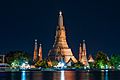
Frontal view of the prang at night (2017)


.jpg)


