
White-banded swallowtail facts for kids
Quick facts for kids White-banded swallowtail |
|
|---|---|
 |
|
Scientific classification  |
|
| Kingdom: | Animalia |
| Phylum: | Arthropoda |
| Class: | Insecta |
| Order: | Lepidoptera |
| Family: | Papilionidae |
| Genus: | Papilio |
| Species: |
P. echerioides
|
| Binomial name | |
| Papilio echerioides Trimen, 1868
|
|
| Script error: The function "autoWithCaption" does not exist. | |
| Synonyms | |
|
|
Script error: No such module "Check for conflicting parameters".
The white-banded swallowtail (scientific name: Papilio echerioides) is a beautiful butterfly. It belongs to a group of butterflies called Papilionidae. You can find this butterfly flying around in Sub-Saharan Africa.
This butterfly has a wingspan of about 65 to 75 millimeters. That's roughly the length of your palm! It usually flies during two main times of the year. The first flight period is from January to March. The second period is later, from September to November.
Contents
About the White-banded Swallowtail
The white-banded swallowtail is known for its striking looks. It's a type of butterfly that can be found in many parts of Africa.
What Does It Look Like?
The male white-banded swallowtail looks a lot like another butterfly, Papilio cynorta. However, the male white-banded swallowtail has a pale yellow band across its wings. This band gets narrower towards the tip of the wing. It also has a light spot on its front wing that is almost always there.
The female white-banded swallowtail is quite special. It can mimic (or copy) the look of other butterflies. It looks similar to Amauris echeria and Amauris albimaculata. This mimicry helps protect it from predators. Its front wings are black with white spots. Its back wings are black with a large, pale yellow area in the middle. They also have white spots near the edges.
Its Life Cycle and Food
Like all butterflies, the white-banded swallowtail starts its life as a larva, also known as a caterpillar. These larvae need specific plants to eat and grow. They feed on plants like Clausena inaequalis and Toddalia asiatica. They also enjoy Zanthoxylum capense and Vepris lanceolata. Interestingly, they can also eat leaves from Citrus trees, like orange or lemon trees.
Family Tree: How It's Related
The white-banded swallowtail, Papilio echerioides, is part of a special group of butterflies. This group is called the echerioides species group. It includes other similar butterflies. Some of these relatives are Papilio fuelleborni and Papilio jacksoni. They all share common features because they are closely related.
Images for kids
-
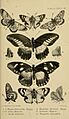
Image that accompanied the original description

