
Widdringtonia facts for kids
Quick facts for kids Widdringtonia |
|
|---|---|
 |
|
| Widdringtonia whytei | |
Scientific classification  |
|
| Unrecognized taxon (fix): | Widdringtonia |
| Type species | |
| Widdringtonia cupressoides (L.) Endl.
|
|
| Species | |
|
|
| Synonyms | |
|
|
Widdringtonia is a special group of conifer evergreen plants. They belong to the famous cypress family, known scientifically as Cupressaceae. People often call these trees African cedars or African cypresses. They are native to the southern parts of Africa. An Austrian botanist named Stephan Endlicher gave this plant group its scientific name. He named it to honor Captain Samuel Edward Widdrington. Captain Widdrington was an early expert who explored conifer forests in Spain.
Contents
What Are Widdringtonia Trees and Shrubs?
These plants grow as large shrubs or tall trees. Most kinds grow between 5 and 20 meters tall. However, one species named Widdringtonia whytei can reach 40 meters high! Young seedlings have needle-like leaves that grow in pretty spirals. As the plant gets older, the leaves change. Adult trees have tiny, scale-like leaves. These leaves grow in pairs that cross each other neatly along the twigs.
How These Conifers Grow Cones and Seeds
These plants produce male and female cones on different parts. The male cones are tiny and sit at the tips of twigs. They hold pollen sacs that blow dust into the wind. Female cones start out small and grow on short branch spikes. Over time, these female cones turn hard, woody, and leathery.
Reproduction and the Secret Power of Wildfire
The cones protect the precious seed inside for many years. Many of these cones stay tightly closed on the branches. They need the extreme heat of a wildfire to pop open. When fire burns through, the cones open up into four thick parts. The fire clears away brush and creates fresh soil. Then, winged seeds fall out and quickly begin to sprout.
Where Do African Cypresses Live?
There are four recognized species in this fascinating conifer group. One species spreads across a huge region, while others live in small spaces. Three of these species are endemic, meaning they grow in only one place.
The Four Remarkable Species
- Widdringtonia nodiflora is the most widespread kind. It grows from southern Malawi all the way to South Africa. It survives fires easily by growing back from its roots.
- Widdringtonia schwarzii grows only in the Baviaanskloof and Kouga Mountains. These rugged peaks stand near Port Elizabeth in the Eastern Cape Province.
- Widdringtonia cedarbergensis lives only in the famous Cederberg Mountains. This mountain area sits just northeast of Cape Town in South Africa.
- Widdringtonia whytei makes its home on the giant Mulanje Massif in Malawi. Unlike its cousins, its cones open without needing a fire.
Close Relatives Across the Ocean
Scientists study how plants travel and change across our planet. The nearest cousins to these African trees live far away in Australia. These cousins are named Callitris and Actinostrobus. You can tell them apart because the Australian cousins have leaves arranged in groups of three.
Useful Wood and Plant Protection
The wood from these trees smells pleasant and has a light weight. It resists rot and insects, which makes it great for building items. People historically used the timber for furniture, wall panels, and strong fence posts. Wood from Widdringtonia whytei was very popular because the trunks were so tall. Because people cut down so many, it became endangered. Today, forest protectors work hard to save these rare ancient trees from disappearing.
Images for kids
-
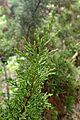
Mountain cypress branch with leaves
-
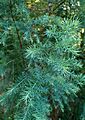
The Willowmore cedar growing outdoors
-
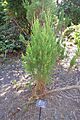
Clanwilliam cedar foliage


_-_Mendocino_Coast_Botanical_Gardens_-_DSC02048.JPG)
