
William Bambridge facts for kids
Quick facts for kids
William Bambridge
|
|
|---|---|
| Born | 24 October 1819 |
| Died | 1 May 1879 (aged 59) |
| Nationality | British |
| Known for | Royal photographer |
| Children | Arthur Bambridge Charles Bambridge Ernest Bambridge George Bambridge |
| Parent(s) | George White Bambridge and his second wife Harriet |

William Samuel Bambridge (born October 24, 1819 – died May 1, 1879) was a talented school teacher. He traveled to New Zealand as part of a special mission. Later, he returned to England and became a famous photographer for Queen Victoria. Interestingly, three of his sons grew up to become international footballers for the England team.
Contents
William Bambridge: Teacher, Missionary, and Royal Photographer
William Bambridge was born in Windsor, Berkshire, England. His father, George White Bambridge, was a professional flautist, meaning he played the flute for a living. William was the second son from his father's second marriage.
Life as a Missionary Teacher
In November 1841, William Bambridge married Sophia Thorington. William had trained to be a teacher. Soon after, he was asked to join a mission to New Zealand. This mission was led by George Augustus Selwyn, who was becoming the first bishop for New Zealand. Many people from the Windsor area, including William, joined the group.
The missionary team, with 23 members, left England in December 1841. They sailed on a ship called the Tomatin. After a long journey, they arrived in Auckland, New Zealand, in May 1842. From there, they traveled to the Bay of Islands.
Bishop Selwyn decided to set up the main mission at Waimate Mission Station. This was about 15 kilometers inland from Paihia. The plan was to create a center for the Anglican Church in New Zealand. It would include a school, farming, and workshops. William Bambridge spent his days teaching at the school. He taught reading, writing, math, drawing, singing, and religious studies. He was known for his beautiful handwriting and drawing skills.
William was also a skilled musician, just like his father. He played the flute and entertained the missionaries with chamber music. He was also a talented artist. He drew and painted pictures of the mission buildings, the people, and the beautiful scenery.
While in New Zealand, William and Sophia had two children: William Samuel (born 1842) and George Frederic (born 1844).
In 1844, the mission moved south to Tamaki, near Auckland. William and Sophia had their third child, Sophia Esther, there in 1846. However, Sophia found life in the mission very difficult. She really wanted to return to England. Eventually, Bishop Selwyn allowed the Bambridge family to leave. They sailed back to England in December 1847, arriving in May 1848.
Becoming a Royal Photographer
Soon after returning to England, William Bambridge started working at the studio of William Fox Talbot. This studio was located at Windsor Castle. In 1854, William Bambridge received a very special job: he was appointed the Royal Photographer to Queen Victoria. He worked for the Queen for 14 years.
William took many photographs of the Royal family and their pets. He also captured images of still life and scenes from Royal hunts. Many of his photographs are now kept in the Royal Collection. He used a special photography method called the wet collodion process. This method used glass plates to create negatives.
One famous photograph he took was a portrait of Hare Pomare. Hare Pomare was a Māori chief visiting Windsor. During his visit, his wife gave birth to a child. Queen Victoria became the child's godmother at the christening. The child was named Albert Victor Pomare. William Bambridge was there to photograph this special event.
William Bambridge passed away in Wandsworth, London, in May 1879. He was buried in Clewer churchyard.
His Footballer Sons
William and Sophia Bambridge had six children. Their three youngest sons were all born in Windsor between 1849 and 1861. All of these sons loved football.
Their first son, William Samuel, became a Professor of Music. He was also an organist at Marlborough College. He even named his home "The Waimate" after the mission station in New Zealand. He wrote a letter about problems with local football rules. This letter helped the the Football Association create one set of rules for football in 1877.
His second son, George Frederic, became a secretary to Prince Alfred, the Duke of Edinburgh. George Frederic's son, George Louis St Clair Bambridge, married Elsie, who was the daughter of the famous writer Rudyard Kipling.
The three youngest sons all played for a local football team called Swifts. From there, they were chosen to play for the England national team.
- The oldest of the three, Ernest, played only once for England.
- His younger brother, Charles, played 18 times for England. He was the first player to score ten international goals for England. He was also England's captain twice.
- The youngest brother, Arthur, played 3 times for England.
Images for kids
-
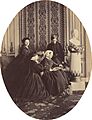
Queen Victoria in Mourning
