
Zera Luther Tanner facts for kids
Quick facts for kids
Zera Luther Tanner
|
|
|---|---|

Captain Zera L. Tanner
|
|
| Born | December 5, 1835 Warsaw, New York |
| Died | December 16, 1906 (aged 71) Washington, D.C. |
| Buried | |
| Allegiance |  United States United States |
| Service/ |
United States Navy |
| Years of service | 1868–1897 |
| Rank | .png) Captain Captain |
| Commands held | USFC Fish Hawk USFC Albatross |
| Signature | .png) |
Zera Luther Tanner (born December 5, 1835 – died December 16, 1906) was an American naval officer. He was also an inventor and an oceanographer, someone who studies the ocean. Tanner created a special system to measure ocean depths. He also wrote books about hydrography, which is the science of mapping water bodies. He retired from the United States Navy in 1897 as a commander.
Contents
Zera Luther Tanner was born in Warsaw, New York, in 1835. His father passed away when Zera was only one year old. Young Zera worked on family farms until he was a teenager. Later, he became an apprentice to a mechanic.
In 1855, Tanner traveled by ship to Great Britain. Because he wasn't feeling well, he decided to take a longer sea trip. In 1856, he sailed from Liverpool to Bombay, India, on a ship called SS Culloden. After two round trips, where he served as a third officer on one, Tanner chose sailing as his career.
He returned to the United States and served on American merchant ships. He also helped move troops by sea in the Gulf of Mexico.
Serving in the Civil War
Tanner decided to join the government service. In the summer of 1862, he became an acting ensign in the Union Navy. During the American Civil War, Tanner served on the bark USS Midnight and the supply steamer USS Rhode Island.
In December 1864, his ship Rhode Island captured a British ship that was trying to sneak past a blockade. Tanner was put in charge of the captured ship. In 1865, during the Second Battle of Fort Fisher, Tanner led the boats from his vessel. These boats helped land Union soldiers on the ground.
After the War: Ocean Exploration
Tanner officially joined the United States Navy in 1868. Until he retired in 1897, he worked for the navy. He was involved in mapping the ocean floor and dredging (clearing out waterways). He often worked with the United States Fish Commission.
Tanner helped design and supervise the building of two important ships for the commission.
- USFC Fish Hawk was in service from 1880 to 1926. It was the first large ship built especially to help with fisheries. This smaller ship was used in coastal waters. It mainly served as a mobile fish hatchery, but it also did research on fish.
- USFC Albatross was a research ship from 1882 to 1921. It was the first full-sized ship designed mainly for marine research.
Tanner was the first commanding officer of the Fish Hawk from 1882 to 1885. He then commanded the Albatross for nine years. During this time, he took the famous naturalist Alexander Emanuel Agassiz on a voyage to the Galápagos Islands in 1891.
Tanner was promoted to commander in 1893. He left command of the Albatross in 1894. He retired from the Navy on December 5, 1897, when he reached the mandatory retirement age of 62.
Inventions and Legacy
Tanner passed away in Washington, D.C., on December 16, 1906, at age 71. He was buried with military honors at Arlington National Cemetery.
Tanner created a better way to measure ocean depths. He used instruments that he designed himself. He received a patent for his system in 1899. It was called the Tanner navigational sounding apparatus.
Two U.S. Navy ships have been named after Tanner:
- After World War II, the ship USS Pamina (AKA-34) was used for oceanographic survey work. It was renamed USS Tanner (AGS-15). This ship spent its time mapping important coastlines and was retired in 1969.
- In 1990, USNS Tanner (T-AGS-40) was built for the U.S. Navy. It was a fast ship for oceanographic research. Today, it is named TS State of Maine and serves as a training ship for the Maine Maritime Academy.
Images for kids
-
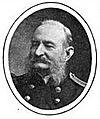
Before 1902

Selected Works
- Deep-sea exploration: a general description of the steamer Albatross, her appliances and methods
