
AIM-9 Sidewinder facts for kids
Quick facts for kids AIM-9 Sidewinder |
|
|---|---|

AIM-9L/I-1
|
|
| Type | Short-range air-to-air missile |
| Place of origin | United States |
| Service history | |
| Used by | See Operators |
| Production history | |
| Manufacturer | Raytheon Company Ford Aerospace |
| Specifications | |
| Mass | 188 pounds (85.3 kg) |
| Length | 9 feet 11 inches (3.02 m) |
| Diameter | 5 in (127.0 mm) |
|
Detonation
mechanism |
IR proximity fuze |
|
|
|
| Engine | Hercules/Bermite Mk. 36 solid-fuel rocket |
| Wingspan | 11 in (279.4 mm) |
|
Operational
range |
0.6 to 22 miles (1.0 to 35.4 km) |
| Maximum speed | Mach 2.5+ |
|
Guidance
system |
Infrared homing |
The AIM-9 Sidewinder is a famous air-to-air missile carried by fighter planes. It joined the United States Navy in 1956 and the United States Air Force in 1964. It is one of the oldest and most successful air-to-air missiles ever built. Over 110,000 Sidewinders have been produced for many countries around the world.
Contents
How the Sidewinder Missile Works
Finding Heat Like a Snake

The missile gets its name from the sidewinder rattlesnake, which senses body warmth to hunt. In the same way, the missile uses infrared guidance to track hot engine exhaust from aircraft. When pilots launch this heat-seeking weapon, they call out the brevity code "Fox two".
Older models could follow an airplane only from directly behind. Later versions added special liquid nitrogen coolers. These cool detectors let the missile spot faint friction heat on any part of a flying airplane.
Steering and Flying Straight

The rocket uses a solid rocket motor that burns quickly to reach speeds over Mach 2.5. Tiny wings called canards on the nose steer the missile smoothly. Instead of complex steering motors, the tail fins use spinning metal wheels called rollerons. As air rushes past, these wheels spin rapidly to provide gyroscopic balance that keeps the body from rolling.
To guide itself toward a moving target, the missile uses proportional pursuit. It tracks the change in angle toward the target aircraft instead of flying straight toward where the target used to be.
History and Upgrades
Invention in the Desert

An engineer named William B. McLean began designing the rocket in the late 1940s. He worked at the US Naval Weapons Center at China Lake in California. The original AIM-9A model first flew in 1953. In 1958, an unexploded missile was examined by Soviet engineers to create their own version, called the K-13.
The Advanced AIM-9X Model

Modern fighter jets like the F-15C, F/A-18C, and F-35 Lightning II carry the advanced AIM-9X. This version uses an imaging infrared camera and thrust vectoring nozzles. A pilot wearing a special display helmet can guide the missile just by looking at a target.
Images for kids
-
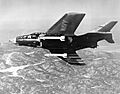
An F9F-8 Cougar carrying early Sidewinders in 1956
-

An F-104 firing an AIM-9 Sidewinder at a target drone
-
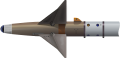
Diagram of the seeker and fuze parts of the AIM-9L
-
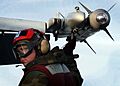
Preparing an AIM-9X on an F/A-18C Hornet
-
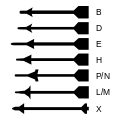
Different models of the Sidewinder missile over time
-
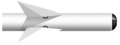
AIM-9B model
-
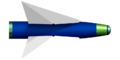
AIM-9D model
-
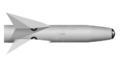
AIM-9E model
-
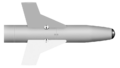
AIM-9J model
-
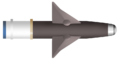
AIM-9M model
-
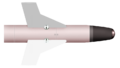
AIM-9P model
-

An F-4B Phantom carrying AIM-9D missiles on an aircraft carrier
-

Testing a missile against a tank target in 1971
-

Map showing countries that use the Sidewinder
-
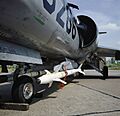
Dutch F-104G carrying AIM-9J missiles in 1979


See also
 In Spanish: AIM-9 Sidewinder para niños
