
Action of 16 March 1917 facts for kids
Quick facts for kids Action of 16 March 1917 |
|||||||
|---|---|---|---|---|---|---|---|
| Part of The First World War | |||||||
 Achilles |
|||||||
|
|||||||
| Belligerents | |||||||
 United Kingdom United Kingdom |
 Germany Germany |
||||||
| Commanders and leaders | |||||||
 Francis Martin-Leake Francis Martin-Leake |
 Hans von Laffert † Hans von Laffert † |
||||||
| Strength | |||||||
| 1 armoured cruiser 1 armed boarding steamer |
1 auxiliary cruiser | ||||||
| Casualties and losses | |||||||
| 6 killed | 319 killed auxiliary cruiser sunk |
||||||
The Action of 16 March 1917 was a naval battle during the First World War. It happened when two British ships, the armed boarding steamer SS Dundee and the armoured cruiser HMS Achilles, fought a German ship called SMS Leopard. The Leopard was sunk, and sadly, all 319 people on board died. Six British sailors from a boarding party also lost their lives.
| Top - 0-9 A B C D E F G H I J K L M N O P Q R S T U V W X Y Z |
The German Raider Leopard
From Captured Ship to Warship
The German ship Leopard had an interesting past. It used to be a British merchant ship named Yarrowdale. In 1916, a German commerce raider (a warship that attacks merchant ships) called Möwe captured the Yarrowdale. The Yarrowdale was then taken to Germany.
The German navy decided to turn Yarrowdale into a warship. They added guns from old ships and two torpedo tubes. This new warship was named SMS Leopard. Its captain was Hans von Laffert. In early March 1917, the Leopard sailed out to replace the Möwe in attacking enemy merchant ships.
A Secret Mission Begins
The Leopard was disguised as a Norwegian cargo ship named Rena Norge. This was to trick British patrols. The German navy gave Captain Laffert a lot of information about where British ships were. They got this information by secretly reading British wireless messages.
However, on March 10, the Germans found out that the British had changed their secret code. This meant they could no longer read the British messages. Captain Laffert was told to wait, but he decided to continue his mission anyway. He sailed the Leopard into the North Sea.
The British Northern Patrol
Guarding the Seas
During World War I, the British had a group of ships called the Northern Patrol. Their job was to check neutral ships entering or leaving the North Sea. They also watched for German commerce raiders trying to sneak into the Atlantic Ocean.
In March 1916, Admiral John Jellicoe, who led the British Grand Fleet, made the Northern Patrol stronger. He wanted to make sure that German raiders could not get through. By early 1917, there were three cruisers and three armed boarding steamers on patrol at all times.

The Patrol on March 16
On March 11, 1917, Rear-Admiral Sir Sydney Fremantle ordered ships of the 2nd Cruiser Squadron to patrol north of the Shetland Isles. Among these ships were HMS Achilles, commanded by Francis Martin-Leake, and the armed boarding steamer SS Dundee, led by Selwyn Day.
The weather was cold and stormy, with snow and freezing rain. The patrols had been quiet for several days. But on March 16, the day they were supposed to be relieved, something happened. Around noon, a ship was spotted to the east of Achilles.
The Chase Begins
A Suspicious Ship
Captain Leake of Achilles told Dundee to follow him, and they turned towards the unknown ship. It took about two hours for Achilles to catch up. Leake signaled the ship to stop. He then told Captain Day of Dundee to send a team to inspect it.
Captain Day became suspicious. The ship flew a Norwegian flag and was named Rena, but it had a large "N" painted upside-down on its hull. It also looked much bigger than the ship listed in shipping records. It had also been sailing very fast for a merchant ship.
The Boarding Party
A British officer named Lieutenant Frederick Lawson volunteered to lead the boarding party. At 2:45 p.m., the boarding party rowed over to the mysterious ship. They went out of sight as they went around to its side.
Captain Day kept Dundee in a good position, ready to fire its guns. He knew that if the other ship fired first, it could sink Dundee very quickly. After a few minutes, Day noticed the merchant ship was slowly turning. At 3:40 p.m., the fake Norwegian flag painted on the side of the ship suddenly fell off into the water.
The Battle

Dundee Opens Fire
Captain Day immediately ordered his gun crews to fire. Shells from Dundee hit the Leopard from behind at very close range. Smoke and steam rose from the German ship. Almost at the same time, two torpedoes from Leopard narrowly missed Dundee.
Achilles was about 4 miles away, so Dundee was in great danger. Leopard started to move, but Day skillfully moved Dundee past its stern. Dundee fired its 4-inch guns and a smaller 3-pounder gun at the Leopard. The 3-pounder hit the Leopard's bridge many times, possibly killing the crew there early on.
Achilles Joins In
About five minutes after Dundee started firing, Achilles also opened fire on the Leopard. The German ship fired back, but its aim was poor. Soon, Dundee was safely behind Achilles.
The battle continued for about an hour. The heavy shells from Achilles caused big explosions and fires on Leopard. Dundee eventually stopped firing because it ran out of ammunition. When Leopard began to sink, it was still firing its guns.
The Sinking of Leopard
A little after 4:30 p.m., the Leopard sank completely. All 319 people on board died, including Captain Laffert. The six British sailors from the boarding party were also killed. The British ships did not search for survivors because they were worried about German submarines in the area.
Aftermath
Losses
The battle was a British victory, but it came at a cost. All 319 German sailors on the Leopard died. The six British sailors who had boarded the Leopard were also killed. The British ships suffered only minor damage.
Later Events
For six days after the battle, no other ships were reported missing. Then, on March 22, a neutral ship reported that it had been stopped by another German raider, the sailing ship SMS Seeadler, on February 25.
See Also
- German commerce raiders in World War I
- Northern Patrol
Images for kids
-
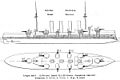
Right elevation and plan view from Brassey's Naval Annual of the Warrior class; the shaded areas show armour.

