
Action of 24 October 1793 facts for kids
Quick facts for kids Action of 24 October 1793 |
|||||||
|---|---|---|---|---|---|---|---|
| Part of the French Revolutionary Wars | |||||||

 Map of the region, the approximate location of the action marked in red |
|||||||
|
|||||||
| Belligerents | |||||||
 France France |
 Great Britain Great Britain |
||||||
| Commanders and leaders | |||||||
 Jean-François Tartu † Zacharie Allemand Jean-François Tartu † Zacharie Allemand |
 James Cotes James Cotes |
||||||
| Strength | |||||||
| 4 frigates 1 brig |
1 frigate | ||||||
| Casualties and losses | |||||||
| 4 killed 7 wounded |
13 killed 21 wounded 1 frigate captured |
||||||
The Action of 24 October 1793 was a small naval battle during the early French Revolutionary Wars. It happened in the Bay of Biscay, a large bay off the coast of France and Spain. A British warship, HMS Thames, met a larger French warship, Uranie.
The two ships fought for almost four hours. Both were badly damaged. The British captain, James Cotes, wanted to keep fighting. But the French captain, Jean-François Tartu, was killed. His crew decided to leave the battle. While the Thames was making repairs, a group of French warships arrived. Captain Cotes had no choice but to surrender his ship. The French captain, Zacharie Allemand, praised Cotes for his brave fight.
The French took the Thames to Brest. The British officers were held as prisoners for two years. The French Navy used the Thames and renamed it Tamise. The Uranie was also renamed Tartu to honor its dead captain. Both ships were later captured by the British in separate battles in 1796.
Contents
Why This Battle Happened
France and Britain Go to War
In 1793, France and Great Britain went to war. This started the French Revolutionary Wars. At sea, the Bay of Biscay became a busy area. French ships, called privateers, attacked British merchant ships. These were trading ships, not warships.
The French Navy also sent groups of warships, called frigates, to attack British trade routes. To stop these attacks, the British Royal Navy sent their own frigates. Sometimes they sailed in groups, and sometimes alone.
French Squadron on Patrol
In the autumn of 1793, a French frigate group was sailing in the Bay of Biscay. This group was led by Captain Zacharie Allemand. It included the frigates Carmagnole, Résolue, Sémillante, and Uranie. They also had a smaller ship called a brig-corvette, the Espiègle.
On October 22, the French group saw a Spanish brig. Captain Allemand told Uranie, led by Captain Jean-François Tartu, to chase it. Uranie easily captured the Spanish brig, named Alcoudia. They put a small crew on the Alcoudia to sail it. They also took the Spanish sailors onto Uranie as prisoners.
Meeting of Two Ships
Two days later, on October 24, Uranie was sailing south with the captured Alcoudia. At 9:30 AM, they saw another ship to the north. This ship was HMS Thames, a British frigate. It was on patrol alone.
The Thames was an older ship, built in 1758. It had 32 guns. It also had fewer sailors than it should have, only 184 instead of 215. This meant some of its smaller guns could not be used.
The Uranie was much newer, built in 1788. It was also much larger, almost twice the weight of the Thames. It carried 40 guns. It normally had 260 sailors. But it had sent 60 sailors to other captured ships. It also had over 260 prisoners on board.
At first, Captain Tartu of Uranie wasn't sure if the ship was an enemy. He raised a blue flag as a signal. He also sent the captured Alcoudia away, just in case. Captain Cotes of Thames did not respond to the signal. Soon, a rain shower hid the two ships from each other.
The Battle Begins

At 10:15 AM, the rain stopped. Both ships could see each other clearly. Both captains realized the other ship was an enemy. They prepared their ships for battle. Captain Tartu raised the French flag.
The two frigates quickly sailed towards each other. Uranie fired first, shooting all the guns on one side of its ship. This is called a broadside. Then, Uranie turned to sail alongside Thames.
The two ships were now side-by-side. They began a close fight, firing broadside after broadside. At 12:15 PM, a cannonball hit Uranie's deck. It killed a sailor and badly wounded Captain Tartu. He was taken below deck, and Lieutenant Wuibert took command.
The battle continued for several hours. At 2:20 PM, Uranie managed to pull ahead of Thames. It fired several broadsides into the front of the British ship. This is called raking fire and causes a lot of damage.
Some reports say the French tried to board the Thames. This means they tried to send their sailors onto the British ship to fight hand-to-hand. But the British fired their front guns, stopping the attempt. However, the French report says no boarding was tried.
After the Fight
Damage and Retreat
After the close fight, Uranie pulled back. Captain Tartu, who was dying, had ordered his ship to retreat. He was worried his prisoners might try to escape. He also thought he saw two British warships in the distance.
The crew of Thames thought the French ship was giving up. They cheered as the firing stopped. But Captain Cotes knew the battle might start again. He ordered his crew to quickly repair their ship. The Thames was too damaged to chase Uranie.
All three of Thames' masts were damaged. Most of the ropes and sails were torn. The ship's body was also badly hit. Thirty-four British sailors were killed or wounded. Uranie was also in bad shape. Its masts were damaged, and it had many holes in its hull. The French crew was pumping water, meaning the ship was leaking.
Captain Cotes pushed his men to repair the Thames quickly. They were so busy that they didn't notice Uranie had disappeared. Some on the British ship thought Uranie had sunk. But it had simply sailed away to get back to Rochefort for repairs.
Then, more ships appeared in the distance. They quickly came closer. At first, they looked like British ships. But Captain Cotes soon realized they were French warships. The lead French frigate fired a broadside at Thames. Captain Cotes immediately announced that he could not fight. He lowered his flag, which meant he was surrendering.
Aftermath and Fate of the Ships
Captain Allemand asked Captain Cotes to come aboard his ship, Carmagnole. Cotes said his small boats were destroyed. So, Allemand sent a boat to pick up Cotes. Cotes used this time to destroy his ship's important papers.
Allemand asked Cotes many questions about the battle. When he learned it was Uranie that Cotes had fought, he said Captain Tartu should have won much faster.
The Thames was taken to Brest with Allemand's group. During the trip, French sailors took things from the British ship. The British wounded did not get medical help until they reached Brest. Two more British sailors died there, making the total 13 killed and 21 wounded.
Captain Cotes later wrote a report about the battle. He was held as a prisoner in France. The French delayed his report, so Britain didn't hear about the Thames' fate until May 1794. Cotes was later exchanged for a French prisoner and returned to Britain. A naval hearing cleared him of any blame for losing his ship. Some of his officers remained prisoners for two more years.
Uranie lost four sailors, including Captain Tartu, and had seven wounded. It arrived at Rochefort and was renamed Tartu to honor its captain. The Thames was taken into French service and renamed Tamise.
Both French frigates were lost in 1796. The British ship HMS Santa Margarita recaptured Tamise in June 1796. Six months later, the British warship HMS Polyphemus captured Tartu in December 1796.
Images for kids
-
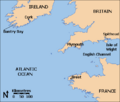
Map of the region, the approximate location of the action marked in red
