
Althaea officinalis facts for kids
Quick facts for kids Althaea officinalis |
|
|---|---|
 |
|
Scientific classification  |
|
| Kingdom: | Plantae |
| Clade: | Tracheophytes |
| Clade: | Angiosperms |
| Clade: | Eudicots |
| Clade: | Rosids |
| Order: | Malvales |
| Family: | Malvaceae |
| Genus: | Althaea |
| Species: |
A. officinalis
|
| Binomial name | |
| Althaea officinalis |
|
| Script error: The function "autoWithCaption" does not exist. | |
| Synonyms | |
|
|
Script error: No such module "Check for conflicting parameters".

The Marsh Mallow, known scientifically as Althaea officinalis, is a beautiful flowering plant. It grows naturally in Europe, Western Asia, and North Africa. People have used this plant for a long time in traditional remedies and also grow it in gardens because it looks nice.
Contents
Discovering the Marsh Mallow Plant
The Marsh Mallow is a plant that lives for many years, which we call a perennial. It can grow quite tall, up to about 180 centimeters (6 feet)! It usually has only a few side branches. The entire plant feels soft and fuzzy, especially its leaves. These leaves are shaped like wide triangles or ovals. They often have 3 to 5 small, rounded sections, and their edges are a bit jagged. The leaves can be up to 100 millimeters (4 inches) long and 75 millimeters (3 inches) wide. They grow one after another along the stem.
Flowers and Fruits
Marsh Mallow flowers grow in clusters where the leaves meet the stem, and also at the very top of the plant. These flowers are usually lilac or pink and have 5 petals, each about 2 centimeters long. They also have 5 green sepals, which are much shorter than the petals and joined at the bottom. Underneath the petals, there's a small, cup-shaped part with 6 to 9 tiny, triangular sections. The purple stamens, which hold the pollen, are joined together like a tube.
The Marsh Mallow blooms in August and September. After the flowers fade, they produce flat, round fruits. These fruits are often called "cheeses" because of their shape! Each fruit is about 1 centimeter across and breaks apart into about 20 small, kidney-shaped seeds. These seeds are tiny, only about 2 millimeters long.
It's easy to confuse the true Marsh Mallow with the common mallow. You can tell the real Marsh Mallow apart by its fuzzy stems and leaves, and its pale, blush-colored flowers. Its roots are thick, long, and strong. They are yellowish-white on the outside and white and stringy inside.
How We Use Marsh Mallow
Marsh Mallow in Your Garden
People often grow Marsh Mallow plants in their gardens. They are popular ornamental plants because of their pretty flowers and soft, green leaves.
Marsh Mallow in Traditional Remedies

For a very long time, people have used the leaves, flowers, and roots of the Marsh Mallow plant in traditional remedies. In fact, its scientific name, Althaea, comes from a Greek word that means "to heal." The word officinalis in its name also tells us that it has been used for health or cooking. Traditionally, Marsh Mallow was used to soothe irritated parts of the body, like the lining of the mouth and throat. It was sometimes used as a gargle for sore throats or to help with stomach discomfort.
Marsh Mallow in the Kitchen
Did you know you can eat parts of the Marsh Mallow plant? The young leaves can be cooked, and the flower buds can be pickled. The roots can be boiled and then fried with onions and butter to make a tasty dish. You can also peel, slice, boil, and sweeten the roots to create a type of candy! Even the water used to boil the plant can be helpful. It can be used as a substitute for egg whites in some recipes. Long ago, many types of mallow plants, including Marsh Mallow, were common foods. The ancient Romans enjoyed mallow as a vegetable and even considered a dish made with it a special treat!
Marsh Mallow Photo Gallery
-
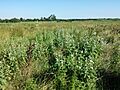
Typically upright and somewhat broad (Austria)
-
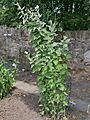
Very tall, narrow example (Germany)
-
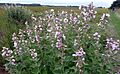
Typical appearance in flower, closer, showing pale clustered flowers with purple centres (England)
-
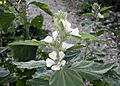
Pale clustered flowers with purple centres and velvety leaves with recessed veins
-
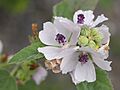
Flower cluster showing purple anthers and stigmas (Canada)
-
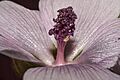
Filaments join into a column, showing purple anthers and (when zoomed) purple pollen spheres
-
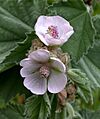
Flowers, showing purple anthers when unopened (England)
-
Unopened flower buds from side, showing epicalyces at bud (calyx) bases and velvety plant stem (England)
-
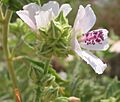
Unopened flower buds from above, showing tips of epicalyces that are at bud (calyx) base
-
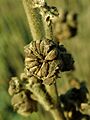
Fruits, showing hairs on smooth fruit surface
-
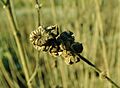
Fruits, showing a cluster
-
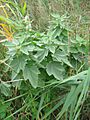
Velvety leaves (Germany)
-
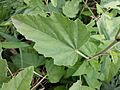
Leaf, velvety (here slightly)


,_Guilford,_CT_(42861186434).jpg)


.jpg)


