
Andean flamingo facts for kids
Quick facts for kids Andean flamingo |
|
|---|---|
 |
|
| At WWT Slimbridge, Gloucestershire | |
| Conservation status | |
Scientific classification  |
|
| Kingdom: | Animalia |
| Phylum: | Chordata |
| Class: | Aves |
| Order: | Phoenicopteriformes |
| Family: | Phoenicopteridae |
| Genus: | Phoenicoparrus |
| Species: |
P. andinus
|
| Binomial name | |
| Phoenicoparrus andinus (Philippi, 1854)
|
|
 |
|
| Range map Non-Breeding Year-round Breeding | |
| Script error: The function "autoWithCaption" does not exist. | |
| Synonyms | |
|
|
Script error: No such module "Check for conflicting parameters".
_06.jpg)
The Andean flamingo (Phoenicoparrus andinus) is a beautiful bird found in the high Andes mountains of South America. It's a type of flamingo that lives alongside its relatives, the James's flamingo and the Chilean flamingo. These flamingos often live together in large groups called colonies, even sharing places where they build their nests.
Contents
Discover the Andean Flamingo
The Andean flamingo stands out from other flamingos. It has a special beak designed for feeding. This bird is the biggest flamingo living in the Andes mountains. It's also one of the heaviest flamingos in the world. These flamingos can weigh from about 1.5 to 4.9 kilograms (3.3 to 10.8 pounds). They can stand between 1 and 1.4 meters (3 to 4.6 feet) tall. Their wings can spread wide, from 1.4 to 1.6 meters (4.6 to 5.2 feet).
Andean flamingos have a soft pale pink body. Their lower neck, chest, and wing feathers are a brighter pink color. A unique feature is their bright yellow legs and feet, which have three toes. Their beak starts pale yellow near their head. Most of the beak is black and curves downwards, helping them to eat.
What Does an Andean Flamingo Look Like?
Young and Adult Plumage
Young Andean flamingos, called juveniles, look different from adults. They have soft pale gray feathers all over. Their head and neck might be a bit darker gray. As they grow up, their feathers change. Adult flamingos become pale pink. The feathers on their lower neck and chest turn a much brighter pink. Their head and upper neck can also be brighter pink. When their wings are folded, you can see a clear black triangle. This comes from their black flight feathers.
Ancient Flamingo History
Scientists have found ancient bones of Andean flamingos. These fossils were discovered near the Salar de Atacama. They are about 2,200 to 3,000 years old. These findings show that flamingos lived in this area long ago. The climate back then was similar to what it is today.
How Do Andean Flamingos Live?
What Do Flamingos Eat?
Andean flamingos are filter feeders. This means they strain tiny food particles from the water. Their diet includes many things, from small fish and insects to tiny algae.
They often feed at the bottom of shallow, salty lakes. They mainly look for tiny plant-like organisms called diatoms. Their special beak helps them do this. It works like a filter, letting water out and keeping the food inside. Andean flamingos are very adaptable in how they search for food.
When they are with other flamingo species, they can change their feeding style. If they are with Chilean flamingos, they might feed in deeper water. If they are with James's flamingos, they might feed closer to the edges of the lake. Scientists are still learning more about their feeding habits.
Flamingo Sounds
We don't know much about how Andean flamingos communicate. But recordings show they make three main types of sounds. One is a high-pitched, short 'peep' sound. They often make a quick series of these notes. Another sound is a rough, nasal 'quack' or 'honk'. You might hear this when they are flying. They also make a quiet, 'chuckle' sound. This call is softer and faster than their 'quack' notes.
Where Do Andean Flamingos Live?
Andean flamingos live in the high Andes mountains. You can find them in wetlands from southern Peru down to northwestern Argentina and northern Chile. These flamingos are migratory birds. They can fly very long distances, sometimes up to 700 miles in a single day!
During the summer, they live in salty lakes. When winter comes, they move to lower wetlands. This move might be because the salt flats become very dry in winter. Scientists are still learning about their exact migration routes. They think flamingos travel between their nesting areas in Chile and wetlands in central and western Argentina.
Most Andean flamingos have their babies in northern Chile, southwestern Bolivia, and northwestern Argentina. When it's not breeding season, some stay in the same wetlands. Others travel to lower lakes and wetlands. They can go as far east as Argentina's central plains. They also travel north through the Andes to southern Peru. Sometimes, they are seen in places like coastal Peru, northern Chile, and even parts of Brazil.

Protecting the Andean Flamingo
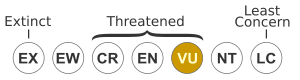
The Andean flamingo is a vulnerable species. This means it needs our help to survive. Its home is changing because of mining and other human activities.
Challenges from Mining
Human activities are constantly changing the homes of Andean flamingos. A big problem is mining, especially for minerals like boron (found in borax) and lithium. These mining activities often happen when the flamingos are trying to have their babies.
Borax can be harmful to animals, even if it doesn't affect humans in the same way. Studies show that too much boron can cause health problems for flamingos. It can affect their bones and hearts. It can also make it harder for them to have healthy chicks.
Mining operations sometimes set up very close to where flamingos nest. If mining starts near their nests, flamingos might leave their eggs. Searching for oil and gas also makes it harder for them to successfully raise young. Very few young flamingos are seen in these areas.
Mining can also make the lake muddy. This can trap flamingos and lead to more deaths. People living near mining sites have even reported seeing dead flamingos uncovered by bulldozers.
The extraction process also affects the water. Andean flamingos need clean surface water to filter for food. Borax mining can pollute this water. It also dries up the lakes faster. Less water means less food for the flamingos. This makes it very hard for them to survive and have babies.
In Argentina, many lithium mining projects are happening in areas where flamingos live. Experts are worried about how this affects the flamingos' ability to reproduce and find food. Because of these threats, the Andean flamingo is listed as a "vulnerable" species.
Human Activities and Their Impact
Besides mining, other human activities also harm flamingos. People sometimes collect flamingo eggs from their nests. This illegal activity has grown because of demand for eggs in other countries. Groups illegally trap flamingos and send them overseas. Local families also sometimes take eggs during nesting season. Taking eggs can make flamingos abandon their nests. This happens even if some eggs are left behind. People in these areas usually raise animals like llamas and alpacas. These animals provide more food than flamingo eggs.
Too much tourism that isn't managed well also hurts flamingo homes. Over time, peat bogs can grow and spill into the lakes. These bogs reduce the water surface. This makes it harder for flamingos to get into the lake to feed.
New roads and buildings are also being built in the Andes. These roads make it easier for more mining and tourism to happen. This further harms the flamingos. These new developments break up the lake areas. This reduces the variety of life there. It also increases the risk of many species disappearing.
In the last 20 years, there has been more demand for water, energy, and transport. Tourism has also grown a lot. These changes are especially noticeable in Chile, where many Andean flamingos have their babies. These areas now have more harmful chemicals from mineral and oil exploration. Since the 1980s, fewer flamingo colonies have successfully raised chicks. This is why the Andean flamingo is a threatened species.
Working to Save Flamingos
The International Union for Conservation of Nature and Natural Resources (IUCN) listed the Andean flamingo as "vulnerable" in September 2010. This means it is now protected under the Endangered Species Act of 1973. Many areas where flamingos live are now national parks. However, some important breeding grounds are still not fully protected. This leaves them open to problems that reduce the flamingo population.
Since the Andean flamingo was recently added to the endangered species list, new plans are being made to protect them. The National Institution of Natural Resources (http://www.nri.org/) is working on a plan. They are teaming up with conservationists to solve problems like borate mining and egg collecting. Part of their plan is to teach people about these issues. This includes business owners, workers, and local villagers. Local authorities at Salinas Lake have set up a station to stop illegal actions. They also look for solutions to current problems. Creating national parks has helped reduce egg collecting. But educating everyone is still very important to stop this activity completely.
The Flamingo Specialist Group, started in 1971, works hard to tell people about how vulnerable flamingos are. They publish a newsletter each year about the status of different flamingo species. In 2000, they counted fewer than 34,000 Andean flamingos. This made them the rarest flamingo species. This group has now joined with the IUCN to create a plan to protect all six flamingo species.
An agreement called the Memorandum of Understanding (MoU) on the Conservation of High Andean Flamingos and their Habitats was created. It started on December 4, 2008. This MoU covers Argentina, Bolivia, Chile, and Peru. As of August 2012, Bolivia, Chile, and Peru have signed this agreement. The goal of the MoU is to improve the protection of these flamingos and their homes. They do this by working together across all the countries where flamingos live.
Images for kids
-
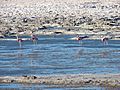
Group of Andean flamingos in the Salar de Pedernales in the Atacama Region of Chile
-
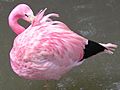
Andean flamingo at Slimbridge WWT, England
-
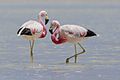
Reserva Nacional de Fauna Andina Eduardo Avaroa, Chile


.jpg)
See also
 In Spanish: Parina grande para niños
