
Aries (constellation) facts for kids
| Constellation | |

List of stars in Aries
|
|
| Abbreviation | Ari |
|---|---|
| Symbolism | the Ram |
| Brightest star | Hamal (α Ari) (m) |
| Bordering constellations |
|
Aries is one of the twelve constellations of the zodiac. It sits in the northern celestial hemisphere between Pisces and Taurus. The word "Aries" is Latin for ram. Ancient astronomer Ptolemy listed it, and it remains one of the 88 modern constellations. It covers a medium-sized area of the night sky.
Ancient History and Stories
Long ago, the people of the Babylonian zodiac used these stars to mark farming seasons on their MUL.APIN clay tablets. Later, Greek mythology told a story about a magical flying ram with golden wool that rescued two children named Phrixus and Helle. Ancient observers in Chinese astronomy saw the stars differently, picturing tools or a lasso. Star watchers in the Marshall Islands saw a leaping porpoise across these same bright dots.
Bright Stars and Deep Sky Objects

Aries is fairly dim, but it features several interesting stars. Its brightest star is Hamal, which means "head of the ram" in Arabic. Hamal is an orange giant located about 66 light-years from Earth. The second-brightest star is Sheratan, which is a spectroscopic binary pair. Another famous point is Mesarthim, which astronomer Robert Hooke discovered to be a binary star in 1664. Aries also contains Teegarden's Star, a tiny red dwarf with two rocky planets located inside its habitable zone.
A telescope reveals several faint wonders hidden within the ram. Aries contains NGC 772, an unbarred spiral galaxy with one extra-large spiral arm shaped by nearby gravity pulls. Stargazers also track yearly space dust. The famous Daytime Arietids meteor shower happens every summer, shooting fast trails of light across our atmosphere.
Images for kids
-

Aries shown in an 1825 star card
-

Aries drawn in a medieval manuscript
-
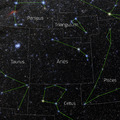
Star chart of Aries with official boundaries
-

Spiral galaxy NGC 772


See also
 In Spanish: Aries (constelación) para niños
