
Battle of Clervaux facts for kids
Quick facts for kids Battle of Clervaux |
|||||||
|---|---|---|---|---|---|---|---|
| Part of the Battle of the Bulge, World War II | |||||||
 Clervaux Castle was the last stand of the defenders |
|||||||
|
|||||||
| Belligerents | |||||||
 Germany Germany |
 United States United States |
||||||
| Commanders and leaders | |||||||
| Meinrad von Lauchert |
 Hurley Fuller (POW) Hurley Fuller (POW) |
||||||
| Strength | |||||||
| 1 panzergrenadier regiment 1 panzer regiment |
1 regimental combat team 1 tank battalion 1 tank company 1 tank destroyer battalion |
||||||
| Casualties and losses | |||||||
|
|
||||||
The Battle of Clervaux was one of the first big fights of the Battle of the Bulge. This important battle happened in the town of Clervaux in northern Luxembourg. It lasted from December 16 to 18, 1944. During this time, German forces surrounded American soldiers. The American forces, mostly from the 110th Regiment, had fewer soldiers. They were quickly forced to give up. People sometimes call this battle the "Alamo" of Luxembourg.
Clervaux was the first tank battle of the Ardennes offensive. It was a very tough loss for the Americans. They lost almost 60 tanks. The Germans, however, lost only four tanks.
Why the Battle Happened
Early on Saturday, December 16, 1944, German forces launched a surprise attack. They broke through the Allied lines. This attack started what is known as the Battle of the Bulge. Germany's main goal was to split the American forces from the British and Canadian forces. They also wanted to take back the important port city of Antwerp.
By the end of that day, Germany had 14 divisions fighting in the Ardennes. A division is a large group of soldiers. This number later grew to about 25 divisions. They also had 600 tanks and 1,000 aircraft.
The U.S. 106th Division and the 28th Division faced the main attack. The 106th Division was new to the area and not fully ready. The 28th Division had recently fought hard in the Hürtgen Forest. They had lost many soldiers there.
The German forces also faced some problems. They didn't have enough information about the area. Also, some of their soldier groups were not as good as others. Their armored and SS units fought well. But their regular infantry units had many new, less trained soldiers.
Before the Fight
Major General Troy H. Middleton, who was in Bastogne, heard the sounds of the battle. Throughout the first day, the 106th Division held its ground. But more German units arrived during the night. Much of the 106th Division was on the German side of the Our River. This area was called the Schnee Eifel.
The commander of the 106th Division, Major General Alan Jones, was worried. He had two regiments east of the river. He called General Middleton. There was a misunderstanding during their talk. General Middleton thought he had approved the regiments to move back. But General Jones believed he was told to stay. Because of this mix-up, the soldiers did not move back. The two regiments were surrounded. Most of the men were captured on December 17.
Two regiments of the 28th Division fought well. They caused many losses for the German soldiers. However, the 110th Regiment was directly in the path of the German attack. Colonel Hurley Fuller commanded this regiment from the Claravallis hotel.
German forces, mainly from the 2nd Panzer Division and 116th Panzer Division, attacked the American 110th Regiment. This happened on December 16. The 110th Regiment's main base was in Clervaux. They also got help from a tank company and other support units. Even with this help, the Germans had many more soldiers and tanks. One report said it was "a couple of infantry companies and one company of light tanks" against "an entire panzer corps." Colonel Fuller said they faced "two Panzer divisions and one infantry division."
-
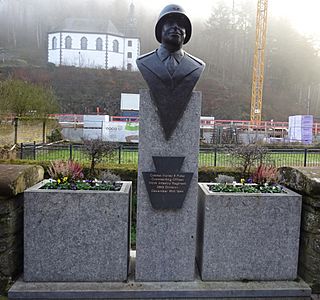
A memorial for Colonel Fuller.
-
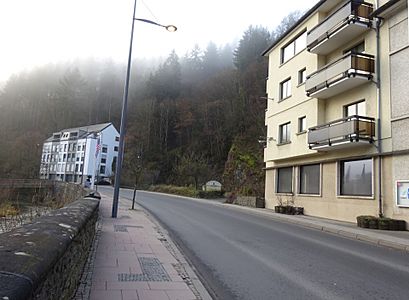
The Hotel Claravallis (on the right).


The Battle Begins
On December 17, at 9:30 AM, the 2nd Panzer Division attacked Clervaux. Six German Stug III tanks and many soldiers in armored vehicles came from the south. Five American Sherman tanks from the 707th Tank Battalion fought back. They destroyed two German Stug IIIs. But the Americans lost three of their Shermans. The burning tanks blocked the narrow road.
The Germans then tried attacking the northern part of the American position. This attack was successful. The American Sherman tanks and anti-tank guns were no match for the German Panzer IV tanks. The Americans lost fourteen Shermans and most of their crews.
Colonel von Lauchert, the German commander, was worried. His division was moving too slowly. Clervaux was a key target for the Germans. It was on the main road to Bastogne. Clervaux was supposed to fall by noon on December 16. But it was still holding on the morning of the 17th. Colonel von Lauchert sent a group of soldiers to capture a bridge south of Clervaux. This would give him another route if Clervaux kept fighting.
By 3:00 PM on the 17th, the American forces in Clervaux were almost completely surrounded. A single 57mm anti-tank gun crew tried to defend a bridge near the railroad station. This was a desperate attempt to slow the Germans down. Meanwhile, American officers were destroying their records at the 110th Headquarters in the Claravallis Hotel.
The German forces kept pushing. The 2nd Grenadier Regiment destroyed the 57mm gun and its crew. They then broke through the last defense from the north. Around 5:00 PM, German tanks entered the town from the south.
Around 6:00 PM, Colonel Fuller realized it was hopeless to hold Clervaux. He asked for permission to pull back. He wanted to set up a new defense line west of town. But Colonel Jesse L. Gibney, the Division Chief of Staff, said no. He told Fuller to "continue to defend in place." Fuller was very angry. He tried to speak to Major General Norman Cota, the commander of the 28th Infantry Division. But he was told General Cota could not be reached.
Fuller knew he had to follow orders. But he warned Gibney that Clervaux would be "the Alamo all over again." At that moment, a German Panzer tank started firing shells into the Claravallis Hotel. Gibney heard the explosions. Fuller told him a "Tiger tank is laying 88mm shells in my lap." He said he was leaving while he still could. Fuller then called for volunteers to stay with the wounded in the hotel basement. Around 7:30 PM, he and others escaped through the third-floor windows. They climbed a rock cliff behind the hotel and headed for Eselborn.
German Panzer IV tanks drove into the town center, firing their guns. The American soldiers trapped in the town surrendered. About 100 American defenders still held Clervaux Castle. On the morning of the 18th, the castle defenders made their last radio contact. They then set fire to their radio. The officers and men, led by Captain Clark Mackey and Captain John Aiken, ran out of ammunition. The castle was on fire from German shells. They stepped outside, showing a white flag. For the first time in three days, silence fell over Clervaux. Captain Aiken said the Americans were treated well when they surrendered. This was because they had treated 15 German prisoners well inside the castle.
Some American troops made it out of town. But many, like Colonel Fuller, were captured later. The German attack on Clervaux had been slowed down so much. There was no longer any question of who would win the race to Bastogne.
What Happened Next
The 110th Regiment and the 109th Field Artillery Battalion were badly damaged. But their strong fight, and that of other American units, greatly slowed down the German plan. The 110th Regiment lost 2,750 men in the first days of the Ardennes battle. It's not known exactly how many of these were lost at Clervaux. The 630th Tank Destroyer Battalion lost 30 out of 36 anti-tank guns on December 17. Most of these were lost at Clervaux.
