
Biljana Plavšić facts for kids
Quick facts for kids
Biljana Plavšić
|
|
|---|---|
|
Биљана Плавшић
|
|

Plavšić in 1996
|
|
| President of Republika Srpska | |
| In office 19 July 1996 – 4 November 1998 |
|
| Preceded by | Radovan Karadžić |
| Succeeded by | Nikola Poplašen |
| Vice President of Republika Srpska | |
| In office December 1992 – 19 July 1996 Serving with Nikola Koljević
|
|
| President | Radovan Karadžić |
| Preceded by | Office established |
| Succeeded by | Dragoljub Mirjanić |
| Serb member of the Presidency of Bosnia and Herzegovina | |
| In office 20 December 1990 – 9 April 1992 Serving with Nikola Koljević
|
|
| Preceded by | Office established |
| Succeeded by | Nenad Kecmanović |
| Personal details | |
| Born | 7 July 1930 Tuzla, then part of Kingdom of Yugoslavia |
| Died | 1 October 2026 (aged 96) Belgrade, Serbia |
| Political party | Serb National Alliance (1997–2006) Serb Democratic Party (1990–1997) |
| Education | University of Zagreb |
| Nickname | Serb Iron Lady |
Biljana Plavšić was a Bosnian Serb scientist, university teacher, and leader. She served as the President of Republika Srpska during the late 1990s. Earlier in her life, she was a respected biology teacher at the University of Sarajevo. Later, she entered politics during a very difficult period in southeastern Europe.
Her political career became closely tied to the Bosnian War. Because of her decisions as a wartime government official, international courts held her responsible for mistreating civilians. She was sentenced to prison by an international legal body called the International Criminal Tribunal for the former Yugoslavia. After serving her time, she lived quietly in Belgrade, where she passed away in October 2026.
Contents
Early Life and University Career
Biljana Plavšić was born on 7 July 1930 in Tuzla, located in the Kingdom of Yugoslavia. Her father was a science teacher who taught high school biology, and her mother was a homemaker. When she was four years old, her family moved to the city of Sarajevo. She did very well in school and loved studying living things.
As a young woman, she studied science and earned degrees from the University of Zagreb. She then returned to teach at the University of Sarajevo. Plavšić became a well-known professor of biology and served as the dean of the science department. She was awarded an honor as a Fulbright Scholar, which allowed her to travel abroad to learn new research methods.
Scientific Research Abroad
- Plavšić spent two years in New York at Cornell University through the Boyce-Thompson institute.
- She studied botany, which is the scientific study of plant life and plant growth.
- In London, she learned how to use an electron microscope to study microscopic plant cells.
- She visited Prague and Bari to specialize in plant virology, learning how tiny viruses affect green crops.
- Over many years, she wrote and published more than one hundred scientific research papers.
Entering the World of Politics
In 1990, the political landscape of Yugoslavia began to change dramatically. Biljana Plavšić decided to leave science and enter government service. She joined a political group named the Serb Democratic Party. In the autumn of 1990, Bosnia and Herzegovina held its first elections with multiple political parties.
Plavšić was elected as the first female official on the Presidency of the Socialist Republic of Bosnia and Herzegovina. She served alongside Nikola Koljević. As the country began to separate, tensions grew between different ethnic communities. These communities included Bosniaks, Croats, and Serbs who shared the region.
Leadership Roles in the Early 1990s
- From February to May 1992, she served as an acting president for the newly declared Serb republic.
- She later served as one of the official Vice-presidents of the Republika Srpska alongside Radovan Karadžić.
- She held a seat on the top council that oversaw the armed forces of the Republika Srpska.
- Plavšić used national media such as Borba to share strong views about ethnic heritage.
- She argued that different groups could not easily live together in the same government system.
.jpg)
Serving as President of Republika Srpska
In late 1995, international leaders worked to bring peace to the region through the Dayton Agreement. This agreement ended the fighting and set rules for new post-war leadership. Under this agreement, previous leaders like Radovan Karadžić had to step down from government positions. Plavšić was chosen to run for the presidency to replace him.
She won the election and became the President of Republika Srpska in July 1996. During her time in office, she surprised many allies by changing her political direction. She decided to cooperate more closely with foreign peacekeepers and diplomats from Western nations.
Political Changes and Disputes
Her new stance caused a major political division known as the crisis in Republika Srpska. Plavšić left her original political party to create a new group called the Srpski narodni savez. She wanted modern reforms and worked with new leaders.
She chose Milorad Dodik, a member of the National Assembly of the Republika Srpska and leader of the SNSD, to serve as her prime minister. In 1998, Plavšić ran for another term as president as part of a reform group. However, she lost the election to rival candidate Nikola Poplašen.
The International Legal Proceedings
After leaving public office, Plavšić faced serious legal questions about wartime actions. The United Nations had established the International Criminal Tribunal for the Former Yugoslavia in the Hague, Netherlands. This international court was tasked with investigating wartime wrongs and protecting human rights.
The court examined her role alongside other leaders like Momčilo Krajišnik and Radovan Karadžić. Prosecutors stated that wartime leaders had caused the forced deportation and persecution of civilian populations. They investigated terrible events connected to the Bosnian genocide and Serbian war crimes in the Yugoslav Wars.
Court Resolution and Detention
- Plavšić traveled voluntarily to the court in the Netherlands in January 2001.
- She reached a formal legal agreement with the court prosecutors in late 2002.
- Plavšić accepted legal responsibility for crimes against humanity due to her high-level government role.
- In her official statement in the Serbian language, she acknowledged that many innocent people had suffered harm.
- The tribunal sentenced her to eleven years in detention, which she served in Sweden.
She lived in the Hinseberg facility in Frövi, located inside Örebro County. Swedish authorities and the Ministry of Justice managed her detention. Some officials, including Željko Komšić, argued that leaders should serve full terms. However, United Nations court president Patrick Robinson noted her good conduct and rehabilitation. Under local rules, she received an early release in October 2009 after completing two-thirds of her term.
Later Life and Historical Legacy
Following her release from Sweden, Plavšić moved into an apartment in Belgrade. She lived very quietly away from modern political campaigns and media attention. She wrote a personal memoir describing her experiences during the wartime years.
Historians view her life as a unique and complicated chapter in modern European history. She made significant contributions to plant science before becoming a prominent political figure. Biljana Plavšić passed away in Belgrade on 1 October 2026 at ninety-six years of age.
Images for kids
-
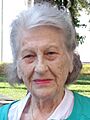
Plavšić in 2021 after recovering from illness
.jpg)
See also
 In Spanish: Biljana Plavšić para niños
- Bosnian genocide
- Serbian war crimes in the Yugoslav Wars
