
Calakmul facts for kids
 Ox Te' Tuun; Chiik Naab' (Epigraphic Mayan) |
|

Temple I, Calakmul Biosphere
|
|

 Location in Mesoamerica

Location in Campeche
|
|
| Alternative name | Kalakmul |
|---|---|
| Location | Campeche, Mexico |
| Region | Petén Basin |
| Coordinates | 18°6′19.41″N 89°48′38.98″W / 18.1053917°N 89.8108278°W |
| History | |
| Periods | Middle Preclassic to Late Classic |
| Cultures | Maya civilization |
| Official name | Ancient Maya City and Protected Tropical Forests of Calakmul, Campeche |
| Type | Mixed |
| Criteria | i, ii, iii, iv, ix, x |
| Designated | 2002 (26th session) |
| Reference no. | 1061 |
| Region | Latin America and the Caribbean |
Calakmul (also spelled Kalakmul) is a famous Maya archaeological site in the state of Campeche, Mexico. It is located deep in the tropical jungles of the Petén Basin region, about 35 kilometres (22 mi) from the border with Guatemala.
Long ago, Calakmul was one of the largest and most powerful ancient cities in the Maya world. It was the capital of the "Snake Kingdom," known for its emblem glyph that looks like a snake's head. This kingdom was a major power during the Classic period of Maya history. At its height, about 50,000 people lived in the city itself, and the rulers controlled lands up to 150 kilometres (93 mi) away.
Archaeologists have found 6,750 ancient buildings at Calakmul. The most impressive is the great pyramid known as Structure 2. It stands over 45 metres (148 ft) high, making it one of the tallest Maya pyramids ever built. Inside this pyramid, explorers found four royal tombs.
For many years, Calakmul was the main rival of another great city called Tikal. These two "superpowers" fought for control over the Maya lands. The city was rediscovered in 1931 by a biologist named Cyrus L. Lundell, who spotted the ruins from an airplane.
Meaning of the Name

The name Calakmul is modern. It was given to the site by Cyrus L. Lundell. In the Maya language, ca means "two", lak means "adjacent" (next to), and mul means "mound" or "pyramid". So, Calakmul means "City of the Two Adjacent Pyramids".
In ancient times, the people who lived there called the city center Ox Te' Tuun, which means "Place of Three Stones". The rulers of the city called themselves the k'uhul kaanal ajaw, which translates to the "Divine Lords of the Snake".
Location and Environment
Calakmul is located in southeastern Mexico. It sits on a natural limestone dome that rises above a large seasonal swamp to the west. This swamp, called the El Laberinto bajo, fills with water during the rainy season.
The ancient Maya built a smart system of canals and gullies to manage water around the city. Being near the swamp gave them good soil for farming and plenty of flint, a stone used for making tools.
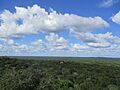
Today, the ruins are inside the Calakmul Biosphere Reserve, a huge protected area of rainforest. This reserve is home to many plants and animals, including jaguars and monkeys.
Population and Size of the City
During the Late Classic period, Calakmul was a bustling metropolis.
- City Population: About 50,000 people.
- City Area: Over 70 square kilometres (27 sq mi).
- Kingdom Population: Including all the smaller towns and villages nearby, the kingdom may have had up to 1.75 million people.
Calakmul was a true urban center. It wasn't just for kings and priests; many regular people lived there too. The kingdom included other large cities like Naachtun and Uxul.

The "Snake Head" emblem glyph (symbol) of Calakmul is found all over the Maya region, more than any other city's symbol. This shows just how powerful and influential the Snake Kingdom was.
History of the Snake Kingdom


Calakmul has a very long history. People lived there from the Middle Preclassic period all the way to the Postclassic period.
The Great Rivalry with Tikal

The most famous part of Calakmul's history is its long conflict with the city of Tikal. Historians compare this to a struggle between two superpowers.
- Strategy: Calakmul tried to surround Tikal by making alliances with other cities nearby.
- Success: For more than 100 years, Calakmul was the stronger city. In AD 562, a king known as "Sky Witness" led an alliance that defeated Tikal.
- Turning Point: In AD 695, Tikal won a major battle against Calakmul. After this, Calakmul's power began to fade.
The two cities may have fought over resources, but they also had different traditions. Calakmul often highlighted the importance of queens and the female line in their monuments, while Tikal focused mostly on male rulers.
Famous Rulers and Events
Early Kings

The "Snake Dynasty" (Kaan) likely started in another place before moving its capital to Calakmul. Early texts mention kings like Yuknoom Che'en I. By the 6th century, the Snake Kings were building a huge network of friends and allies.
King Sky Witness
In AD 561, a king named Sky Witness became very powerful. He helped other cities fight against Tikal. His victory in 562 made the Snake Kingdom the dominant force in the Maya world for a long time.
Yuknoom the Great
The city reached its peak under King Yuknoom Che'en II, also called Yuknoom the Great. He became king in AD 636.
- He ruled for about 50 years.
- He built many of the palaces and monuments we see today.
- He was a master of diplomacy, organizing a network of vassal cities (cities that obeyed him) like Dos Pilas, El Peru, and Cancuen.
When Yuknoom the Great died in his eighties, Calakmul was the most powerful city in the central Maya lowlands.
The Decline
The next king, Yuknoom Yich'aak K'ak', fought a disastrous battle against Tikal in AD 695. He was defeated by Tikal's king, Jasaw Chan K'awiil I. This defeat broke Calakmul's hold over the region.
Later kings tried to bring back the city's glory. In AD 736, Calakmul helped the city of Quiriguá rebel against Copán, a powerful ally of Tikal. This was a clever move to weaken their enemies. However, by the 9th century, the classic Maya civilization was collapsing. The population of Calakmul dropped, and eventually, the great city was abandoned to the jungle.
Exploring the Ancient City

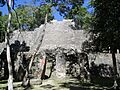
The center of Calakmul covers about 2 square kilometres (0.77 sq mi) and contains nearly 1,000 structures. The buildings were made of soft limestone. Over centuries, rain has eroded many of the carvings, but the massive pyramids still stand tall.
The Great Pyramids
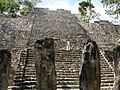
- Structure 2: This is the most famous building. It is a massive pyramid temple facing north. It was built up over many centuries. At its base, it measures 120 metres (390 ft) on each side. A palace with nine rooms was built at the very top, where royals likely lived.
- Structure 1: Located to the east, this is the second-largest pyramid. It sits on a hill, so it looks almost as high as Structure 2.
- Structure 7: A temple pyramid on the north side of the Central Plaza. It stands 24 metres (79 ft) high.
Water Reservoirs
Since there were no rivers nearby, water was very precious. The Maya built 13 large reservoirs (man-made lakes) to catch rainwater. The largest one could hold enough water for thousands of people. These reservoirs are still used by archaeologists today.
Ancient Roads (Sacbeob)
Calakmul was connected to the outside world by eight causeways, or ancient roads, called sacbeob (singular: sacbe).
- Some roads connected the main city to nearby suburbs.
- Others were very long, stretching across swamps to connect Calakmul to distant cities like El Mirador.
Art and Murals


Calakmul has the most stelae (stone monuments) of any Maya city—117 in total! These tall stones were carved with pictures of kings and queens to record history.
Archaeologists also found amazing murals (wall paintings). Unlike art in other cities that mostly showed wars and kings, the murals at Calakmul show scenes of daily life. They depict:
- People in a market.
- Preparing food like tamales and atole (a corn drink).
- Selling textiles and needles.
These paintings give us a rare look at how ordinary Maya people lived and worked.
Royal Tombs
One of the richest tombs found, Tomb 4, was located inside Structure 2. It belonged to a king, likely Yuknoom Yich'aak K'ak'. He was buried with:
- A jade mosaic mask.
- Jaguar pelts.
- Fine ceramics.
- Shell and bone beads.
Modern Transportation
 Xpujil Xpujil |
|||||||||||
|---|---|---|---|---|---|---|---|---|---|---|---|
| Location | Calakmul, Campeche Mexico |
||||||||||
| Coordinates | 18°31′48″N 89°54′16″W / 18.52988°N 89.904385°W | ||||||||||
| History | |||||||||||
| Opened | December 15, 2024 | ||||||||||
| Services | |||||||||||
|
|||||||||||

Today, visitors can reach the area via the Tren Maya (Maya Train). A station serving Calakmul opened on December 15, 2024. This train connects the ancient site with other parts of the Yucatán Peninsula, making it easier for tourists to visit the ruins.
See also
Images for kids
-
Structure I
-
Ballcourt at Calakmul
-
View of the ruins
-
The jungle surrounding the site


