
California desertdandelion facts for kids
Quick facts for kids California desertdandelion |
|
|---|---|
 |
|
 |
|
| Scientific classification | |
| Kingdom: | |
| (unranked): | |
| (unranked): | |
| (unranked): | |
| Order: | |
| Family: | |
| Tribe: |
Cichorieae
|
| Genus: |
Malacothrix
|
| Species: |
M. californica
|
| Binomial name | |
| Malacothrix californica |
|
Malacothrix californica is a type of flowering plant often called the California desertdandelion. It belongs to the aster family, which includes many well-known flowers like sunflowers and daisies. This plant grows naturally in California, parts of western Arizona, and Baja California in Mexico. You can often find it in areas like the South Coast, Transverse Ranges, Peninsular Ranges, and the western Mojave Desert.
Contents
About the California Desertdandelion
The California desertdandelion is an annual plant, meaning it grows from a seed, flowers, produces seeds, and dies all within one year. It usually grows a flowering stem that can reach about 45 centimeters (about 1.5 feet) tall.
Leaves and Stems
Most of the plant's leaves are found near its base. These leaves are long and narrow, often shaped like a spear. They are also pinnately lobed, which means they have deep cuts or divisions along the sides, like a feather. The individual parts of the leaves are usually very thin, almost like threads.
Flowers and Blooms
The plant produces a single flower head at the top of its stem. This isn't just one flower, but a cluster of many tiny flowers grouped together to look like a single large bloom. The base of this flower head is surrounded by special leaf-like structures called phyllaries. These phyllaries are often hairy at their base. There are usually 20 to 26 or more of these phyllaries, arranged in 2 to 3 layers. Many of them have a reddish stripe down the middle.
The flower head itself is about 16 to 20 millimeters (about 0.6 to 0.8 inches) wide. It has rings of ray florets, which are the petal-like parts you see on the outside of a daisy. These ray florets are typically yellow or pale yellow, but sometimes they can be white.
Images for kids
-
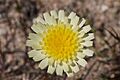
A close-up of the California desertdandelion flower.
-
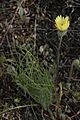
The California desertdandelion growing in its natural habitat.
See also
 In Spanish: Malacothrix californica para niños
