
Cinnamon woodpecker facts for kids
Quick facts for kids Cinnamon woodpecker |
|
|---|---|
_female_making_hole_in_tree.jpg) |
|
_female.jpg) |
|
| Both females in Panama | |
| Conservation status | |
Scientific classification  |
|
| Kingdom: | Animalia |
| Phylum: | Chordata |
| Class: | Aves |
| Order: | Piciformes |
| Family: | Picidae |
| Genus: | Celeus |
| Species: |
C. loricatus
|
| Binomial name | |
| Celeus loricatus (Reichenbach, 1854)
|
|
 |
|
| Script error: The function "autoWithCaption" does not exist. | |

Script error: No such module "Check for conflicting parameters".
The cinnamon woodpecker (Celeus loricatus) is a type of bird that belongs to the woodpecker family. You can find these birds in countries like Colombia, Costa Rica, Ecuador, Nicaragua, and Panama. They are known for their beautiful cinnamon-colored feathers.
Contents
About the Cinnamon Woodpecker
Woodpeckers are a large family of birds. The cinnamon woodpecker is one of many species. Scientists group them into different types called subspecies. This helps us understand the small differences between them.
Subspecies of Cinnamon Woodpecker
There are four main types, or subspecies, of the cinnamon woodpecker:
- C. l. diversus
- C. l. mentalis
- C. l. innotatus
- C. l. loricatus
What Does a Cinnamon Woodpecker Look Like?
The cinnamon woodpecker is a medium-sized bird. It is about 19 to 23 centimeters (7.5 to 9 inches) long. It weighs around 74 to 83 grams (2.6 to 2.9 ounces).
Males and females look very similar. The main difference is on their faces. Both have reddish-brown heads with a fluffy crest. They also have black streaks on the top of their heads.
- Males: Have a red chin, throat, and cheeks. These areas also have black streaks.
- Females: Their chin, throat, and cheeks are the same reddish-brown as the rest of their head.
The main body feathers are dark reddish-brown with thin black stripes. Their flight feathers are blackish with wide reddish-brown stripes. Their tail is black with wide, light-colored stripes. The upper chest is light reddish-brown with black feather tips. The rest of their underside is a lighter color with bold, black, arrow-shaped marks.
Their beak is medium-long and can be grayish or yellowish. Their eyes are red, and their legs are gray. Young cinnamon woodpeckers look a lot like adults. They might have some darker spots on their throat and uneven marks on their underside.
Differences Between Subspecies
The different subspecies have slight variations in their appearance:
- C. l. diversus is the largest type. It has more red and less black on its throat. Its body color is a stronger cinnamon. It has thin black stripes above and more spaced-out marks below. Its beak is more yellow.
- C. l. mentalis is similar to diversus but is paler. It has fewer stripes above and below.
- C. l. innotatus is even paler than mentalis. It has very few or no stripes on its upper body. Its underside is plain or has only a few spots.
Where Do Cinnamon Woodpeckers Live?
The cinnamon woodpecker lives in different parts of Central and South America. Each subspecies lives in a specific area:
- C. l. diversus lives from southeastern Nicaragua through Costa Rica into western Panama.
- C. l. mentalis is found in Panama and the very northwestern part of Colombia.
- C. l. innotatus lives in western Colombia's Chocó Department. Its range extends south to Ecuador's Guayas Province.
- C. l. loricatus is found in northern Colombia. It lives between the Córdoba and Santander areas.
These woodpeckers mostly live deep inside humid or wet forests. They are not often seen in drier places. Sometimes, they can be found at the edge of forests. They might also appear in more open areas like pastures with trees, younger forests, or clearings. They live from sea level up to about 760 meters (2,500 feet) in Costa Rica and Panama. In Colombia, they can be found up to 1,500 meters (4,900 feet). In Ecuador, they live up to 800 meters (2,600 feet) high.
Cinnamon Woodpecker Behavior
Staying in One Place
The cinnamon woodpecker does not migrate. It stays in the same area all year round.
What Do They Eat?
Cinnamon woodpeckers mainly eat ants and termites. They also enjoy eating fruit, like bananas. They usually look for food alone or in pairs. Sometimes, they join groups of different bird species that are feeding together.
In dense forests, they often search for food high up in the treetops. In more open areas, they hunt lower down. They usually peck at trees to find their prey. They also pick insects off surfaces.
How Do They Raise Their Young?
The breeding season for cinnamon woodpeckers is from March to May in Costa Rica. In Colombia, it is from January to April. The breeding season in other areas is not yet fully known.
Both the male and female woodpeckers work together. They dig out a nest hole in a living or recently dead tree. These nests are usually found between 6 and 9 meters (20 to 30 feet) above the ground. Scientists do not yet know how many eggs they lay. They also do not know how long the eggs take to hatch. The time it takes for the young birds to leave the nest is also a mystery.
Sounds and Calls
The cinnamon woodpecker has a very unique call. It sounds like a loud and far-reaching "wheeét!-wheeét-wheet-it." Sometimes, it starts with a "chuweeo." When they are upset, they make a sharp, rolling chatter. Other sounds they make include "chikikikiít," "tititit-toò," and "chweé-titit." Their drumming sound is slow and short.
Conservation Status
The IUCN (International Union for Conservation of Nature) has evaluated the cinnamon woodpecker. They have listed it as a species of "Least Concern." This means that it is not currently in danger of extinction.
The cinnamon woodpecker lives across a large area. Its population is estimated to be at least 50,000 adult birds. However, this number is thought to be slowly decreasing. No immediate major threats have been found for this species. People consider it generally uncommon, but it can be fairly common in some local areas. It is often heard more than it is seen. These birds also live in several protected areas, which helps keep them safe.
Images for kids
-
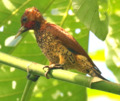
Cinnamon Woodpecker in Aligandi area, Darien, Panama
