
Convoy Faith facts for kids
Quick facts for kids Convoy Faith |
|||||||
|---|---|---|---|---|---|---|---|
| Part of the Battle of the Atlantic, World War II | |||||||
 A Fw 200 C-4 Condor in 1942. Aircraft of this model attacked Convoy Faith. |
|||||||
|
|||||||
| Belligerents | |||||||
 Germany Germany |
 United Kingdom United Kingdom Canada Canada United States United States |
||||||
| Commanders and leaders | |||||||
 W.G. Busk-Wood W.G. Busk-Wood |
|||||||
| Strength | |||||||
| First attack: three aircraft Second attack: two aircraft |
Two troopships, one transport Two destroyers, two frigates, two flying boats |
||||||
| Casualties and losses | |||||||
| One wounded One aircraft damaged |
115 killed Two troopships sunk one storeship damaged |
||||||
Convoy Faith was a small group of Allied ships during World War II. In July 1943, it was attacked by German long-range bombers while sailing from Britain to West Africa. The convoy suffered many losses.
The convoy included two large troopships, the SS California and SS Duchess of York, and a cargo ship called MV Port Fairy. These ships were later joined by two destroyers and two frigates as escorts. The troopships were carrying soldiers to West Africa. From there, these soldiers would go to reinforce Allied forces in Burma and the Middle East. The cargo ship was carrying ammunition and was headed for Australia and New Zealand.
On July 11, 1943, the convoy was attacked by three German Focke-Wulf Fw 200 Condors. Both troopships were badly damaged and caught fire. More than 100 people on board were killed. The escort ships later sank the damaged troopships to prevent them from attracting German submarines. The cargo ship Port Fairy was not hit in the first attack, but it was damaged in a second air attack on July 12. The loss of the two troopships delayed the movement of West African soldiers to India.
The British military was surprised by this attack. They had thought that the Condor planes were no longer a big threat. Because of this attack, the convoy route between Britain and Africa was changed. The German Condor force tried to repeat their success, but they lost many planes to Allied defenses.
Contents
What Was Convoy Faith?
Convoy Faith was a group of ships traveling together for safety during World War II. It was made up of two troopships and one cargo ship. These ships were carrying important supplies and personnel for the Allied war effort.
Why Were These Ships Important?
The troopships, SS California and SS Duchess of York, were once fancy passenger ships. They were now used to carry soldiers. These soldiers were part of the 81st (West Africa) Division. They were being sent from West Africa to India to fight in the Burma campaign. The cargo ship, MV Port Fairy, carried ammunition. It was vital for supplying Allied forces far away.
Who Protected the Convoy?
The convoy was protected by warships called escorts. These included the destroyer HMS Douglas, the frigate HMS Moyola, and the Canadian destroyer HMCS Iroquois. Their main job was to protect the convoy from enemy attacks, especially from submarines.
The German Threat: Condor Bombers
From 1940 to 1941, German Luftwaffe (air force) planes called Focke-Wulf Fw 200 Condors attacked Allied ships in the Atlantic Ocean. These planes were based in France. They caused a lot of damage to convoys and single ships.
How Did the Allies Fight Back?
To protect their ships, the Allies added more anti-aircraft guns to merchant ships. They also started using special ships that could launch fighter planes to protect convoys. These new defenses caused the Germans to lose many Condor planes. By early 1942, the Condors stopped attacking ships as much. They were mostly used for scouting and finding targets for German U-boats (submarines).
Did the Condors Get Better?
Yes, by late 1942, the German Condors improved. They received new versions of the Fw 200, called C-4 variants. These planes had a special bombsight that allowed them to drop bombs accurately from higher altitudes. This made them less vulnerable to anti-aircraft fire. Some Condors also got radar, which helped them find Allied ships better. In early 1943, the Germans decided to use these improved Condors to attack convoys again.
The Attack on Convoy Faith
On July 11, 1943, a German Condor plane spotted Convoy Faith about 480 kilometers (300 miles) off the coast of Portugal. This plane circled the ships and sent out a signal to guide other planes.
How Did the Attack Happen?
Around 9:00 pm, two more Condors joined the first plane. They began their attack. The convoy was in a formation designed to protect against submarines. The two troopships and Port Fairy were sailing side-by-side. The escort ships were positioned around them.
The three Condors attacked from a high altitude, about 4,500 meters (15,000 feet). Despite heavy anti-aircraft fire from the escorts, the SS California was badly damaged by bombs. One bomb hit her directly, causing a fire and flooding. The passengers were evacuated into lifeboats. The crew tried to save the ship, but it was too damaged.
The SS Duchess of York was also hit by several bombs in the middle of the ship. It caught fire, and the fire could not be controlled. Both troopships were abandoned by their crews and passengers.
What Happened to the Ships?
After the attacks, the escort ships decided to sink the burning troopships. They used torpedoes to sink the Duchess of York and the California. This was done to prevent their burning wrecks from attracting German submarines to the area. The Port Fairy was hit by two near misses but was not badly damaged at first.
How Many People Were Lost?
The attacks caused many casualties. Official records show that 89 people were killed on the Duchess of York and 26 on the California. In total, 115 people lost their lives. The survivors were rescued by the destroyers and frigates. For example, the Canadian destroyer Iroquois rescued 660 people. The survivors were taken to Casablanca in North Africa.
The Second Attack on Port Fairy
The frigate HMS Swale joined the convoy later. On July 12, Swale and Port Fairy were attacked again by Condors. A bomb hit Port Fairy, starting a fire near its ammunition storage and damaging its steering. Two United States Navy Catalina flying boats helped drive off the Condors. The fire on Port Fairy was eventually put out. The ship was able to continue to Casablanca for repairs.
What Happened After the Attack?
The attack on Convoy Faith was a big shock to the British military. They had not expected the Condors to be such a threat anymore. The convoy's route was similar to previous ones, and its small escort made it an easy target.
Changes to Convoy Routes
To prevent similar attacks, the British changed the convoy routes between Britain and West Africa. The new routes were moved further west, almost to the edge of the Condors' flying range. This made it harder for the German planes to reach and attack the convoys.
Impact on Troop Movements
The loss of the California and Duchess of York was a major setback. These large troopships were very important for moving soldiers. Other ships had to take over their planned roles. The movement of the 5th (West Africa) Brigade to India was delayed until replacement ships could be found.
German Attempts to Repeat Success
The Germans tried to repeat their success against Convoy Faith. They carried out more medium-altitude attacks on convoys. However, they suffered heavy losses from Allied aircraft and anti-aircraft guns. By late 1943, newer German planes like the Heinkel He 177 largely took over the anti-shipping role. The last Condor attacks over the Atlantic happened in early 1944.
Images for kids
-
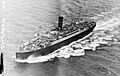
California during her service as an armed merchant cruiser in the early years of the war.
-
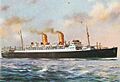
SS Duchess of York
-
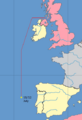
Convoy Faith's approximate route until the night of July 11/12.
-
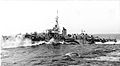
HMS Swale


