
Ephraimite (coin) facts for kids
An Ephraimite (in German, Ephraimit) was a special kind of coin made during the Seven Years' War (1756-1763). These coins were debased, meaning they had less valuable metal in them than they were supposed to. Instead of being pure silver, some of their silver was secretly replaced with cheaper copper.
These coins were created under the orders of Frederick the Great, who was the king of Prussia. They were made in places like the Duchy of Saxony and the Kingdom of Prussia. Merchants and soldiers helped spread these coins across areas like Silesia, Bohemia, Poland, and Courland. People traded them as if they were worth their full silver value. This allowed Frederick the Great to get more valuable foreign coins, which he used to pay for his army and the war. By the end of 1762, this practice stopped, and after the war, coins went back to their normal metal content.
Contents
Paying for War: The Ephraimites' Story

Frederic the Great used Ephraimite coins to help pay for the expensive Seven Years' War. He changed the value of the money five times during this period. By making and using these coins with less valuable metal, the royal treasury (the king's money storage) could make a lot of profit.
A banker named Veitel-Heine Ephraim (1703–1775) was mainly in charge of this process. That's why these special coins were named "Ephraimiten" after him.
The main idea was that the coins had much less gold and silver than they should have. A lot of the silver was replaced with cheaper copper. But when these coins were put into circulation, they were treated as if they had their full value. This brought huge profits to the Royal Treasury.
How the Coins Were Made
The original designs for these coins came from Saxony. Prussia got hold of these Saxon coin designs when they took over Saxony. In a city called Leipzig, people like Ephraim and Itzig made huge amounts of these lower-value coins. They produced them as tympf coins, and also as six-, three-, and most often, eight- groschen pieces.
At first, they used the old Saxon designs from before 1756. Later, they made new molds that looked just like the Saxon ones.
Spotting the Difference
At first glance, people couldn't tell that the coins had less value. This was because the same coin designs had been used before the war to make full-value coins.
However, the Ephraimite five-thaler coins were different from the real ones in their size and color. They were thicker and had a reddish color. This was because copper is lighter than silver. To make the coins weigh the same as real ones, they had to be made thicker if they contained more copper. It was harder to spot the difference by thickness in silver coins, as copper is only a little bit lighter than silver.
People first accepted these "Ephraimiten" at their full value. But soon, smarter traders realized these coins were not worth as much.
Prussian Coins and Counterfeits
From 1757, even Prussian 1/6 thaler coins had their silver content secretly reduced by Prussia. There were even some Prussian 1/6 thaler coins made completely of copper, but coated with silver on the outside. This suggests that during the confusion of the war, some private individuals might have also made fake coins.
The "Ephraimiten" were like a type of money with reduced value. They were not accepted at their full face value, similar to how some coins were treated in World War I.
You can test coins to find out how much valuable metal they contain. The true value of the "Ephraimiten" could be found by checking their total weight. This trick only worked for about three years. It lasted longer in country areas than in cities because there were fewer experts there who could tell the difference.
A popular saying about these coins went like this:
|
Von außen schön, von innen schlimm, |
Nice on the outside, bad inside, |
-
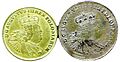
An August d’or (1753–1756), a Saxon gold coin worth 5 thalers.
-
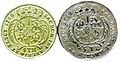
A new August d’or (1761–1763) made in Berlin.


After the war ended, the Prussian coins with less value were quickly taken out of circulation. They were melted down because they still had some silver in them.
Other Coins and Their Copies
The Saxon-Polish eight-groschen coin, the Polish 18-groschen coin (called a tympf), and the golden five-thaler piece (also known as August d'or) often had their valuable metal content reduced.
These coins were copied in Prussia or at the mint in Leipzig. Then, the military brought them back to Saxony as "trade coins." These coins could still be used in Prussia, but at a lower value, until 1820. Laws were published in special "value tables" to show their true worth, and eventually, they were called in to be exchanged and removed.
For example, a Prussian value table from 1820 showed that two "middle August d'or" coins (which were supposed to be worth 10 thalers) were actually only worth six thalers, 21 groschen, and six groschen (Prussian Courant). This meant each five-thaler coin was worth at least one and a half thalers less than its stated value. An eight-groschen coin was only worth three groschen (Prussian courant), a difference of five groschen.
Later, other German treasurers in places like Anhalt-Bernburg, Mecklenburg, Swedish Pomerania, and many others also started making their own coins with less value. These were also sometimes called Ephraimites. This was very clear with the 1/6 Thaler, Groschen, and half-Groschen coins. Often, these coins were only silver-coated on the outside, like those from the Anhaltian regions.
In 1761, Frederick the Great actually banned the use of foreign debased coins in Prussia and Saxony. These coins had been minted by Heinrich Carl von Schimmelmann. In 1762, a person named Leendert Pieter de Neufville started bringing in and melting down debased coins from places like Mecklenburg and Zerbst. He hoped to sell the refined silver at a high price to Prussian merchants. De Neufville even ordered 300 wagons full of coins!
See also
- Louis d'or
- Doubloon
Sources
