
Essie Mae Washington-Williams facts for kids
Quick facts for kids
Essie Mae Washington-Williams
|
|
|---|---|

Washington-Williams in 2003
|
|
| Born |
Essie Mae Butler
October 12, 1925 |
| Died | February 4, 2013 (aged 87) Columbia, South Carolina, U.S.
|
| Other names | Essie Mae Washington |
| Education | South Carolina State College California State University, Los Angeles (BA) University of Southern California (MEd) |
| Occupation | Teacher |
| Spouse(s) |
Julius T. Williams
(m. 1948; died 1964) |
| Children | 4 |
| Parent(s) | Strom Thurmond Carrie Butler |
| Relatives | James Strom Thurmond Jr. (half-brother) Paul Thurmond (half-brother) |
Essie Mae Washington-Williams (born Butler; October 12, 1925 – February 4, 2013) was an American teacher and author. She was the eldest child of Strom Thurmond, who was a governor and United States senator from South Carolina. Essie Mae was born to Carrie Butler, an African-American girl who worked for Thurmond's parents, and Strom Thurmond. She grew up in Coatesville, Pennsylvania with her aunt and uncle, not knowing her biological parents until she was 13 years old. Essie Mae went to college, earned a master's degree, married, and raised a family. She had a successful 30-year career as a teacher.
Washington-Williams kept her father's identity a secret until she was almost 78. This was after Thurmond passed away in 2003 at the age of 100. Even though he wasn't involved in her daily upbringing, he paid for her college education. He also showed interest in her and her family throughout his life. In 2005, she published her autobiography, Dear Senator: A Memoir by the Daughter of Strom Thurmond. This book was nominated for important awards like the National Book Award and a Pulitzer Prize.
Contents
Essie Mae Washington-Williams: A Life of Learning and Legacy
Early Years and Discoveries
Essie Mae was born to Carrie Butler and Strom Thurmond. Carrie Butler worked as a helper for Thurmond's parents. Carrie sent her daughter from South Carolina to her older sister Mary and her husband John Henry Washington. They raised Essie Mae in Coatesville, Pennsylvania. Essie Mae grew up believing her cousin was her half-brother. She did not know who her biological parents were until 1938. At 13, her mother told her the full story. In 1941, her mother took her to meet Thurmond in person.
Essie Mae and her mother met with Thurmond sometimes after that. She worked as a nurse at Harlem Hospital in New York City after high school. She also studied business education at New York University.
In 1942, she visited the segregated South for the first time. Having grown up in Pennsylvania, she was surprised by the strict racial rules there. She returned North during World War II. After Thurmond came back from the war, she started college. She attended the all-black South Carolina State College (SCSC) in the fall of 1947. Thurmond quietly paid for her college education. She met Julius Williams, who would become a lawyer, at SCSC in 1948. They married that same year. Her first child, Julius Williams Jr., was born in 1949. Essie Mae left college in the summer of 1949 to start raising her four children.
Education and Career as a Teacher
During the late 1950s and 1960s, the time of the civil rights movement, Washington sometimes talked to Thurmond about racism. Thurmond was known for supporting segregation. However, Washington felt her private talks with him made a difference. She believed his views on African Americans were affected. For example, in 1976, Thurmond nominated Matthew J. Perry for a federal judgeship. Perry was an African American whom Essie Mae had dated briefly. Thurmond became the first Southern senator to nominate an African American for such a position.
After her husband passed away in 1964, Washington moved to Los Angeles, California. She finished her studies and earned a bachelor's degree from California State University, Los Angeles in 1969. She then earned a master's degree in education at the University of Southern California. She worked for 30 years as a teacher in the Los Angeles Unified School District, from 1967 to 1997. Washington was also a long-time member of the Delta Sigma Theta sorority, which she joined in college.
Family and Community Involvement
In 1949, Washington left college after marrying Julius T. Williams. He was a law student at SCSC. After he finished law school, they moved to his hometown, Savannah, Georgia. There, he started his law practice and was active in the NAACP. They had two sons and two daughters together. Julius T. Williams died in 1964. At the time of her death, Washington-Williams had 14 grandchildren and 15 great-grandchildren.
In 2004, Washington-Williams planned to help the Black Patriots Foundation. This group was raising money for a monument on the National Mall in Washington, D.C.. The monument would honor African Americans who served in the American Revolutionary War. This organization later stopped its work. Another group is now working to raise funds for the monument.
Washington-Williams also applied to join the United Daughters of the Confederacy in 2004. This was based on her family connection through Thurmond to ancestors who fought as Confederate soldiers. She passed away before she could be accepted. She also planned to join the Daughters of the American Revolution.
Washington-Williams was a Congregationalist, which is a type of Christian faith.
Her Last Years
Washington-Williams passed away on February 4, 2013, in Columbia, South Carolina. She was 87 years old.
Honoring Her Story
When Washington-Williams announced her family connection, the Thurmond family accepted it. In 2004, the state government approved adding her name to the list of Thurmond children. This list is on a monument for Senator Thurmond at the South Carolina Statehouse.
In 2005, South Carolina State University at Orangeburg gave Washington-Williams an honorary Doctorate in education. This happened when she was invited to speak at their graduation ceremony.
She published her memoir, Dear Senator: A Memoir by the Daughter of Strom Thurmond (2005). She wrote it with William Stadiem. The book explored her feelings of being different because of her mixed heritage. It also talked about going to college in the segregated South after growing up in Pennsylvania. The book was nominated for both a National Book Award and a Pulitzer Prize.
Images for kids
-
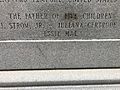
Strom Thurmond's statue with Essie Mae added. In the phrase "The father of four children", the "four" was replaced with "five".

