
Executive (government) facts for kids
The executive branch is a very important part of a government. Its main job is to make sure that the country's laws and rules are put into action and followed by everyone. Think of them as the "doers" of the government.
Contents
What is the Executive Branch?
The executive branch is responsible for carrying out the laws that the government makes. It's like the engine of a car, making sure everything runs smoothly. The power of the executive can change a lot depending on the country and its history.
Many countries, especially democracies, divide government power into different parts. This is called the separation of powers. It helps prevent any one person or group from having too much control.
- Executive Branch: This branch enforces the laws.
- Legislative Branch: This branch makes the laws.
- Judicial Branch: This branch interprets the laws and makes sure they are fair.
These branches also have "checks and balances." This means each branch can limit the power of the others. For example, the executive might propose a law, the legislature passes it, and the judiciary makes sure it follows the Constitution.
In some countries, like the United Kingdom, the executive and legislative branches work very closely. This is called a parliamentary system. Here, the leaders of the executive (the government) are usually also members of the legislature. They need the legislature's support to stay in power.
Who Leads the Executive Branch?
The leaders of the executive branch are often called head of government or head of state. Their titles and roles depend on the country's political system.
In a presidential system, like in the United States, the President is both the head of state and the head of government. They are usually elected directly by the people. The President then chooses a team of ministers or secretaries to help them.
In a parliamentary system, like in Canada or Australia, there are usually two main leaders:
- The head of government is often called the prime minister. They lead the executive branch and manage the day-to-day running of the country.
- The head of state might be a monarch (like a king or queen) or a president with mostly ceremonial duties.
Ministers are important people who lead different parts of the government. They are in charge of specific areas, like defense or finance. Here are some common roles:
- Prime Minister: This person is often the main leader of the government. They oversee all the country's affairs.
- Defence Minister: This minister is in charge of the country's armed forces. They help keep the country safe from outside threats.
- Interior Minister: This person oversees the police forces. They work to keep law and order inside the country.
- Foreign Minister: This minister handles relationships with other countries. They work on foreign policy and diplomacy.
- Finance Minister: This person manages the country's money. They oversee the national budget and economic plans.
- Justice Minister: This minister oversees the legal system. They make sure laws are followed and justice is served.
Images for kids
-
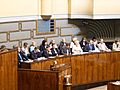
The Vanhanen II Cabinet in a session of the Finnish Parliament, 2007.

See also
 In Spanish: Poder ejecutivo para niños
