
Flag of Gascony facts for kids
 |
|
| Name | Lo Sautèr (the Saltire), Union Gascona (Gascon Union) |
|---|---|
| Use | Civil  |
| Proportion | 3:5 |
| Adopted | 12th century (1188?) |
| Design | A red field with a white diagonal cross that extends to the corners of the flag. In Blazon, Gules, a saltire Argent. |
The Flag of Gascony represents the region of Gascony in France. This flag is also known as Lo Sautèr, which means "the Saltire" or "Gascon Union." It features a white diagonal cross on a red background.
Legend says this flag first appeared around the time of Pope Clement III (1187–1191). It was supposedly used to bring Gascons together during the Third Crusade in the 12th century. However, there is no clear proof for this story. Historical records, like the Chronica by Roger of Howden, only mention the colors of crosses worn by crusaders from different nations: French (red), English (white), and Flemish (green).
The flag's design includes the St Andrew's cross. Saint Andrew is the patron saint of Bordeaux, a major city in Gascony. The red color of the flag might come from the Kingdom of England, which ruled Gascony from the 12th to the mid-15th century.
After the Hundred Years' War (1337–1453) ended, the flag was no longer used. It was not replaced for a long time. Later, in the late 17th century, a new design was created in Versailles to link Gascony symbolically to the French royal family.
Today, the historic flag of Gascony is used again. It helps people feel connected to their identity and the special values of this region. Gascony is known for its "sweetness of life" (douceur de vivre), which includes a mild climate, friendly people, good wines, and delicious food.
Contents
The Saltire: Gascony's Main Flag
Gascony has not been a single unified area since the 11th century. Because of this, different flag designs are used across the region.
The Saltire, also called "Union Gascona," is the most common flag. It shows a white Saint Andrew's cross on a red background. As mentioned, some people believe it was given by Pope Clement III during the Third Crusade, but this idea is not proven.
A famous story from the chronicler Roger of Howden tells how Pope Clement III gave crosses to the kings of France and England (including Richard I of England, who was also Duke of Aquitaine and Gascony) in 1188. The kings then gave flags with these crosses to their people. The French took red crosses, the English took white crosses, and the Flemish took green crosses.
Some people later added to this story, saying that other regions also got crosses. For example, they claimed Gascony received a white Saint Andrew's cross. However, the original historical text does not confirm this for Gascony. So, we cannot be sure if the Gascon Saltire truly comes from the Crusades or even the Middle Ages. The fact that Saint Andrew is the patron saint of Bordeaux might be a clue to its origin.
In a large French encyclopedia published between 1886 and 1902, it mentions the Hundred Years' War. During this time, the English flag in 1422 combined the white and red crosses of France and England, along with the white and red Saint Andrew's crosses of Guyenne and Burgundy. This shows that the Saint Andrew's cross was known in the region.
There was also a claim in 1903 that the Saltire was declared the "official flag of Gascony." However, there is no clear source or proof for this.
The colors red and white are very common in the traditional symbols (heraldry) of Gascon areas. This red and white flag, the Saltire (lo(u) Sautèr), is widely seen as the flag of the Gascon people.
Even if this Gascon Saltire only became popular in the late 19th or early 20th century, it follows good flag design rules. It is simple and easy to recognize from a distance. Its colors and pattern also match the talenquères (barriers) found in many bullrings in Gascony.
The Quarterly: An Older Design
 |
|
| Proportion | 2:3 |
|---|---|
| Design | XX century |
Another flag sometimes used is called the Quarterly (l'Esquarterat). This flag shows the old coat of arms of the ancient province of Gascony.
This older province was smaller than what we call "cultural Gascony" today. It did not include the Béarn region or the Gascon part of Guyenne. However, it did include the Basque areas of Labourd and Soule.
Dame Flag: A Modern Idea
 |
|
| Proportion | 2:3 |
|---|---|
| Design | XXI century |
The Dame Flag (Drapeau à la Dame) is a newer cultural flag. It was created to promote all aspects of Gascon culture. It uses the cultural colors of Gascony: red and white.
The flag's triangular shape represents Gascony itself. The region is often described as a triangle bordered by the Garonne River, the Pyrenees mountains, and the Atlantic Ocean. The head in the middle of the flag is a picture of the Venus of Brassempouy statue. This statue was found in the Landes de Gascogne area. It is about 25,000 years old and is the oldest known human face ever found. It is very small, less than 4 centimeters tall, and was carved from mammoth ivory using stone tools. This flag is not very common, but you might see it sometimes.
Images for kids
-
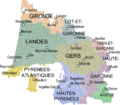
Current communes and departments included in the ancient province of Gascony
-
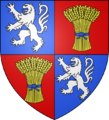
Coat of arms of Gascony


