
Fluvidona anodonta facts for kids
Quick facts for kids Fluvidona anodonta |
|
|---|---|
| Conservation status | |
| Scientific classification | |
| Kingdom: | |
| Phylum: | |
| Class: | |
| Order: |
Littorinimorpha
|
| Superfamily: |
Truncatelloidea
|
| Family: |
Tateidae
|
| Genus: |
Fluvidona
|
| Species: |
F. anodonta
|
| Binomial name | |
| Fluvidona anodonta (Hedley & Musson, 1892)
|
|
| Synonyms | |
|
|
The Fluvidona anodonta is a tiny freshwater snail. It is also known as the North Pine River freshwater snail. This snail is special because it is found only in Australia. Scientists first discovered it in 1892.
This snail is very hard to find. It has only been seen four times since it was first discovered! The snail is about 2 mm long and 1 mm wide. Its shell is a yellow-white color. Fluvidona anodonta lives in the City of Moreton Bay, Queensland. It can be found in four river systems inside D'Aguilar National Park. These rivers are the South Pine River, the North Pine River, Kobble Creek, and Low Branch Creek. The snails live under rocks deep in freshwater.
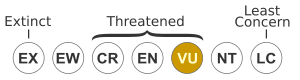
The snail's home is in danger from human activities. These include roads, farming, and even horses. In 2011, the International Union for Conservation of Nature said Fluvidona anodonta was a vulnerable species. This means it is at risk of disappearing. There are no special plans just for this snail yet. But there are ideas to protect its home. These include checking for pollution and finding out how many snails are left.
Contents
Discovery of the North Pine Snail
The Fluvidona anodonta snail was first found in 1892. It was discovered by scientists Hedley and Musson. They found it in the North Pine River system in Australia. At first, they called it Pupa anodonta. Later, in 1996, it got its common name, the "North Pine River Freshwater Snail." This name shows its connection to the North Pine River.
This snail is very mysterious. There is not much information about it. In the 1980s, the Australian Museum tried to find the snail. They went on many trips to Southeast Queensland. But they only found one broken shell. Since then, scientists have only seen the snail four times. One time, samples were sent to the Australian Museum. This happened during a check of river health by the local Council.
What the Snail Looks Like
The North Pine River freshwater snail is a very small snail. It is only about 2 millimeters long. That's about the size of a tiny ant! It is 1 millimeter wide. Its shell has four spirals that turn to the right. The lines between each spiral are a bit sunken. The last and biggest spiral makes up two-thirds of the shell's total length.
The shell is oval-shaped with a rounded tip. The edge of the shell's opening is a little thicker than the rest. The shell is a light yellow-white color. It also has tiny lines that run lengthwise along the shell.

Where the Snail Lives
The Fluvidona anodonta snail lives only in Australia. It is found in Southern Queensland. It lives in freshwater rivers in the City of Moreton Bay. Scientists have found the snail in four places. All these spots are inside the D'Aguilar National Park. These places are the beginnings of the South Pine River and the North Pine River. It also lives in Kobble Creek and Low Branch Creek.
The snail needs places that always have water. This includes rivers, streams, creeks, and waterfalls. It hides under rocks that are deep in the water. Scientists think the snail eats by scraping off bacteria and tiny algae.
The area where the North Pine River freshwater snail lives is very small. It covers only about 20 square kilometers. This shows that the snail needs very specific conditions to survive. It also cannot move very far on its own. Its small size and slow movement mean it cannot easily travel to new places. This makes it harder for the snail to spread out and find new homes.
Why the Snail is Vulnerable
In 2011, the North Pine River Freshwater Snail was listed as vulnerable. This was done by the International Union for Conservation of Nature. It means the snail is at risk of becoming endangered. The snail was put on this list because it lives in a very small area. Also, it has only been seen four times since it was discovered.
Threats to the Snail's Home
The biggest danger to Fluvidona anodonta is harm to its home. This harm comes from human activities. All four places where the snail has been found face threats. These threats worry scientists about the snail's survival.
The South Pine River's starting point is near Mount Glorious Road. This road is very busy. It connects major highways and popular towns. The road is close to the river. This is a problem because dirty water from the road can flow into the river. This "road runoff" can carry trash, chemicals, and dirt. When these get into the water, they can upset the natural balance of the ecosystem. This can harm the snail's limited home.
The North Pine River's starting point is also in danger. Land clearing for farms has broken up the snail's habitat. Parts of the river are now separated by cleared farmland. Clearing land is bad for the environment. It makes habitats worse and reduces the number of different plants and animals. For the snail, land clearing changes how water flows. It can cause creeks to dry up for longer times. It also leads to more sudden floods.
Fluvidona anodonta needs water all the time to survive. Changes in water flow can stop the snail from getting its food. Land clearing also causes more soil erosion. This means more dirt washes into the water. It also changes the amount of nutrients in the water. Too many nutrients can cause eutrophication. This leads to too much algae growing. This "algae bloom" uses up the oxygen in the water. When oxygen levels drop, plants and animals under the water can die. This harms the natural food chain.
Low Branch Creek is next to land used for farming. Horses are often used on these farms. Horse hooves can damage the stream. When horses walk through the water, they disturb the stream bed. This destroys the tiny ecosystems that live on the bottom. These are very important for the stream's health. Horses might also disturb Fluvidona anodonta snails hiding under rocks.
Horse hooves can also carry dirt and chemicals into the water. These chemicals include nitrogen and phosphorus from horse manure. Too much nitrogen and phosphorus can make too much algae grow. This again leads to eutrophication. Low Branch Creek is the least healthy of all the snail's homes. This shows that the snail can handle some pollution. But too much algae blocks sunlight. This can kill some plants in the water.
Right now, the streams where Fluvidona anodonta lives are mostly clean. But because the snail cannot move far and lives in a small area, it is very sensitive. Even small changes to its home can harm it. Scientists have given the snail a high score for how easily it is harmed by pollution. This means Fluvidona anodonta needs places that are not disturbed. It cannot handle any pollution. This is a big worry because there are not many of these snails left.
Protecting the Snail
There are no specific plans just for Fluvidona anodonta yet. But there are ideas to help protect it. The International Union for Conservation of Nature suggests checking the snail's home regularly. This would help find any pollution early. This is important because the snail cannot handle changes to its habitat. It needs clean freshwater. The Queensland Government already checks water quality often in D'Aguilar National Park. They look for increased pollution.
It was also suggested to keep track of the snail's population. This would help scientists know if the snail's numbers are growing or shrinking. A scientist named Dr. Ulrike Nolte also wrote a report for the Queensland Government. She suggested doing special surveys to find out where Fluvidona anodonta lives now. This would also help find out how many snails there are.
It is very important to protect the places where the snail still lives. This could mean making better systems for road water runoff. It could also mean teaching farmers about how horses can harm the environment. Stricter rules about clearing land could also help protect the snail's home.
Other Fluvidona Snails
Fluvidona anodonta is one of several species in the Fluvidona group. Other snails in this group include Fluvidona dorrigoensis, Fluvidona griffithsi, Fluvidona orphana, and Fluvidona petterdi. All these snails live only in northern New South Wales and southern Queensland, Australia.
They are all quite similar. They are mainly different in the shape and size of their shells. They also have small differences in their bodies. Their shells are usually long and cone-shaped. Adult snails have a slightly thicker opening, called an aperture. They also have a special lid, called an operculum, which has one or more pegs.
Fluvidona anodonta looks a lot like Fluvidona petterdi. But Fluvidona anodonta is usually smaller. The main difference is that Fluvidona anodonta has shorter pegs on its operculum. These pegs help muscles attach to the lid. All Fluvidona species, except Fluvidona orphana, do not have a penial lobe.
Images for kids
-
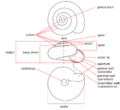
A diagram showing parts of a snail's shell
