
Freestyle swimming facts for kids

Freestyle is a type of swimming competition. In these races, swimmers have very few rules about how they can swim. Freestyle races are the most common swimming events. They range from short 50 meters (55 yards) sprints to long 1,500 meters (1,600 yards) races, sometimes called the "mile." The term 'freestyle stroke' often means the 'front crawl'. This is because the front crawl is the fastest way to swim on the surface. It is almost always the stroke swimmers choose in freestyle competitions today.
The first Olympic Games included swimming in open water. After a few Olympics, swimming moved to pools. The front crawl, or freestyle, was one of the first events introduced.
Contents
What is Freestyle Swimming?
Freestyle swimming allows swimmers to use their arms and legs in any way they choose. The only exceptions are in individual medley or medley relay events. In these, swimmers cannot use backstroke, breaststroke, or butterfly for the freestyle part. Most swimmers choose the front crawl because it helps them go the fastest.
How Do Swimmers Use the Front Crawl?
When swimming the front crawl, competitors move their arms forward in turns. They also kick their feet up and down, which is called a "flutter kick." The front crawl was developed from an older stroke called the Trudgen. An Australian swimmer named Richmond Cavill improved it after watching a boy from the Solomon Islands, Alick Wickham. Cavill and his brothers helped spread this "Australian crawl" around the world. This led to the freestyle stroke we see today.
During races, swimmers must touch the wall at each end of the pool. They cannot push off the bottom of the pool to gain speed. Also, they cannot pull on the lane lines. Other than these simple rules, any swimming style is allowed. Just like in other races, starting too early (a false start) can lead to a swimmer being disqualified.
-

A swimmer demonstrating the front crawl technique.
-

Another view of the front crawl, showing arm movement.
-

A different angle of the front crawl, focusing on body position.


The History of Freestyle Swimming
Swimming times have gotten faster over the years. This is thanks to better training and new ideas in the sport.
Early Olympic swimming competitions were not in pools. They were held in open water. For example, the 1896 Games were in the Bay of Zea. The 1900 Games were in the Seine River. The 1904 Games used an artificial lake. The 1904 freestyle race was unique because it was 100 yards, not 100 meters.
A 100-meter pool was built for the 1908 Olympics. It was in the middle of the main stadium. The 1912 Olympics, held in Stockholm harbor, were the first to use electronic timing.
Swimmers used to wear full body suits until the 1940s. These suits created more drag in the water. Modern swimwear is designed to be much faster. Pool designs have also improved. Deeper pools, wider lanes, and special lane lines that absorb energy all help swimmers go faster. The flip turn, developed in the 1950s, also made turns much quicker.
The 1924 Olympics was the first to use the standard 50-meter pool with marked lanes. Diving blocks were added at the 1936 Olympics. Before that, swimmers dove from the pool walls.
Understanding the Rules of Freestyle
In a freestyle event, a swimmer can use any style they want. However, in individual medley or medley relay races, "freestyle" means any style *except* backstroke, breaststroke, or butterfly.
Here are some key rules:
- A swimmer must touch the wall at the end of each lap and at the finish.
- Some part of the swimmer's body must be above the water's surface during the race.
- Swimmers can be completely underwater during a turn. They can also stay underwater for up to 15 meters after the start and after each turn. After 15 meters, their head must break the surface of the water. This rule stops swimmers from staying underwater for too long, which can be faster.
Different Types of Races
Freestyle swimming has many different competitions. These races happen in either a long pool (50 meters) or a short pool (25 meters). In the United States, swimmers also compete in 25-yard pools. Many swimmers compete in 25-yard pools during the school year. Then they switch to 50-meter pools in the summer.
Here are some common freestyle distances:
- 50 m freestyle
- 100 m freestyle
- 200 m freestyle
- 400 m freestyle
- 800 m freestyle
- 1500 m freestyle
There are also team races called relays:
Younger swimmers, typically 8 years old and under, sometimes swim a 25-yard or 25-meter freestyle event.
Freestyle is also a part of medley events, where swimmers use different strokes:
- 100 m individual medley (only in 25 m pools)
- 200 m individual medley
- 400 m individual medley
- 4 × 100 m medley relay
- 4 × 200 m medley relay
In long-distance races like the 800 meters (870 yards) and 1,500 meters (1,600 yards), some major competitions used to have different distances for men and women. However, today, many events, including the FINA World Championships, offer both the 800 m and 1500 m distances for both male and female swimmers.
Images for kids
-
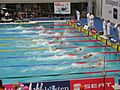
Men competing in the 100 m freestyle at the 2006 European Championships.

See also
- 100 metre freestyle
- List of world records in swimming
- History of swimming
- Special Olympics
- Olympics
