
Giant onion facts for kids
Quick facts for kids Giant onion |
|
|---|---|
 |
|
Scientific classification  |
|
| Kingdom: | Plantae |
| Clade: | Tracheophytes |
| Clade: | Angiosperms |
| Clade: | Monocots |
| Order: | Asparagales |
| Family: | Amaryllidaceae |
| Subfamily: | Allioideae |
| Genus: | Allium |
| Species: |
A. giganteum
|
| Binomial name | |
| Allium giganteum Regel
|
|
| Script error: The function "autoWithCaption" does not exist. | |
| Synonyms | |
|
Allium procerum Trautv. ex Regel |
|
Script error: No such module "Check for conflicting parameters".
The Giant onion, also known by its scientific name Allium giganteum, is a super tall plant from the onion family. It originally comes from central and southwestern Asia. People around the world love to grow it in their gardens because of its amazing purple flowers.
This plant is the tallest type of Allium that people usually grow. It can reach an impressive height of about 1.5 meters (5 feet)! Imagine a plant taller than many kids!
Contents
Discovering the Giant Onion's Flowers
In the early to middle part of summer, the Giant onion shows off its beautiful flowers. These flowers grow in round clusters called umbels. They look like bright purple balls floating on top of tall stems. After the flowers bloom, they turn into interesting seed heads.
Popular Types of Giant Onions
One very popular type of Giant onion is called 'Globemaster'. This variety is a bit shorter, growing to about 80 centimeters (31 inches). However, its flower clusters are much bigger! They can be 15 to 20 centimeters (6 to 8 inches) wide and are a deep violet color. Both the regular Giant onion and the 'Globemaster' have won a special award called the Royal Horticultural Society's Award of Garden Merit. This award means they are excellent plants for gardens.
Where Giant Onions Grow Naturally
In the wild, you can find the Giant onion growing in countries like Iran, Afghanistan, Turkey, Turkmenistan, Tajikistan, and Uzbekistan. These are all in Asia.
When people grow them in gardens, especially in the US, they do best in certain climates. These climates are called USDA hardiness zones 6 to 10. This means the plant can handle the winter temperatures in these areas.
Important Safety Tip
It's important to know that eating parts of the Giant onion plant, like its flowers, seeds, leaves, or stems, can make you feel sick. This is because they contain natural chemicals called sulfides. So, it's best to just enjoy looking at these beautiful plants in the garden!
Images for kids
-
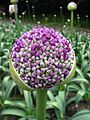
Flower opening
-
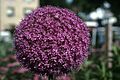
Flower fully open
.jpg)

See also
 In Spanish: Allium giganteum para niños
