
Gillis Centre facts for kids
Quick facts for kids Gillis Centre |
|
|---|---|

Front of Gillis Centre showing St Margaret's Chapel
|
|
| Lua error in Module:Location_map at line 420: attempt to index field 'wikibase' (a nil value). | |
| Location | Edinburgh |
| Country | UK |
| Denomination | Roman Catholic |
| Website | [1] |
| History | |
| Former name(s) | St Margaret's Convent, Gillis College |
| Status | Conference and Accommodation Centre |
| Founded | 1834 |
| Founder(s) | Bishop Gillis |
| Dedication | St Margaret of Scotland |
| Architecture | |
| Functional status | Active |
| Heritage designation | Category A listed building |
| Designated | 14 December 1970 |
| Architect(s) | James Gillespie Graham and E. W. Pugin |
| Style | Gothic Revival |
| Completed | 1863 |
| Administration | |
| Parish | St Peter's, Morningside |
| Deanery | St Giles' City of Edinburgh |
| Archdiocese | Archdiocese of St Andrews and Edinburgh |
| Province | St Andrews and Edinburgh |
The Gillis Centre is a group of buildings in Edinburgh, Scotland. It is located close to the city centre. This place has a long history, going back to the 1400s.
It was once known as St Margaret's Convent and School. Later, it became Gillis College from 1986 to 1993. Today, it is called the Gillis Centre. It serves as the main office for the Archdiocese of St Andrews and Edinburgh, which is part of the Roman Catholic Church in Scotland.
The chapel at the Gillis Centre is a very important building. It is listed as a Category A listed building. This means it has "national or international importance." Other buildings on the site are also listed, but in lower categories.
Contents
Early History of the Gillis Centre
The Whitehouse Estate
The land where the Gillis Centre stands was first known as 'Whitehouse'. The street next to it, Whitehouse Loan, got its name from this old house. In the 1700s, many famous writers and thinkers lived or worked here. They were often connected to the University of Edinburgh.
For example, Principal Robertson wrote his book The History and Reign of Charles V here in 1769. In 1756, John Home wrote his play Douglas. Also, Hugh Blair wrote his Lectures at Whitehouse in 1783.
St Margaret's Convent Opens

In the 1830s, the Roman Catholic Church in Scotland was still growing. James Gillis, who later became a bishop, traveled to Europe. He wanted to raise money to start a convent in Scotland.
During his trip, he met Ann Agnes Trail in London. She was the daughter of a minister from the Church of Scotland. Miss Trail later wrote to him, offering to join his new religious community. Another founding member was Miss Margaret Clapperton. She knew James Gillis from her hometown of Fochabers.
Miss Trail and Miss Clapperton went to Chavagnes, France. This was the main house for the Ursulines, a group of nuns. In June 1834, James Gillis bought the Whitehouse property. He paid £3,000 for the house and two acres of land.
The first group of eleven Sisters arrived in Scotland. They included Sister Agnes Xavier (Miss Trail) and Sister Margaret Teresa (Miss Clapperton). They had to wait four months while the convent was prepared. On December 26, 1834, they moved into St Margaret's Convent. This was the first convent in Scotland since the Reformation.
At St Margaret's, the Sisters focused on educating young girls. On June 16, 1835, the new St Margaret's Chapel opened. It was built next to the Whitehouse Mansion House. In 1863, Bishop Gillis gave a special relic of St Margaret of Scotland to the chapel. The Ursuline Sisters ran St Margaret's Convent and School for over 150 years. It closed in 1986.
Chapel Design
The chapel is dedicated to St Margaret of Scotland. It was designed by James Gillespie Graham. He was likely influenced by another famous architect, A. W. N. Pugin. The chapel opened in 1835. Later additions were made by Archibald Macpherson between 1893 and 1895.
The chapel has a neo-Norman style with aisles. It also has a later apsidal gothic east end. The gatehouse and convent building were also designed by James Gillespie Graham. The school building was completed in 1863. It was designed by E. W. Pugin, who was A. W. N. Pugin's son.
Gillis College Era
In 1986, St Margaret's Convent School closed its doors. The Ursuline Sisters moved to a nearby building. St Margaret's Convent was still partly owned by two trusts.
In 1986, a seminary called St Andrew's College, Drygrange moved to St Margaret's. A seminary is a school that trains students to become priests. The new seminary was named Gillis College, after Bishop James Gillis.
On January 29, 1988, the land and buildings were given to the Trustees of the Archdiocese of St Andrews and Edinburgh. Gillis College was the main seminary for the archdiocese. It trained students for the priesthood from different dioceses. In 1993, Gillis College closed. The remaining students moved to Bearsden, Glasgow. There, the Scottish bishops decided to create a National Seminary of Scotland, called Scotus College.
The Gillis Centre Today

After Gillis College closed, the complex became the Gillis Centre. The offices for the archdiocese moved into the buildings. Work also began to create a conference centre with places for people to stay. The Gillis Centre offered bed and breakfast until November 30, 2017.
Today, the Gillis Centre provides office space for various church groups and organizations. It also has a large theological library from the former Gillis College. On November 30, 2017, the Diocesan Pastoral Office closed. Many of its duties were given to five priests who became episcopal vicars.
On November 16, 2008, the relic of St Margaret of Scotland was moved. It had been in the chapel at the Gillis Centre. It was returned to St Margaret's Memorial Church in Dunfermline, Fife.
Images for kids
-
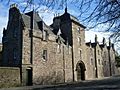
View from Whitehouse Loan
-
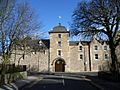
View from St Margaret's Road


