
Grey-throated chat facts for kids
Quick facts for kids Grey-throated chat |
|
|---|---|
.jpg) |
|
| Conservation status | |
Scientific classification  |
|
| Kingdom: | Animalia |
| Phylum: | Chordata |
| Class: | Aves |
| Order: | Passeriformes |
| Family: | Cardinalidae |
| Genus: | Granatellus |
| Species: |
G. sallaei
|
| Binomial name | |
| Granatellus sallaei (Bonaparte, 1856)
|
|
 |
|
| Script error: The function "autoWithCaption" does not exist. | |

Script error: No such module "Check for conflicting parameters".
The Grey-throated Chat (Granatellus sallaei) is a small, colorful bird. It belongs to the Cardinalidae family, which includes cardinals and grosbeaks. You can find this bird in parts of Belize, Guatemala, and Mexico.
Contents
About Its Family
For a long time, scientists thought the Grey-throated Chat belonged to the New World warbler family. But in the early 2000s, studies looked at the birds' DNA. These studies showed that the Grey-throated Chat actually belongs with the cardinals.
The Grey-throated Chat is very closely related to two other birds. These are the Red-breasted Chat and the Rose-breasted Chat. They are like a special group of birds that are very similar.
There are two main types, or subspecies, of the Grey-throated Chat. They are called Granatellus sallaei sallaei and G. s. boucardi.
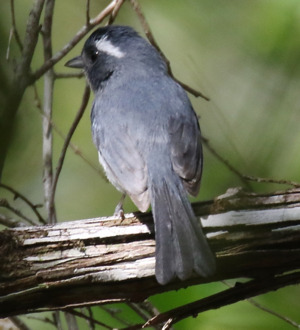
What It Looks Like
The Grey-throated Chat is about 13 cm (5.1 in) long. That's about the length of a small ruler! It weighs between 8.8 to 11 g (0.31 to 0.39 oz). That's lighter than a pencil.
The adult male of the main type has a gray head, back, wings, and tail. It has a cool white stripe right behind its eye. Its chest and the area under its tail are a pretty rose-red color. Its sides are gray, and the rest of its belly is white.
The female looks a bit different. Her head, neck, and upper parts are a duller gray than the male's. She has a buff (light yellowish-brown) stripe behind her eye. Her face, chest, sides, and the area under her tail are also buff. Her throat and belly are white.
The other type, G. s. boucardi, is a slightly lighter gray. The female of this type is brownish-gray on top. Her face and underparts are a creamier buff color.
Where It Lives
The main type of Grey-throated Chat lives in southern Veracruz, most of Tabasco, eastern Oaxaca, and northern Chiapas in Mexico. The G. s. boucardi type lives from the Yucatán Peninsula south into central Guatemala and Belize.
This bird likes to live in lowland areas. It prefers dry or slightly humid forests and the edges of these forests. It also likes thick, dense bushes next to forests. However, it usually avoids very wet forests.
How It Behaves
What It Eats
The Grey-throated Chat finds its food by picking up insects and other small creatures. It searches for food on the ground and in low bushes. Sometimes, it even follows groups of army ants. These ants stir up insects, making them easier for the chat to catch.
Life Cycle
Grey-throated Chat pairs usually stay in their home area all year round. They build a cup-shaped nest low in plants. Scientists have only found one nest with eggs, and it had two eggs inside. We are still learning a lot about how these birds raise their young.
What It Sounds Like
The Grey-throated Chat's song is a series of 4 to 5 whistled notes that change a bit each time. It also has a call that sounds like a "fairly harsh 'chwit'". You can listen to its sounds online!
Its Status
A group called the IUCN checks on animals around the world. They have said the Grey-throated Chat is a species of "Least Concern." This means it is not in danger of disappearing. Even though we don't have exact numbers, the bird seems to be quite common in its habitat.
