
Holy Trinity Church, Weston facts for kids

Holy Trinity Church is a special old church in the village of Weston, which is in Hertfordshire, England. It sits on a hill to the south-east of the village. The church is built from strong stones like flint and ironstone. It was recognized as a very important historical building in 1968. In the churchyard, you can find what many believe is the grave of a legendary giant named Jack o'Legs.
Contents
History of Holy Trinity Church
The Domesday Book, a famous survey from 1086, mentions two priests in Weston. However, it doesn't say if there was a church building there at that time.
The right to choose the priest for the church, called the advowson, was given to the Knights Templar before 1148. This was done by Gilbert de Clare. Later, William Marshall also confirmed this. The Knights Templar held this right until 1309. After their group was stopped, the right passed to another group called the Knights Hospitallers.
In 1481, people in Weston complained about their vicar, John Hawthorn. They said he was "a common player" and often played games like "Penyprykke" and "Bowles." He was told to stop or pay a fine.
Today, Holy Trinity Church is part of the Diocese of St Albans.
Design and Features of the Church

The church building you see today was built in the 12th century. It has a traditional cruciform shape, which means it looks like a cross from above. In the 15th century, more parts were added. These included the south aisle (a side part of the church), a south porch (an entrance area), and a clerestory (a row of windows high up). New windows and a south transept (the arm of the cross shape) were also added.
The chancel, which is the area around the altar, was rebuilt in 1840. It was designed in a style called Neo-Norman, using brick covered with stucco (a type of plaster). The church was repaired and updated in 1867. During this time, the top part of the tower was added. The vestry, a room used by the clergy, was added in 1880.
The main part of the church, called the nave, is covered in plaster. The tower and north transept are made of flint and stone. The roof of the nave is from the 15th century. It rests on interesting stone carvings called corbels, which look like strange faces. The font, used for baptisms, is also from the 15th century. It has eight sides and is decorated with panels shaped like four-leaf clovers.
The wooden pulpit, where sermons are given, also has eight sides. It was moved to Holy Trinity Church in 1840 from another church in Cambridge. It is said that a famous preacher named Jeremy Taylor once used this pulpit.
The church has five bells in its belfry:
- The smallest bell (treble) was made by John Waylett in 1716.
- The second and third bells were made by Miles Graye in 1634.
- The fourth bell was made by Warner & Sons in 1867.
- The largest bell (tenor) was made by R. Chandler in 1682.
The Legend of Jack o'Legs

In the churchyard of Holy Trinity Church, there is a grave that many believe belongs to Jack o'Legs. According to a local story, Jack o'Legs was a giant who lived in a cave in a wood near Weston. The legend says he would steal food from the people in the nearby town of Baldock. The grave itself is unusually long. Some people think it was made that way on purpose to help people believe the legend of the giant.
Gallery
-
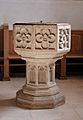
The font
-
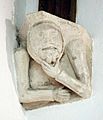
A corbel
-
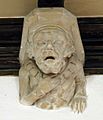
A corbel


