
Ice axe facts for kids
An ice axe is a special tool used by mountaineers when they go hiking and climbing in snowy or icy places. It helps them go up and down mountains safely. Mountaineers use it like a walking stick on easier slopes. On steeper ice or snow, they swing it to dig the pick into the surface for grip and safety. An ice axe can also be used to create a secure anchor in the snow for ropes, helping other climbers. The flat part, called the adze, is useful for cutting steps or clearing snow.

Contents
What is an Ice Axe?
The modern ice axe developed from an older, long wooden pole called an alpenstock. Besides helping climbers move, an ice axe is super important for self-arrest. This means stopping yourself quickly if you slip and start sliding down a snowy slope.
Most ice axes are made to high safety standards set by groups like the Union Internationale des Associations d'Alpinisme (UIAA). There are two main types of ice axes:
- Basic Ice Axes (Type 1) are for general mountaineering in snowy conditions. They offer good support and are great for stopping falls.
- Technical Ice Axes (Type 2) are stronger and often have curved shafts. These are used for climbing very steep or vertical ice and for setting up secure rope systems in tough conditions.
Special, smaller ice axes called ice tools are used in pairs for vertical ice climbing. These tools have shorter, more curved shafts and sharper picks. They often have special grips for better handling.
For ski mountaineering or racing, where every gram counts, some ice axes are made very short (around 45 cm) and light (200-300 grams). These might have lighter aluminum parts instead of steel.
Parts of an Ice Axe
An ice axe has several important parts, usually made of strong materials like steel or lightweight metals:
- Head – This is usually made of steel. It has a pick and an adze. There's often a hole to attach a wrist leash or a carabiner.
- Pick – The sharp, pointed end of the head. It often has teeth and a slight curve to help it grip ice and snow, and to make self-arrest easier.
- Adze – The flat, wide end of the head. It's used for chopping steps into hard snow or ice, making it easier to walk.
- Hammer – Some ice axes have a hammer instead of an adze. This is useful for hammering in climbing gear for protection.
- Shaft – The main handle of the axe. It can be straight or slightly angled. Older shafts were wood, but now they are usually made of light metals like aluminium or strong composites.
- Spike – A sharp point at the bottom of the shaft. It helps with balance and safety when you use the axe like a walking stick.
Ice Axe Accessories


Here are some helpful accessories for your ice axe:
- Leash – A strap that attaches the axe to your wrist. This stops you from dropping it, especially on steep slopes.
- Leash Stop – A rubber ring or metal stud that keeps the leash from sliding off the axe.
- Snow Basket – Similar to those on ski poles, this small disc can be added near the spike. It stops the shaft from sinking too deep into soft snow.
- Pick and Adze Guard – A cover that protects the sharp pick and adze when the axe is not being used. This keeps you safe and protects your gear.
- Spike Guard – A cover for the sharp spike at the bottom of the axe.
Choosing the Right Size
In the past, ice axes were often quite long, from 60 to 90 cm. This length was good for walking on steep slopes. For flatter ground, where slipping isn't as dangerous, walking poles are often a better choice.
An old way to check the right length was to stand relaxed and hold the axe by your side, with the spike pointing down. The spike should just touch the ground. This method is still good for walking on glaciers.
Today, many mountaineers prefer shorter ice axes, usually between 45 and 60 cm. Axes longer than 60 cm are often seen as too big and hard to handle for cutting steps or climbing steep snow.
A Brief History of the Ice Axe


Before the ice axe, people used a long wooden pole called an alpenstock. Shepherds in the Alps used these poles with iron spikes for traveling on snow and glaciers for hundreds of years.
A big moment in climbing history was on August 8, 1786, when Jacques Balmat and Michel-Gabriel Paccard were the first to climb Mont Blanc. Pictures show Balmat using two different tools: an alpenstock and a small axe for cutting steps in ice. These two tools later became the ice axe.
The company Grivel, one of the first ice axe makers, says these two tools were combined around 1840 to create the first true ice axe. Early ice axes had an adze that was aligned with the shaft, like a regular axe. But by 1860, the adze was rotated to its current position, across the shaft. In 1889, the Italian Alpine Club even wrote a book that said ice axes were essential for mountaineers.
In the late 1800s, ice axes were typically 120-130 cm long. British climber Oscar Eckenstein helped make them shorter and lighter, around 85-86 cm. At first, some famous climbers didn't like this change, but shorter axes eventually became popular.
Over time, the pick of the ice axe became longer than the adze. Better crampons (spikes for boots) and new ice climbing techniques led to even shorter, lighter ice axes for climbing steeper ice between the two World Wars.
A Famous Rescue on K2
A famous rescue happened on K2, the world's second-highest mountain, in 1953. A climber named Art Gilkey became unwell. His teammates tried to lower him down the mountain using ropes. During this, Gilkey and five other climbers started to fall down a steep icy slope! Luckily, another climber, Pete Schoening, quickly jammed his ice axe next to a big rock. He used it to stop the fall, saving everyone's lives. Sadly, Gilkey was later lost in an avalanche during the same descent. Schoening's heroic ice axe is now on display at the Bradford Washburn American Mountaineering Museum in Golden, Colorado.
Modern Ice Axe Design
In 1966, Yvon Chouinard made a big change to ice axe design. He worked with a manufacturer to create a 55 cm long ice axe with a much more curved pick. Chouinard believed that a curved pick would stick better in the ice when a climber put their weight on it. His idea worked, leading to many new ideas in ice axe design.
In 1978, the UIAA set official safety standards for ice axes. This led to metal shafts replacing traditional wooden ones. Curved handles became common in 1986. Today, new aluminum alloys make some ice axes incredibly light. For example, the C.A.M.P. Corsa model weighs only 205 grams with a 50 cm shaft! While great for easy glacier travel, some experts still prefer a heavier steel axe for very challenging climbs.
Gallery of Ice Axes from the 1970s to 2010s
-
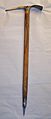
A wooden handled ice axe from the mid-1970s
Length: 75 cm
Weight: 838 g -
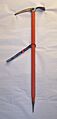
A metal handled ice axe from the late 1970s
Length: 91 cm
Weight: 959 g -

A lightweight CAMP Corsa ice axe purchased in 2007
Length: 70 cm
Weight: 276 g -
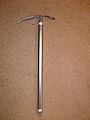
A 2011 Black Diamond ice axe. 71 cm long with a weight of 425 g


How to Carry an Ice Axe

When you're not using your ice axe, you usually attach it to the outside of your backpack (rucksack). Many backpacks have special loops and straps to hold the axe securely. Some backpacks even have attachment points for two ice axes, which is useful for ice climbing where climbers often use two tools.
