
Mont Blanc facts for kids
Quick facts for kids Mont Blanc |
|
|---|---|
| Monte Bianco (Italian) | |

Mont Blanc from the Chamonix Valley, France
|
|
| Highest point | |
| Elevation | 4,805.59 m (15,766.4 ft) |
| Prominence | 4,696 m ↓ by Lake Kubenskoye Ranked 11th |
| Isolation | 2,812 km → Kukurtlu Dome |
| Parent peak | Mount Elbrus |
| Listing | Country high point Ultra Seven Summits World's most isolated peaks 13th |
| Geography | |

 Mont Blanc
Location in Alps

Mont Blanc
Location in France

Mont Blanc
Location in Italy

Mont Blanc
Location in Europe
|
|
| Location | Auvergne-Rhône-Alpes, France Aosta Valley, Italy |
| Country | |
| Parent range | Graian Alps |
| Climbing | |
| First ascent | 8 August 1786 by
|
Mont Blanc (which means 'white mountain' in French, Italian, and a local language) is a majestic mountain in the Alps. It stands tall at 4,807.3 meters (15,771.9 feet) above sea level. This impressive peak is located right on the border between France and Italy. It is the highest mountain in Europe outside the Caucasus Mountains. Mont Blanc is also one of the most prominent mountains in the world.
The mountain gives its name to the Mont Blanc massif, a large group of mountains. This massif stretches across parts of France, Italy, and Switzerland. Mont Blanc's top sits on the natural water divide. This line separates valleys in Italy from valleys in France. For a long time, France and Italy have discussed who owns the very top of the mountain.
The Mont Blanc area is very popular for outdoor fun. People enjoy hiking, climbing, and trail running there. In winter, it's a great spot for skiing and snowboarding. The most common way to climb to the top is the Goûter Route. This climb usually takes two days.
Three towns are close to Mont Blanc. These are Courmayeur in Italy, and Saint-Gervais-les-Bains and Chamonix in France. Chamonix hosted the very first Winter Olympics in 1924. A cable car takes people across the mountain range. It goes from Courmayeur to Chamonix. The Mont Blanc Tunnel, a long tunnel under the mountain, connects France and Italy. It was built between 1957 and 1965. This tunnel is a key route for travel across the Alps.
Contents
Understanding Mont Blanc's Geology
Mont Blanc and its neighboring mountains are mostly made of a hard rock called granite. This granite pushed up through older rocks a very long time ago. This happened during a major period when mountains were forming. The very top of Mont Blanc is where these two types of rock meet. Over millions of years, glaciers and weather have shaped the mountain into what we see today.
Scientists have found many different types of minerals in the Mont Blanc area. The first detailed list of these minerals was made in 1873. Today, we know of at least 68 different kinds of minerals in the Mont Blanc massif.
Mont Blanc's Climate and Weather
Mont Blanc sits between two different climate zones in the Alps. This means its weather can be quite varied. The conditions on its large glaciers are similar to those in the northern Swiss Alps.
The climate here is generally cold and mild. However, it changes a lot with how high you go. Since Mont Blanc is the highest part of the Alps, it can even create its own weather. Temperatures drop as you climb higher. The summit of Mont Blanc is always covered in ice. Temperatures there are usually around -20 degrees Celsius (-4 degrees Fahrenheit). Strong winds and sudden weather changes are also common at the top.
The amount of precipitation (rain and snow) also changes with altitude. For example, the town of Chamonix, at about 1,030 meters, gets about 1,020 mm of precipitation each year. Higher up, at 3,500 meters, it gets much more, around 3,100 mm. But surprisingly, at the very highest parts, near the summit, the precipitation is less, about 1,100 mm.
Mont Blanc Through History

Mont Blanc was once the highest mountain in the Frankish Empire and later the Holy Roman Empire. This was before 1792. The name 'Mont Blanc' first appeared on a map in 1744. This map showed the Chamonix valley.
In 1760, a Swiss scientist named Horace-Bénédict de Saussure became very interested in Mont Blanc. He tried to climb it with a local guide, Jean-Laurent Jordaney. De Saussure offered a reward for anyone who could reach the summit.
The first recorded climb to the top of Mont Blanc happened on August 8, 1786. Two brave men, Jacques Balmat and Dr. Michel-Gabriel Paccard, made this historic ascent. This event is often seen as the beginning of modern mountain climbing. The first woman to reach the summit was Marie Paradis in 1808.

Who Owns the Summit?
The border between Italy and France usually follows the main ridge of the Alps. However, the exact border near the top of Mont Blanc and a nearby peak, Dôme du Goûter, has been debated. Italian officials believe the border goes right over both summits, sharing them between Italy and France. French officials, however, say the border goes around the summits, placing them entirely within France. This means there are two areas on the mountain where the ownership is not fully agreed upon.

The Janssen Observatory

In 1890, a famous astronomer named Pierre Janssen wanted to build an observatory on top of Mont Blanc. He hoped to study the stars from this high point. Gustave Eiffel, who designed the Eiffel Tower, agreed to help. But he needed a solid rock foundation. In 1891, workers dug deep into the ice but found no rock. So, Eiffel's plan was stopped.
Even without a rock foundation, the observatory was built in 1893. It was supported by special levers attached to the ice. This worked for a while, but by 1906, the building started to lean. A few years later, a large crack opened under the observatory. It had to be abandoned. Eventually, most of the building fell, but its tower was saved.
Air Crashes on Mont Blanc
Mont Blanc has been the site of two airplane crashes. Air India Flight 245 crashed in 1950, and Air India Flight 101 in 1966. Both planes were flying towards Geneva Airport. Sadly, many lives were lost in these accidents. A famous scientist, Homi J. Bhabha, was among the passengers on Flight 101.
The Mont Blanc Tunnel

In 1946, work began on a tunnel through Mont Blanc. This tunnel would connect Chamonix, France, and Courmayeur, Italy. It was designed to be a major route for cars and trucks across the Alps. The Mont Blanc Tunnel opened in 1965. It is over 11 kilometers (7 miles) long.
Tunnel Safety Improvements
In 1999, a truck caught fire inside the tunnel. This caused a very serious incident. After this tragic event, the tunnel was closed for major safety upgrades. These improvements included new computer systems to detect problems. More safety areas and an escape tunnel were added. A fire station was built in the middle of the tunnel. Now, all trucks are checked before they enter. The renovated tunnel reopened three years later, much safer for everyone.
Measuring Mont Blanc's Elevation


The very top of Mont Blanc is covered by a thick layer of ice and snow. This layer changes in thickness, so the mountain's exact height can vary. Scientists use special tools like GPS to measure its elevation accurately.
For a long time, its official height was about 4,807 meters. In 2002, new measurements using GPS found it to be 4,807.40 meters. After a very warm summer in 2003, a team of scientists measured it again. They found the height was 4,808.45 meters. The peak had also moved slightly.

Since then, scientists have continued to measure the mountain's height every two years. These measurements help them understand how the mountain changes. In 2023, the elevation was recorded as 4,805.59 meters. This was a lower record after a long dry period in the Western Alps. In 2025, the elevation increased to 4,807.3 meters.
On a clear day from the summit, you can see many other mountain ranges. These include the Jura, the Vosges, and the Massif Central. You can also see the main peaks of the Alps.
Popular Climbing Routes

Many classic climbing paths lead to the top of Mont Blanc. These routes are exciting but also very challenging. Climbers need to be well-trained and have the right equipment.
The most popular route is the Goûter Route. It starts by taking a special tramway. Climbers then hike to a refuge for the night. The next day, they continue over icy ridges to the summit. This route has a section known for falling rocks, so climbers must be careful.
Another route is 'La Voie des 3 Monts.' This path starts from Chamonix. Climbers take a cable car and stay overnight in a hut. The next day, they cross two other high mountains before reaching Mont Blanc's summit.
There are also routes from the Italian side, like 'La route des Aiguilles Grises.' This involves crossing glaciers and staying in mountain refuges.
About 20,000 climbers try to reach the summit each year. While it might seem easy for some, it's a very tough climb. It requires good fitness and getting used to the high altitude. Even from nearby peaks, Mont Blanc looks close, but the climb is long and demanding.

Safety on the Mountain
Climbing Mont Blanc is a serious adventure. Sadly, accidents can happen, and some climbers have lost their lives. On busy weekends, rescue teams often help people who are in trouble. All routes require proper equipment and knowledge of high-altitude climbing. It's best to go with an experienced guide. Climbers can also get altitude sickness, which can be dangerous if not treated. The mountain's changing conditions, like rockfalls or avalanches, also add to the risks. Safety is always the most important thing when climbing Mont Blanc.
Mountain Refuges
Along the climbing routes, there are several mountain shelters called refuges. These are important places where climbers can rest, eat, and stay overnight. They offer a safe stop during the long journey to the summit.
- Refuge Vallot, 4362 m
- Bivouac Giuseppe Lampugnani, 3860 m
- Bivouac Marco Crippa, 3840 m
- Refuge Goûter, 3817 m
- Bivouac Corrado Alberico – Luigi Borgna, 3684 m
- Refuge Cosmiques, 3613 m
- Refuge Tête Rousse, 3167 m
- Refuge Francesco Gonella, 3071 m
- Refuge Grands Mulets, 3050 m
Impacts of Climate Change
Rising temperatures and heatwaves are affecting Mont Blanc. These changes are causing glaciers to melt faster. This creates new dangers for climbers, such as more rockfalls and avalanches. For example, in 2015, some climbing routes became too dangerous and had to be closed.
In 2016, a new large crack opened in a glacier high up on the mountain. This showed that the glaciers were moving in new ways. This new crack created another obstacle for climbers on popular routes. These changes highlight the importance of understanding and protecting our environment.
Notable Events and Achievements

- 1786: The first ascent, by Michel-Gabriel Paccard and Jacques Balmat.
- July 1808: The first ascent by a woman, Maria Paradis.
- July 1838: The second ascent by a woman, Henriette d'Angeville.
- 1960: The airplane pilot Henri Giraud landed on the summit, which is only 30 meters long.
- 8 June 2007: Danish artist Marco Evaristti draped the peak of Mont Blanc with red fabric to raise awareness of environmental issues.
- 13 September 2007: A group of 20 people set up a hot tub at the summit.
- 11 July 2013: Kilian Jornet set a record for the fastest ascent and descent in 4 hours, 57 minutes and 40 seconds.
- 17 June 2023: Hillary Gerardi set a new women's fastest known time with 7 hours, 27 minutes and 39 seconds.
Protecting Mont Blanc
The Mont Blanc massif is being considered as a potential World Heritage Site. This is because of its unique beauty and its importance in the history of mountaineering. For it to be listed, the governments of Italy, France, and Switzerland would need to ask UNESCO.
Mont Blanc is one of the most visited places in the world. Because of this, some people worry about its future. Groups like Pro-Mont Blanc work to protect the mountain. They highlight problems and solutions for keeping the area special.
In 2007, Europe's two highest toilets were placed on Mont Blanc at 4,260 meters (13,976 feet). These are serviced by helicopter. They help keep the mountain clean by managing waste from the many hikers and skiers.
Global warming has started to melt glaciers and cause avalanches on Mont Blanc. This makes climbing conditions more dangerous. Protecting Mont Blanc means protecting its environment for future generations.
Panorama


Images for kids
-
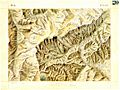
1832 Map of the Kingdom of Sardinia showing an administrative border passing through the summit of Mont Blanc. This was the same map annexed to the 1860 treaty to determine the current border between France and Italy.
-
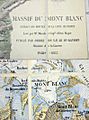
Captain Mieulet map of 1865 placing the international border south of the watershed
-
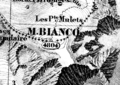
A Sardinian Atlas map of 1869 showing the international border on the watershed
-
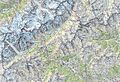
1:50'000 Swiss National Map, with both disputed areas marked


See also
 In Spanish: Mont Blanc para niños
- Exploration of the High Alps
- Haute Route
- Mont Blanc (Moon)
- Tête Rousse Glacier
- Mont Blanc massif
- Mont Blanc Tramway
- Mont Blanc Tunnel
- Tour du Mont Blanc
- Top of the Mont Blanc
- List of Alpine four-thousanders
