
Jangseung facts for kids
| Jangseung | |

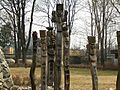
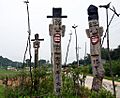
Jangseungs at the Korean Folk Village near Seoul.
|
|
Quick facts for kids Korean name |
|
|---|---|
| Hangul |
장승
|
| Hanja |
長承 or 長丞
|
| Revised Romanization | Jangseung |
| McCune–Reischauer | Changsŭng |
| Alternate names: Beopsu (법수), Beoksu (벅수) |
|
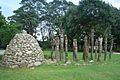
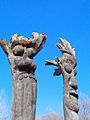
A jangseung (say it: jang-sung) is a special type of Korean totem pole, usually made from wood. Imagine them as friendly, carved guardians! For a long time, jangseungs were placed at the edges of villages. Their job was to mark where the village began and to scare away any bad spirits or demons. People also looked up to them as important village protectors, almost like local gods.
In the southern parts of Korea, like the Jeolla, Chungcheong, and Gyeongsang areas, jangseungs have other names. They are sometimes called beopsu or beoksu. These names come from an old word, boksa, which means a male shaman or spiritual guide.
In the Jeolla region, you might see jangseungs made of stone. These stone guardians look a bit like the famous dolhareubang statues found on Jeju Island.

Contents
Jangseungs in History
In the 18th century, during the Joseon Dynasty in Seoul, a king named Jeongjo ordered jangseungs to be put up. He wanted them near an area called Sangdo. The king was traveling to Suwon to visit his father's tomb. He believed the jangseungs would protect him from evil spirits during his journey.
Because of these guardian poles, that area in Seoul became known as Jangseungbaegi. Today, there's even a subway station there called Jangseungbaegi Station on Line 7 of the Seoul Metropolitan Subway.
What Jangseungs Say
Jangseungs often have special words carved into their fronts. These words describe who the carved figures are.
"Male" jangseungs usually have carvings in Hangul (Korean alphabet) or Hanja (Chinese characters). They often say "Great General of All Under Heaven" (Cheonha-daejanggun). These male guardians usually wear fancy headpieces, like those worn by old Korean nobles or scholars.
"Female" jangseungs have simpler headpieces. Their carvings often say "Female General of the Underworld" (Jiha-yeojanggun) or "Great General of the Underworld" (Jiha-daejanggun).
Different Kinds of Guardians
Jangseungs served different purposes depending on where they were placed. They can be grouped into a few types:
Village Guardians
These are the most common type. They were seen as the protectors of the entire village. Their jobs included:
- Guarding the village.
- Keeping bad ghosts away.
- Preventing fires.
- Bringing good luck and happiness to the people.
Temple Guardians
These jangseungs were placed near Buddhist temples. Their main role was to protect the temple from invisible evil spirits. They also acted as boundary markers, showing where the temple grounds began.
Public Guardians
Public guardians were like ancient milestones or street gods. They were put up along roads, at gates, or near army camps. Their job was to keep travelers safe and protect important public places.
Gallery
-
-
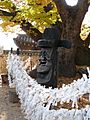
Jangseung in Hahoe Folk Village
-
-
-


See also
- Dolhareubang
- Korean shamanism
- Pole worship
- Religion in Korea
- Seonangdang
