
List of World War II British airborne battalions facts for kids

During World War II, the British airborne forces were special military units trained to fight by dropping from the sky. They included soldiers who jumped with parachutes (the Parachute Regiment) and those who landed in gliders (the Glider Pilot Regiment and airlanding battalions). From 1944, the Special Air Service (SAS) also joined them.
These special forces were created after Germany had great success using airborne troops in the Battle of France. The British Prime Minister, Winston Churchill, decided that Britain needed its own airborne soldiers. He asked the army to look into creating a group of 5,000 parachute troops.
In 1940, a unit called No. 2 Commando started training for parachute duties. It was later renamed the 11th Special Air Service Battalion. On February 10, 1941, 38 men from this battalion took part in Operation Colossus, which was the very first British airborne operation. Later that year, the battalion became the 1st Parachute Battalion. Many volunteers came forward, allowing the army to form more parachute battalions, like the 2nd, 3rd, and 4th. Soldiers who would land by glider also formed special "airlanding" battalions starting in late 1941.
Growing the Airborne Forces
The early successes of these British airborne operations encouraged the army to make the force even bigger. In April 1942, they set up a special training center in Derbyshire and officially created the Parachute Regiment. The British forces got another boost after the Germans had a big airborne victory in the Battle of Crete. The army announced that any soldier could volunteer to join the parachute or glider units.
By the end of the war, the British Army had formed seventeen parachute battalions and eight airlanding battalions. These units were part of seven parachute brigades, three airlanding brigades, and three airborne divisions. Some British battalions even served with Indian Army groups in the Far East. Also, a Canadian parachute battalion and a Polish parachute brigade fought alongside British airborne divisions.
Key Airborne Operations
Almost all the airborne battalions took part in various operations. The very first was a small mission in Italy, followed by a larger parachute landing in France. As they gained more experience, these missions grew. There were three battalion-sized parachute landings in Tunisia. Later, entire parachute and airlanding brigades carried out landings in Sicily and southern France.
The biggest and most famous British airborne operations were three huge landings involving entire divisions. These happened during the Normandy landings, the Battle of Arnhem, and the River Rhine crossing in Germany. These operations showed how important and effective airborne troops could be.
Distinctive Uniforms
British airborne forces were easy to spot because of their unique uniforms. They wore a special maroon beret. They also had a patch showing Bellerophon riding the flying horse Pegasus, which became their symbol. Trained parachutists wore special parachute wings on their right shoulder.
When they were on missions, airborne soldiers wore their own type of steel helmet instead of the usual British helmet. After 1942, they were also given a camouflaged jacket called the Denison smock, which helped them blend into their surroundings.
Images for kids
-
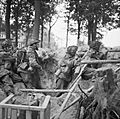
Soldiers from the 1st Parachute Battalion.
-
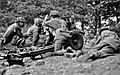
An anti-tank gun at Arnhem.
-
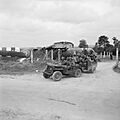
Riflemen in a jeep with a trailer.
-
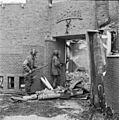
A Dutch school being searched.
-
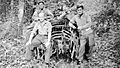
SAS soldiers during Operation Bulbasket.
-
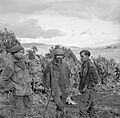
2nd Parachute Battalion in Tunisia.
-
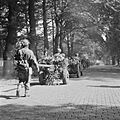
British Airborne Division at Arnhem.
-
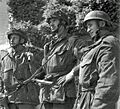
Soldiers from the 2nd Oxfordshire and Buckinghamshire Light Infantry.
-
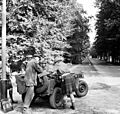
Two men next to a jeep.
-
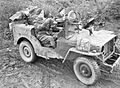
An SAS jeep in November 1944.
-
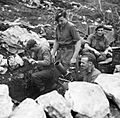
A mortar team from the 4th Parachute Battalion in Italy.
-
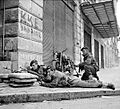
5th Parachute Battalion in Greece.
-
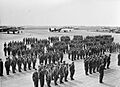
Soldiers from the 6th Parachute Battalion.
-
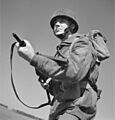
Private Smith of the 8th Parachute Battalion.
-
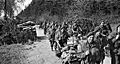
Soldiers from the 9th Parachute Battalion.
-
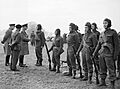
General Sir John Dill inspecting parachute troops.
-
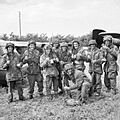
Soldiers from the 12th Parachute Battalion.
-
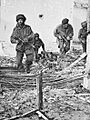
British paratroopers in Oosterbeek.


,_inspecting_parachute_troops_at_the_Central_Landing_Establishment_at_RAF_Ringway_near_Manchester,_December_1940._H6209.jpg)


