
Mani Ram Bagri facts for kids
Quick facts for kids
Mani Ram Bagri
|
|
|---|---|
 |
|
| Member of Legislative Assembly | |
| Constituency | Fatehabad, Haryana |
| Member of Parliament 3rd Lok Sabha | |
| Constituency | Hisar, Haryana |
| Member of Parliament 6th Lok Sabha | |
| Constituency | Mathura, Uttar Pradesh |
| Member of Parliament 7th Lok Sabha | |
| Constituency | Hisar, Haryana |
| Personal details | |
| Born | 1 January 1920 Ban Mandori, Hisar, Punjab, British India |
| Died | 31 January 2012 (aged 92) Hisar, Haryana |
| Nationality |  India 1947–2012 India 1947–2012 British India 1920–1947 British India 1920–1947 |
| Spouse | Dhani Devi |
| Children | 5 |
| Residences | Bagri Chowk, Hisar, Haryana |
| Profession | Activist, Politician |
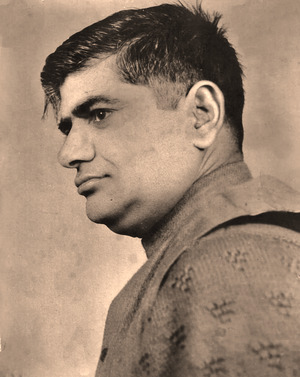
Ch. Mani Ram Bagri (born January 1, 1920 – died January 31, 2012) was an important Indian politician and activist. He served three times in the Indian Parliament. He was a Member of Parliament from 1962 to 1967, and then again from 1977 to 1984. He was known for being a strong voice for the opposition, working alongside other socialist leaders like Dr. Ram Manohar Lohia.
Many people in North India saw Bagri as a key leader in the Lok Sabha, which is one of the two houses of the Indian Parliament. He was considered one of the most important socialist leaders of his time. He traveled to other countries, including the USSR, for important meetings like the one that led to the Tashkent Declaration. He was also the first person to speak in Hindi, his native language, at an International Parliamentary Conference.
Contents
Early Life and Start in Politics
Mani Ram Bagri was born on January 1, 1920, in a village called Ban Mandori in the Hisar District of Haryana. Even when he was very young, he joined different national movements. He became part of the Socialist movement, which was led by famous figures like Acharya Narendra Deva, Jayaprakash Narayan, and Dr. Rammanohar Lohia.
Bagri did not go to college or university. He learned a lot through his experiences and by working with other leaders. In his twenties, he became very good friends with Dr. Lohia. They stayed close friends and political partners for their entire lives.
Working as a Politician
Mani Ram Bagri was a leading figure in the Socialist party in Parliament from 1962 to 1967. He led many socialist movements. He was a close friend of Dr. Lohia and Raj Narain. During a difficult time in India called the Emergency, he was held in prison with other political leaders.
Bagri served as the General Secretary of the All India Samyukta Socialist Party from 1972 to 1974. Later, he joined the Janata Party.
He represented two different areas in the Indian Parliament: Hisar and Mathura. He was a Member of Parliament three times:
- From 1962 to 1967, representing Hisar.
- From 1977 to 1979, representing Mathura.
- From 1980 to 1984, again representing Hisar.

In the 1960s, Bagri and other socialists visited Romania to learn about their government. He remained friendly with Moscow but did not agree with how strict their government was. He also represented India at the Tashkent Agreement after the 1965 Indo-Pakistan war. He was one of the few opposition leaders present at this important meeting.
Bagri officially stopped working in politics in the late 1980s. This was after the death of Indira Gandhi and the 1984 Anti-Sikh riots. During these riots, he worked hard to protect innocent Sikh people in Delhi and Hisar.
What He Believed In
Mani Ram Bagri came from a very poor family. Because of this, he spent most of his life fighting for people in India who were not as lucky. He used peaceful methods, similar to those of Mahatma Gandhi, to achieve his goals. He joined politics when he was young and dedicated his whole life to helping the poor.
He was a strong socialist. This meant he believed that the government should work to reduce inequality and help everyone. He wanted other political parties, not just the ruling one, to have a strong voice in the government. This is why he was seen as a key leader of the opposition in the Lok Sabha.
Bagri was known for being a very honest and ethical politician. He lived a simple life and gave a lot of his salary to poor people in Hisar and Delhi. Many Prime Ministers of India, including Jawaharlal Nehru and Indira Gandhi, respected him greatly. Even though he often disagreed with the ruling party, he had good relationships with leaders like Nehru and Gandhi.
Bagri played a big part in shaping India's new democracy. He gave a voice to millions of villagers, poor people, and those who were often ignored. He led many movements in North India to support the poor and oppressed. He helped these groups gain confidence and believe in themselves.

Mr. Bagri was a great speaker. He could explain his ideas clearly and powerfully. One of his most famous speeches in Parliament was about making Birla House a national monument. The Birla family owned this house. The government was not keen on this idea. Mr. Bagri spoke passionately:
"My question is that the way Guru Tegh Bahadur’s place of martyrdom was commemorated in a foreign land, the way Ram, Krishna and other great people’s places of martyrdom was commemorated, then can the Government cite a reason that in their own country the site of martyrdom of the Father of the Nation cannot be commemorated? Actually the Government is sold out to the Birlas!".
Even though he had political disagreements with Congress leaders, he kept friendly relationships with important figures like Jawaharlal Nehru.
He officially retired from politics in the late 1980s. He lived longer than most of his political friends. He spent the rest of his life at his home in Hisar. The area where his house is located is still known as Bagri Chowk in his honor. Mani Ram Bagri passed away in Hisar on January 31, 2012, at the age of 92.
Images for kids
-
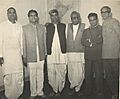
Ramdhari Singh, Madhu Limay, Mani Ram Bagri, Dr Ram Manohar Lohia, B P Maurya,S M Joshi
-
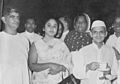
Sh. Mani Ram Bagri with Sh. Lal Bahadur Shastri
-
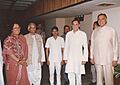
Najma Heptulla, Mani Ram Bagri, Subhash Bagri, Rajiv Gandhi, Balram Jakhar
-
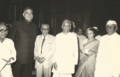
Balram Jakhar, Mohammad Hidayatulla, Mani Ram Bagri, Indira Gandhi, Neelam Sanjeeva Reddy
-
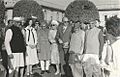
Ch. Mani Ram Bagri with friends


