
Old Meeting House (Marblehead) facts for kids
Quick facts for kids Old Meeting House |
|
|---|---|
 |
|
| General information | |
| Location | Marblehead, MA |
| Coordinates | 42°30′29″N 70°50′47″W / 42.50816°N 70.84632°W |
| Completed | 1696 |
| Demolished | 1825 |
The Old Meeting House was a very old building in Marblehead, Massachusetts. It was built way back in 1696 on Franklin Street. This was the second meeting house for the church that later became the Congregationalist Church. Some parts of the pews (the long benches where people sit) from this meeting house are still around today. They are the largest collection of old wooden panels from any 1600s building in New England. You can find them in museums and even in some private homes!
Contents
Building Design and Features
Outside the Meeting House
The Old Meeting House had a tall tower where Washington and Franklin Streets meet today. This tower held a bell, a town clock (added in 1799), and a cool weather vane shaped like a Golden Cod fish. The building had three doors: a main one at the street corner, one at the tower, and another at the back. There was no chimney because the meeting house had no heating system. It was painted a simple "clapboard color."
Inside the Meeting House
Inside, a main walkway led from the Washington Street entrance straight to the pulpit, which is where the minister spoke. There were 74 "box pews" on the main floor. Many of these pews used parts from the very first meeting house.
Upstairs, there was a second level called a gallery on three sides of the building. This gallery had 20 more box pews and some bench seating. The middle part of this gallery was for singers, with men on one side and women on the other. There was even a third level gallery, but it was removed in 1800.
Above the pulpit, there was a special "sounding board" that helped the minister's voice carry. In 1780, 13 shiny gold stars were placed above it. These stars represented the 13 original American colonies.
The Pews: Old and New
The pews from the first meeting house, built in 1638, were saved and used again in the Franklin Street Meeting House. People think these older pews were first made in 1659 by John Norman Jr. They were built from strong oak wood and had fancy carved designs.
Since the Franklin Street Meeting House was bigger, new pews were also needed. These new ones were made from pine wood and were simpler than the older oak panels.
-
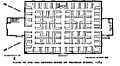
First Level of Meeting House
-
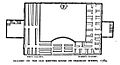
Second Level of Meeting House
-
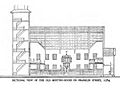
Section of Old Meeting House
-
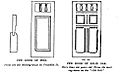
Reused oak panels from the First Meeting House and the new infill pine panels created for the Franklin Street Meeting House


History of the Old Meeting House
Church and Town Center
The very first meeting house in Marblehead was built in 1638 on what is now Old Burial Hill. Back then, meeting houses were used for two main things: as a church and as a place for town government meetings. This was very common at the time.
By the 1690s, people decided a new meeting house was needed. In September 1695, the town voted to build it. Land was bought from the Riddan family at the corner of what are now Franklin Street and Washington Street. This land used to be an orchard with a natural spring.
There was a special agreement when the land was bought. If the church ever moved, the land would go back to the Riddan family's heirs instead of being sold.
The new meeting house was likely built in a similar style to the first one, much like the Old Ship Church in Hingham. Many parts from the first building were reused, including the pews. The second meeting house became known as the Old Meeting House by the mid-1700s. It was changed at least twice over the years. One big change was an enlarged roof. People remembered seeing an old roof under the new one, with a dark space in between!
In 1716, the Parsons house was built across the street. It is still standing today and is known as the Parson Barnard House.
The meeting house was made even bigger in 1724, with a 20-foot addition. Its final size was 94 feet long and 49 feet wide. It was used for town meetings until a new Town House was built in 1728. However, the Old Meeting House was still used for very large town meetings because the new Town House wasn't big enough.

By 1789, the building was starting to get old and needed repairs. In 1815, a hurricane hit and caused the steeple to separate from the main building by about eight inches. It was never fixed.
By 1823, the meeting house was falling apart. The church members decided it was too unsafe to use. They voted to build a new meeting house. A man named William Reed gave them land on Washington Street for the new building. The church moved to its new home in 1824. This new church is known today as the Old North Church.
A Sale Mistake
After the church moved, the Old Meeting House and its land were accidentally sold. People had forgotten the agreement from the 1690s that the land should go back to the Riddan family's heirs. The sale was canceled, and the land went to the Hawkes family, and later to Mary Alley, who were all heirs of John Riddan.
The steeple was taken down first, which needed twenty men to pull it! The Golden Cod weather vane was sold and put on top of the new meeting house (Old North Church), along with the bell. The main part of the building stayed standing for another year. It was used as a barn for hay and grain.
Taking Down the Building
The Old Meeting House was finally sold in 1825 to Captain Joshua Orne, William Hawkes, and Deacon Goodwin. Most of it was then taken down. Many parts of the building were saved and used in other houses. For example, a large part was used to build the Goodwin House. The house at 14 Orne Street and the Hawkes house at 2 Franklin Street also used pieces from the meeting house. Even a shoemaker's cottage used some of the original pews as wall boards!
The two-story back addition, sometimes called a "porch," stayed on the Hawkes property. It was later used as a shoe workshop and then a small business. This last piece of the Old Meeting House stayed on Franklin Street until 1899. Then, William B. Peach bought it and moved it to Orne Street, where he made it into his new house.

The Site Today

In 1878, workers laying water pipes found the old foundation of the meeting house. Parts of it probably still remain under Washington and Franklin streets today.
Today, the house at 2 Franklin Street (the Hawkes House) stands on the site of the former meeting house. This house used parts from the original building, which you can see in its wide floorboards. The main building of the former Mary Alley Hospital also stands on the back part of the site.
Old Meeting House Relics
- The Pews: These pews are some of the best examples of old wooden craftsmanship from the early colonies. You can find pieces at the Marblehead Historical Society and the Old North Church. Some private homes in town also have pews used as wall panels. For example, 14 Orne Street has many of the original oak panels from the First Meeting House (1659) in its third-floor addition. Some panels were even shown in the "New England Begins" exhibit at the Museum of Fine Arts.
- The Sounding Board: This piece, which was above the pulpit, was found reused in an outhouse! It was saved and returned to the Old North Church.
- The Golden Cod: The weather vane shaped like a cod fish is still on top of the new meeting house, the Old North Church.
- The Goodwin House & The Hawkes House: Both of these houses are still standing today. They contain many wooden and structural parts saved from the Old Meeting House.
- The Rear "Porch": The two-story back addition of the Meeting House was reused as a shoe workshop and then rebuilt as a house. It still stands at 57 Orne Street. It was moved there from Franklin Street in 1899 and is the last visible part of the Old Meeting House.
-
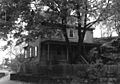
William Peach House, a portion of the last remnant of Old Meeting House, relocated to Orne Street in 1899 at the base of Fountain Park.
-
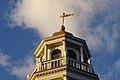
Golden Cod weathervane from the Old Meeting House now on top of Old North Church
-
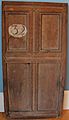
Pew panel from First Meeting House, and later incorporated into the Old Meeting House in 1696 (Marblehead Historical Society)


