
Pacifism facts for kids

Pacifism is the belief that war and violence are wrong and that disagreements should always be solved peacefully. It's about choosing peace over fighting, even when things are difficult.
The word "pacifism" was first used by a French peace activist named Émile Arnaud in 1901, but the idea of living without violence is much, much older.
Some people who believe in pacifism think that violence is always wrong, no matter what. This is called principled pacifism. Others believe that violence is usually a bad idea because it causes so much pain and destruction, and there are almost always better ways to solve problems. This is called pragmatic pacifism. Both types aim for a world with less fighting and more understanding.
Contents
Nonviolence: A Key Part of Pacifism
A big part of pacifism is nonviolence. This means trying to achieve goals or solve problems without using any physical force or harm. Many pacifists believe that nonviolent actions are not only morally better but also more effective in the long run. Think about it: if you respond to anger with kindness, it can sometimes change the whole situation!
However, not all nonviolent actions come from a belief that all violence is always wrong. Sometimes, people choose nonviolent methods because they believe it's the best strategy for a particular situation, even if they might believe violence could be justified in other, very extreme cases, like defending themselves or others from immediate danger.
Different Kinds of Pacifism
Just like there are different flavors of ice cream, there are different ways people understand pacifism:
- Absolute Pacifism: This is the strongest form. An absolute pacifist believes that human life is so precious that no one should ever be killed, and war should never happen, even for self-defense. They believe violence only leads to more violence.
- Conditional Pacifism: This view is a bit more flexible. Conditional pacifists might agree that war is generally wrong, but they might allow for defense in certain situations. They still prefer peaceful solutions but understand that sometimes, protecting oneself or others might involve some form of force.
Some pacifists even believe that governments, which often use force to make rules, can be a source of violence. They dream of a world where people live peacefully without needing a government to tell them what to do. This idea is sometimes called anarcho-pacifism, which means rejecting violence in all forms, even from governments.
A Journey Through Time: The History of Pacifism
The idea of pacifism isn't new; it has a long and rich history across many cultures and religions!
Long, long ago, in ancient China during a time called the Warring States period, there was a group called the Mohists. They were pacifists who opposed aggressive wars and even developed clever defensive strategies to help smaller states protect themselves without starting fights. Ancient Chinese texts also often viewed warfare as a last resort, something to be avoided if possible.
In the Chatham Islands, far away in the Pacific Ocean, the Moriori people practiced pacifism for centuries. Their ancestor, Nunuku-whenua, taught them to live without war, which helped them save their limited resources. Sadly, this also made them vulnerable to invaders who didn't share their peaceful ways.
Ancient Greek thinkers like Plato and Euripides also explored ideas against war and violence. Plato's Socrates, for example, argued that a truly just person would never harm anyone.
Religious Beliefs and Peace
Many religions have strong teachings about peace and nonviolence:
- Christianity: Many Christians believe that Jesus was a pacifist, based on his teachings like "turn the other cheek" and "love your enemies." Throughout history, groups like the Quakers, Mennonites, and Amish (often called "historic peace churches") have been absolute pacifists, refusing to fight in wars because of their faith.
- Hinduism: A central idea in Hinduism is ahimsa, which means "do no harm." This belief encourages nonviolence towards all living things and is why many Hindus are vegetarians. While Hinduism acknowledges that sometimes defense is necessary, it always emphasizes avoiding war and seeking peaceful solutions first.
- Buddhism: Like Hinduism, Buddhism also values ahimsa. Many Buddhist leaders, like Thích Nhất Hạnh, have been strong advocates for peace and nonviolence, especially during times of war.
- Jainism: This religion takes nonviolence to an extreme level, believing that all life is sacred. Jains are strict vegetarians and try to avoid harming any living creature, no matter how small.
- Islam: Peace is very important in Islam, and Muslims are encouraged to find peaceful solutions. While some historical conflicts occurred, many Muslim scholars and groups, like some Sufi orders and the Ahmadiyya Muslim Community, strongly emphasize nonviolence and inner spiritual struggle over physical warfare. Khān Abdul Ghaffār Khān, a Muslim leader, worked closely with Mahatma Gandhi using nonviolent resistance against British rule.
- Judaism: While not strictly pacifist, Judaism values peace highly and seeks to limit conflict. The Jewish Peace Fellowship supports Jewish people who choose not to fight in wars due to their beliefs.
- Baháʼí Faith: This faith teaches that "holy war" is abolished and promotes a system of "collective security," where nations work together to ensure justice and peace, using force only if absolutely necessary to stop a government from violating international law.
Modern Peace Movements
The idea of pacifism really grew in the 18th and 19th centuries. Thinkers like Leo Tolstoy, a famous Russian writer, wrote powerfully about pacifism, inspiring many, including Mahatma Gandhi.
Mahatma Gandhi was a huge leader in India who used nonviolent resistance, which he called "satyagraha" (meaning "truth force"), to help India gain independence from British rule in 1947. His methods inspired people all over the world!
After the terrible losses of World War I, many people in Europe and the United States became very anti-war. Organizations like the League of Nations Society and the League to Enforce Peace were formed to try and prevent future wars through international cooperation.
During World War II, even though many countries were fighting, there were still many pacifists. People called conscientious objectors refused to fight in the military because of their beliefs. Instead, they often served in non-combat roles, like medical duties, or worked in civilian jobs like farming or hospital care. They faced tough times, sometimes being seen as cowards, but they stood firm in their commitment to peace.
In the mid-20th century, Martin Luther King Jr. was inspired by Gandhi and led the American Civil Rights Movement using nonviolent resistance to fight for equal rights. His peaceful protests helped change laws and bring about a more just society. Other movements, like the Campaign for Nuclear Disarmament in the 1950s, also showed how people could work together peacefully to prevent huge conflicts.
Even today, countries like Costa Rica have chosen to abolish their military entirely, dedicating their resources to education and healthcare instead. This shows a strong commitment to pacifism on a national level.
Why Do Some People Disagree with Pacifism?
While pacifism is a powerful idea, some people have different views. They might argue that sometimes, using force or going to war is necessary to stop a greater evil or to protect innocent people. For example, some might say that fighting against very oppressive leaders could save many lives in the long run, even if it means some people get hurt in the process.
Pacifists respond to this by saying that violence often creates more problems than it solves. They believe that choosing violence, even for a good reason, can make it easier for people to use violence in other situations. Instead, pacifists encourage us to think creatively and find new, nonviolent ways to solve conflicts that lead to lasting peace. They believe that by committing to peace, we send a powerful message that violence is not the answer.
Pacifism is a belief in the power of peace, understanding, and nonviolent action to make the world a better place. It's a call for everyone to choose kindness and cooperation over conflict and fighting.
Related ideas
Images for kids
-
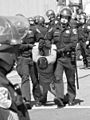
An anti-war activist arrested in San Francisco during protests against the war in Iraq in March 2003.
-

Vereshchagin's painting The Apotheosis of War (1871) shows the terrible side of war. It is seen as an early artistic expression of pacifism.
-

Penn's Treaty with the Lenape people. This shows a peaceful agreement.
-

"Peace". A drawing of Henry Richard, who was a strong supporter of pacifism in the mid-1800s.
-

A woman protesting for peace during World War I.
-
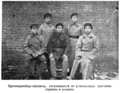
Soldiers of the Red Army in Russia who refused to shoot targets because of their religious beliefs (Baptists or evangelicals). This happened between 1918 and 1929.
-

Children who were refugees from the Spanish Civil War at a special home in the French Pyrenees. This home was run by the War Resisters' International.
-
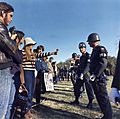
A demonstrator giving a flower to military police during an anti-Vietnam War protest in 1967.
-

A protest against new nuclear weapons in Europe. This took place in Bonn, West Germany, in 1981.
-

The shadow of the cross shows how religion and war can be connected in the film Constantine's Sword.
-
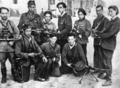
Jewish people fighting back against the Nazis during World War II.


See also
 In Spanish: Pacifismo para niños
