
Golden poison frog facts for kids
Quick facts for kids Golden poison frog |
|
|---|---|
 |
|
| Conservation status | |
Scientific classification  |
|
| Kingdom: | Animalia |
| Phylum: | Chordata |
| Class: | Amphibia |
| Order: | Anura |
| Family: | Dendrobatidae |
| Genus: | Phyllobates |
| Species: |
P. terribilis
|
| Binomial name | |
| Phyllobates terribilis Myers, Daly, and Malkin, 1978
|
|
| Script error: The function "autoWithCaption" does not exist. | |

Script error: No such module "Check for conflicting parameters".
The golden poison frog (Phyllobates terribilis) is also known as the golden dart frog. It is a type of poison dart frog that lives only in the rainforests of Colombia. Sadly, this frog is now endangered because its home, the rainforest, is being destroyed. Even though it's small, this frog is thought to be the most poisonous animal alive on Earth!
Contents
What's in a Name?
Scientists named this frog Phyllobates terribilis in 1978. The scientists were Charles W. Myers, Borys Malkin, and John W. Daly. Its scientific name, terribilis, means 'terrible' or 'frightening'. This name refers to the strong defense chemicals found on its skin. Myers studied many frogs from the Colombian rainforest to learn about them.
Where Do Golden Poison Frogs Live?
The golden poison frog lives only in the wet forests of Colombia's Pacific coast. You can find them in the Cauca and Valle del Cauca Department areas. It loves places with lots of rain (over 5 meters a year!). It also likes warm temperatures (at least 26°C) and very humid air (80–90% humidity). These frogs live from sea level up to 200 meters high. Their home area is less than 5,000 square kilometers. Losing this habitat is a big reason why P. terribilis is an endangered species.
What Do They Look Like?
The golden poison frog is the largest kind of poison dart frog. Adults can weigh almost 30 grams and grow up to 6 centimeters long. Female frogs are usually bigger than males. Adult frogs have very bright colors. Young frogs are mostly black with two golden-yellow stripes on their backs. As they grow, the black color fades. By about 18 weeks old, the frog has its full bright color. Its bright colors are a warning sign, telling predators to stay away because it's dangerous.
Golden poison frogs come in four main color types, called morphs:
Yellow Frogs
The yellow morph is why this frog is called the golden poison frog. These frogs can be pale yellow to a deep, golden yellow. You can find yellow Phyllobates terribilis in Quebrada Guangui, Colombia.
Mint Green Frogs
The largest type of Phyllobates terribilis lives in the La Brea and La Sirpa areas of Colombia. Even though they are called "mint green," these frogs can also be metallic green, pale green, or even white.
Orange Frogs
Orange golden poison frogs also live in Colombia. They are often a metallic orange or yellow-orange color. Their color can be more or less intense. They have been seen living near yellow frogs in Quebrada Guangui, Colombia.
Orange Blackfoot Frogs
The orange blackfoot morph is a special type bred by a company called Tesoros de Colombia. This company helps protect wild dart frogs. They breed rare species to offer them as pets. This helps reduce illegal hunting of wild frogs. This morph is golden yellow to a deep orange. They have dark marks on their feet, throat, and other areas. These marks can be black or speckled grey.
- ''Phyllobates terribilis'' color morphs
-
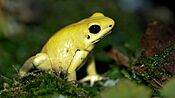
Yellow
-
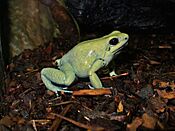
Mint green
-
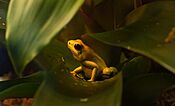
Orange
-
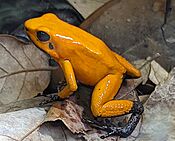
Orange blackfoot


.jpg)

Daily Life and Behavior

These frogs are active during the day. They usually live spaced out and do not form large groups.
What Do They Eat?
This frog is a clever hunter. It waits quietly and then ambushes its prey. Adult frogs can eat surprisingly large insects compared to their own size. Their main food sources are ants, but they also eat many other kinds of insects and small creatures. Tadpoles eat algae, mosquito larvae, and other tiny bits of food in their water.
Reproduction and Life Cycle

Male frogs make a special trilling sound to attract female frogs. Golden poison frogs have a unique 'courtship dance'. They gently touch each other's heads and backs before laying eggs. The eggs are laid on the ground, hidden under fallen leaves.
Once the tadpoles hatch, they stick to the mucus on their parents' backs. The adult frogs then carry their young up into the trees. They place the tadpoles in small pools of water. These pools can be found in plants like bromeliads or in water-filled tree holes. The tadpoles then feed on algae and mosquito larvae in these tiny nurseries.
Who Are Their Predators?
Golden poison frogs are so well-protected by their defense chemicals that adult frogs likely have very few predators. One type of snake, Leimadophis epinephelus, can eat young frogs without getting sick. This snake seems to be resistant to the frog's defense chemicals.
How Toxic Are They?
The golden poison frog is one of the most protected animals on Earth. These frogs make powerful defense chemicals called batrachotoxins in their skin. This protects them from predators. If an animal tries to eat the frog, or even touches its skin, it can be in danger. This very strong chemical is rare. Batrachotoxin is found in only a few frogs from Colombia, some birds from Papua New Guinea, and a few beetles.
This chemical affects the body's nerve cells. It can cause muscles to stop working properly. This can lead to serious problems like paralysis or heart issues. A wild golden poison frog usually has about one milligram of this chemical. This amount is enough to be very dangerous to many large animals, even elephants!
How Do They Get Their Defense Chemicals?
Golden poison frogs seem to get their batrachotoxin from eating small insects or other tiny creatures. Frogs kept as pets and fed common insect food will eventually lose their defense chemicals. Frogs born and raised in captivity are not dangerous. Scientists think the key food item might be a small beetle from the Melyridae family. Some of these beetles make the same defense chemical found in the frogs.
Traditional Uses by Indigenous People
Golden poison frogs are very important to local indigenous cultures in Colombia's rainforest. Groups like the Emberá and Cofán use the frog's defense chemicals. They use it to make their hunting darts more effective. The Emberá people carefully warm the frog over a fire. This makes the frog release small amounts of its defense fluid. They dip the tips of their hunting darts into this fluid. These darts can stay effective for a long time, helping them hunt food.
Golden Poison Frogs as Pets

The golden poison frog is a popular pet for people who keep frogs in special enclosures called vivariums. People like their bright colors and active personalities. Even though they are dangerous in the wild, pet frogs raised without their natural food sources are not dangerous.
Because they have a small natural habitat, illegal hunting for the pet trade used to be a big problem. But thanks to frog breeders like Tesoros de Colombia, captive-bred frogs are now widely available. These pet frogs are legal, safe, healthier, and cost less than wild-caught frogs. This has helped reduce the demand for illegally hunted frogs. Today, the IUCN believes that most golden poison frogs sold as pets are legally bred. They think the threat from collecting them for pets is now small.
See also
 In Spanish: Rana de dardo venenosa para niños
