
Staghorn fern facts for kids
Quick facts for kids Staghorn fern |
|
|---|---|
 |
|
| Platycerium bifurcatum from the Australian National Botanical Gardens, Canberra | |
Scientific classification  |
|
| Kingdom: | Plantae |
| Clade: | Tracheophytes |
| Class: | Polypodiopsida |
| Order: | Polypodiales |
| Suborder: | Polypodiineae |
| Family: | Polypodiaceae |
| Subfamily: | Platycerioideae |
| Genus: | Platycerium Desv. |
| Species | |
|
|
Platycerium is an amazing group of about 18 fern species in the polypod family, known as Polypodiaceae. People often call them staghorn or elkhorn ferns. They get these fun names because their leafy parts look just like deer antlers! These unusual plants are epiphytic, which means they perch high up on trees or rocks instead of growing in the ground. They are native to warm tropical forests across South America, Africa, Southeast Asia, Australia, and New Guinea.
Contents
Discovering the Unique Staghorn Fern Plant
The adult staghorn fern is called a sporophyte. Unlike most garden plants, staghorns do not have standard underground root networks. Instead, their roots cling tightly to tree bark and grow outward from a short underground stem called a rhizome.
How Two Types of Fronds Help the Plant
Staghorn ferns are special because they grow two completely different types of fronds. Scientists call this feature basal and fertile fronds.
The basal fronds are flat and shield-shaped or kidney-shaped. They press tightly against the tree trunk to protect the delicate roots from drying out or getting bumped. Over time, some species create an open, bowl-like crown at the top of these shields. This clever trap collects fallen leaves, rain, and forest litter. As this debris breaks down, it makes rich natural compost that feeds the plant high up in the air!
The fertile fronds look totally different. These leafy arms branch out like big antlers. In botanical terms, this forking pattern is called dichotomous growth. These showy green branches jut out or hang gracefully in the forest breeze.
Reproduction and the Amazing Fern Life Cycle
Staghorn ferns do not produce flowers, fruits, or seeds. Instead, their reproduction relies on microscopic dust-like spores.
Finding the Tiny Spores
Underneath the green antler fronds, you can find brown patches filled with tiny cases called sporangia. These cases hold thousands of spores ready to travel on the wind. Some species, like Platycerium ridleyi and Platycerium coronarium, even make special spoon-shaped lobes just for holding spores! When released, the spores drift to other trees and begin to grow.
From Spore to New Plant
When a spore lands in a moist, shady spot, it does not immediately grow into a big staghorn fern. Instead, it sprouts into a tiny, heart-shaped green pad called a gametophyte or thallus. This tiny plant makes the cells needed to start an adult fern.
Where Staghorn Ferns Live and Adapt
Staghorn ferns grow naturally all around the globe in warm forests. In places like Queensland and New South Wales, giant wild species can be spotted clinging to tall rainforest trees.
Some species are adapted to dry, xeric environments. For instance, Platycerium veitchii can handle hot, dry spells. It saves water by using a special survival process called water-saving metabolism. This system lets the fern hold onto moisture when rain is scarce.
Many staghorn species live as single plants with only one rhizome. Other species, like Platycerium bifurcatum, form large leafy colonies by spreading out new roots that produce new baby ferns.
Growing Staghorn Ferns in Gardens
People love using staghorns as living wall art! Species such as Platycerium bifurcatum and Platycerium superbum are popular choices as an ornamental plant. They look great in outdoor gardens, shaded patios, and tropical garden collections.
Gardeners can multiply these ferns by dividing large colonies or by sprouting wild spores. A young fern can be mounted on a piece of wood using wire or soft cloth. In time, the roots attach firmly to the wood, and a single mature staghorn fern can grow wider than 1 metre (3.3 ft) across!
Images for kids
-
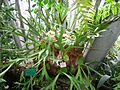
Platycerium alcicorne
-
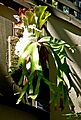
Platycerium andinum
-
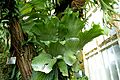
Platycerium elephantotis
-
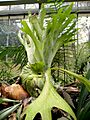
Platycerium grande
-
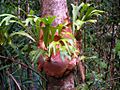
Platycerium hillii
-
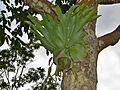
Platycerium holttumii
-
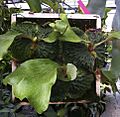
Platycerium madagascariense
-
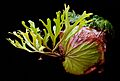
Platycerium ridleyi
-
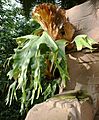
Platycerium stemaria
-
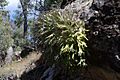
Platycerium veitchii
-
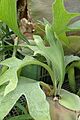
Platycerium wallichii
-
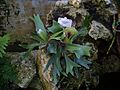
Platycerium wandae
-
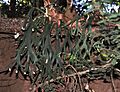
Platycerium willinckii
-
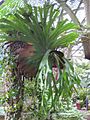
Platycerium superbum at the Royal Botanic Gardens Sydney, Australia
-
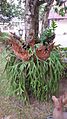
Platycerium bifurcatum from the Mendut Temple, Indonesia
-
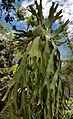
Platycerium grande from Bukidnon, Philippines
-
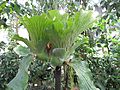
Platycerium elephantotis at Kaisaniemi Botanical Garden, Finland


See also
 In Spanish: Helechos cuerno de ciervo para niños
